

Ask most astrology apps about the square and you get a warning. Friction. Conflict. A hard aspect. The word sits in your chart like a bad grade.
So we counted, hour by hour, across sixty years of births. 91.3 % of charts hold at least one square. Nine people in ten. A thing that nine people in ten carry is not a personal curse. It is the normal shape of a chart.
This page gives you the count, the method behind it, and what the tradition actually says once you read the old texts rather than the app blurb.
What is a square in astrology?
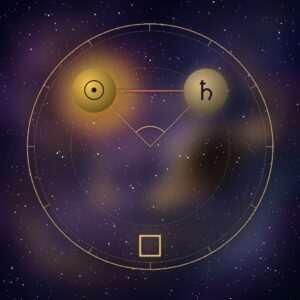
A square is the angle of 90° between two planets in a chart.
Picture the zodiac as a clock face. Each planet sits somewhere on the rim. Take any two and measure the gap between them. When that gap comes to a quarter turn of the circle, the two planets are square.
Ninety degrees is 360 divided by four. That is the whole reason the angle is on the list. Claudius Ptolemy laid this out in the second century, in the four books known as the Tetrabiblos. He kept only the angles you get by cutting the circle with small whole numbers: in two, in three, in four, in six. The square is the quarter cut.
No pair of planets sits at a flawless 90°. Real charts give you 87°, or 93°, or 85°. So astrologers allow a margin around the exact figure. That margin is called the orb. With an orb of 6°, any gap from 84° to 96° counts as a square. When the gap lands on 90° to the degree, the square is called exact, or partile in the older Latin texts.
The orb you pick changes what you have. Our guide to planetary orbs shows how much.
How common is a square? The count across sixty years
Here is the method, so you can run it yourself.
We stepped through every hour from 1 January 1950 to 1 January 2010 and treated each hour as a birth chart. For each one we computed the tropical longitude of ten bodies: Sun, Moon, Mercury, Venus, Mars, Jupiter, Saturn, Uranus, Neptune and Pluto. Ten bodies make 45 pairs. For every pair we measured the gap and checked it against 90°, with an orb of 6°. Positions come from the astronomy-engine library, checked against the Swiss Ephemeris. The other four major aspects are covered on our main aspects page.
| Squares in the chart | Share of people |
|---|---|
| 0 | 8.7 % |
| 1 | 16.4 % |
| 2 | 23.6 % |
| 3 | 22.6 % |
| 4 | 16.0 % |
| 5 or more | 12.7 % |
Read the middle of that table. The most common chart holds two or three squares. Three people in four hold two or more. Only 8.7 % hold none at all.
The average across all those hours is 2.66 squares. The square is the second most common of the five major aspects, behind the sextile at 60°. It makes up 21.9 % of every major aspect in the count.
So the honest answer to “do I have a lot of squares” is almost always no. Four squares puts you in the top 29 %. Six puts you in the top 5 %. Below four, you are in the crowd.
Does a square always fall between signs of the same modality?
Every guide on the web says yes. We measured it, and the answer is no — 89.4 % of the time, not all of the time.
Start with why the rule exists. The twelve signs split into three groups of four, called modalities: cardinal, fixed and mutable. Cardinal signs start things. Fixed signs hold them. Mutable signs adapt. Our guide to the three modalities works through each one.
Signs of one modality sit three signs apart around the wheel. Three signs of 30° each make 90°. So a square between two planets at the same degree of their signs lands on two signs of the same modality, by construction. Aries and Cancer are both cardinal. Taurus and Leo are both fixed. Gemini and Virgo are both mutable.
Now bring back the orb. A square counts from 84° to 96°, not just at 90°. A planet at 28° Aries and a planet at 1° Cancer sit 93° apart. Both are cardinal, so the rule holds. But a planet at 2° Aries and a planet at 88° along the wheel — that is 28° Gemini — sit 86° apart. Aries is cardinal. Gemini is mutable. The rule breaks.
Here is where all the squares we counted fell.
| Signs apart | Share of squares | Same modality? |
|---|---|---|
| 2 signs | 5.4 % | No |
| 3 signs | 89.4 % | Yes |
| 4 signs | 5.2 % | No |
One square in ten crosses into a neighbouring modality. Those are the squares near the edge of the orb, where one planet sits in the last degrees of a sign or the first degrees of the next. Astrologers call such a planet a cusp planet, sitting on the wall between two rooms.
This matters when you read a chart. A Mars at 5° Leo square a Saturn at 5° Scorpio is textbook fixed, and the fixed reading applies cleanly. A Mars at 29° Cancer square a Saturn at 25° Libra is still a square, at 86°. But Cancer is cardinal and Libra is cardinal, so that one holds too. Move Mars to 1° Leo and the pair crosses into two modalities at once. The label is a strong guide, not a law.
Which planets square each other most, and which never can
Not every pair has the same odds. Some pairs cannot make a square at all.
Mercury and Venus orbit inside the orbit of Earth. From where we stand they never stray far from the Sun. Across those sixty years the widest Sun–Mercury gap was 27.79°, and the widest Sun–Venus gap was 47.15°. A square needs 90°. Neither planet gets near it.
The count of Sun–Mercury squares from 1950 to 2010 was zero. Sun–Venus, zero. Mercury–Venus, zero. If a report hands you a Sun square Mercury, the software is broken.
Neptune and Pluto are the other zero, for the opposite reason. They are so slow that across the whole 1950–2010 window they stayed between 51° and 65° apart, in a long sextile. They never reached 90° in that window. Uranus and Pluto came close only at the very end of the window: 0.46 % of charts, all of them born in mid-2009, as the pair closed toward the square it reached in 2012.
For other pairs, the picture flips.
| Pair | Charts with this square |
|---|---|
| Uranus–Neptune | 8.19 % |
| Saturn–Uranus | 7.36 % |
| Venus–Jupiter | 7.12 % |
| Mars–Neptune | 7.00 % |
| Mercury–Jupiter | 6.95 % |
| Sun–Moon | 6.78 % |
| Mars–Saturn | 5.65 % |
Uranus–Neptune tops the list because both move slowly. When two slow planets reach 90°, they hold the angle for years, so everyone born in that stretch carries it. That is a generational square, shared with millions of people your age. It says little about you as a person.
The number worth holding: 42 % of charts carry at least one square between the slow planets, Jupiter through Pluto. Two people in five share a square with their whole birth cohort.
A Sun–Moon square, by contrast, depends on the hour of your birth. That one is yours.
Five common pairs have their own pages: Venus square Saturn, Sun square Pluto, Moon square Pluto, Mars square Saturn and Sun square Saturn.
Where the bad reputation came from
The square has been called harsh for about two thousand years, and it is worth knowing why.
Hellenistic astrologers — the Greek-speaking writers whose work, from roughly 100 BC to 600 AD, is where Western astrology begins — sorted the angles by how the two signs related. Signs of the same element got the friendly angles. Signs that shared nothing got the rough ones. Vettius Valens, writing in Greek in the second century in his Anthologies, uses the square in charts of loss and struggle.
William Lilly carried the same reading into English. In Christian Astrology, published in London in 1647, the square is “an aspect of imperfect enmity”. Lilly was a working astrologer answering paying clients about lawsuits, illness and missing property. A grammar of trouble suited his job.
The shift came in the twentieth century. Robert Hand set it out plainly in Planets in Aspect in 1976: a square marks a point where two drives in a chart refuse to take turns, and the person has to build something to hold both. Hand’s argument was not that squares feel pleasant. It was that they are where a chart does its work. Liz Greene has pressed the same case from the psychological side for decades — an ability that costs nothing is an ability you rarely bother to develop.
Demetra George and Chris Brennan, both working from the Hellenistic sources, add the historical caution. The old texts were written for questions about property and survival, not for self-knowledge. Reading Valens as a forecast of your inner life asks a text to do a job it was never built for.
So the label “hard” describes the texture of the angle. It is not a grade, and it is not a prediction about your life.
Cardinal, fixed and mutable squares
Since the great majority of squares fall inside one modality, the modality gives you the flavour.
| Modality | Signs | What the tradition reads |
|---|---|---|
| Cardinal | Aries, Cancer, Libra, Capricorn | Two starts that collide. The pressure arrives fast and asks for a decision. |
| Fixed | Taurus, Leo, Scorpio, Aquarius | Two positions that hold. The pressure builds slowly and moves late. |
| Mutable | Gemini, Virgo, Sagittarius, Pisces | Two adjustments at once. The pressure scatters rather than locks. |
You can watch each of these three in the sky, on a date you can check.
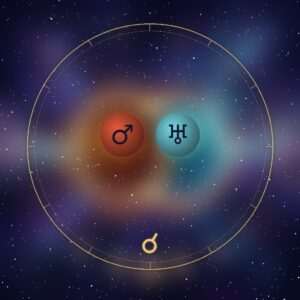
- Cardinal: on 23 December 2027, Mars reaches 21°01′ Capricorn while Saturn sits at 21°01′ Aries. An exact Mars–Saturn square, both signs cardinal.
- Fixed: on 24 June 2028, Saturn is at 8°25′ Taurus and Pluto at 8°23′ Aquarius. Both fixed, and both planets slow, so the angle holds for months.
- Mutable: on 10 September 2027, Jupiter reaches 9°57′ Virgo and Uranus 9°57′ Gemini. Both mutable.
Pick one, note the date, and read the sky against your own week. Watching a square form teaches the idea faster than any diagram.
Applying and separating: which way is your square going?
Two planets move at different speeds, so the gap between them changes daily.
When the gap is closing toward the exact 90°, the square is applying. When the gap has passed 90° and is opening again, the square is separating. Traditional practice reads the applying square as the stronger of the two, because what it describes has not finished arriving.
Your birth chart is a frozen moment, so a square in it is applying or separating for life. To tell which, compare the speed of the two planets. The faster one is usually the Moon, Mercury, Venus, the Sun or Mars. If the faster planet is moving toward the exact angle, the square applies.
A square is two planets, not three
One point of confusion is worth clearing.
A square joins two planets. A T-square joins three: two planets in opposition, with a third squaring both. That third planet is called the apex, and it carries the weight of the figure. Our guide to the T-square covers it properly, because it reads differently from a plain square.
Four planets in a ring of squares make a grand cross. Both figures are patterns, not aspects, and they belong to a different layer of chart reading.
How to read a square in your own chart
Work in this order. It keeps you from interpreting before you have looked.
- List every square, with the orb of each one. A square of 1° speaks louder than one of 6°.
- Mark which are slow-planet pairs. Those are shared with your whole age group.
- Note the modality of each pair, and check for the one square in ten that crosses modalities.
- Check which planet is faster, and whether the square applies or separates.
- Only now look at which planets, in which signs, in which houses.
That last step is where geometry stops and reading begins. A square between two planets means nothing until you know which two.
Frequently asked questions
What does a square mean in astrology?
A square is a 90° angle between two planets. The tradition reads it as friction: two drives at the same tempo that pull in different directions. It is called a hard aspect because it asks for effort, not because it forecasts misfortune.
Is a square positive or negative in astrology?
Neither, on the evidence. 91.3 % of charts hold at least one, and the average chart holds 2.66. An aspect that almost everyone carries cannot mark out a group of unlucky people. The old texts call it harsh; Robert Hand and Liz Greene read it as the working part of a chart.
How rare is a square in astrology?
It is not rare at all. Across births from 1950 to 2010, 91.3 % held at least one square, and only 8.7 % held none. The square is the second most common major aspect, after the sextile.
What does it mean if my chart has a lot of squares?
Count first. Two or three squares is the most common result, and covers 46 % of charts. Four puts you in the top 29 %, six in the top 5 %. Above that, check how many are slow-planet pairs shared with everyone born near your date.
Do squares always join signs of the same modality?
Almost, not always. We measured 89.4 % of squares falling three signs apart, in one modality. The other 10.6 % cross into a neighbouring modality, because the 6° orb lets a square reach past the sign boundary.
Two Sun signs can square each other too, and our page on Pisces and Gemini compatibility measures how many such couples form a true square by degree.
Can the Sun and Mercury form a square?
No, and this one is certain. Mercury never appears more than about 28° from the Sun as seen from Earth. A square needs 90°. From 1950 to 2010 the count was zero. The same holds for Sun and Venus, and for Mercury and Venus.
What is the difference between a square and an opposition?
A square is 90° and joins signs of the same modality. An opposition is 180° and joins signs across the wheel. The square is far more common: 91.3 % of charts hold one, against 65.5 % for the opposition.
See the squares in your own chart
Counting squares by hand is slow, and reading them well takes practice. An Astrovision natal chart analysis maps every square in your chart, names the orb of each one, marks which are generational and which are yours alone, and explains what the pair is doing together — in writing and in a personal audio guide.