

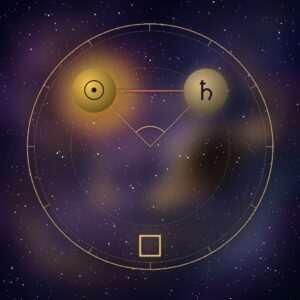
Two planets stand 86° apart. A square needs 90°. Does the chart hold a square or not?
The answer is not in the sky. It is in a setting, and the setting is called the orb. This page explains what that setting does and gives the numbers behind it. It also shows how much of a birth chart rests on a choice nobody makes out loud.
What is an orb in astrology?
An orb is the margin of error allowed around an exact angle.
Planets almost never sit at a round number of degrees from each other. They sit at 86°, or 93°, or 271 arcminutes short of a trine. So astrologers draw a band on each side of the exact angle and count anything inside that band as the aspect. The width of the band is the orb.
With a 6° orb, a square covers every gap from 84° to 96°. A gap of 97° is nothing at all. The two planets are 1° short of being in aspect. That single degree is the whole difference between a chart that holds the square and one that does not.
Three words go with the orb, and they come up on every chart report.
- An aspect is exact when the angle is right to the arcminute. Older texts call this partile.
- An aspect is applying while the gap is still closing toward the exact angle.
- An aspect is separating once the gap has passed the exact angle and is opening again.
Everything that follows turns on one point: the orb is a rule of the house, not a law of nature. Two astrologers with the same birth data and different orbs hand you two different charts, and both are reading the sky correctly.
Lilly gave orbs to planets, not to aspects
The modern habit is to fix one orb per aspect. The older habit was the opposite.
In 1647, the English astrologer William Lilly published Christian Astrology, the first full textbook of the craft in English. He gave each planet its own orb, and the orb travelled with the planet into every aspect it made. A wide-orbed planet reached further. A narrow-orbed one had to be close.
| Planet | Orb given by Lilly, 1647 |
|---|---|
| Sun | 17° |
| Moon | 12°30′ |
| Jupiter | 12° |
| Venus | 8° |
| Saturn | 10° |
| Mars | 7°30′ |
| Mercury | 7° |
To judge whether two planets were in aspect, Lilly added their two orbs and halved the sum. Sun and Mercury gave 17° plus 7°, halved: 12°. A wide band, because the Sun is in it.
The logic behind the list was brightness. A planet was thought to cast a circle of light around itself, and the brighter the body, the wider the circle. Ptolemy had already tied aspects to visible rays in the Tetrabiblos, in the second century. Vettius Valens worked with degrees of light in his Anthologies. Lilly’s table is the end of that line of thought, not the start of it.
Nobody uses 17° for the Sun today. The reason is practical rather than theoretical: with orbs that wide, almost every chart holds almost every aspect, and a reading loses its edges.
The orbs most astrologers use now
There is no governing body for this, and no two textbooks agree exactly. What follows is the common ground of modern practice.
| Aspect | Angle | Common orb | Tight reading |
|---|---|---|---|
| Conjunction | 0° | 8° | 3° |
| Opposition | 180° | 8° | 3° |
| Trine | 120° | 7° | 3° |
| Square | 90° | 7° | 3° |
| Sextile | 60° | 5° | 2° |
| Minor aspects | 30°, 45°, 150° | 2° | 1° |
Three adjustments ride on top of that table, and all three are widely kept.
The Sun and the Moon get more room. Add 1° or 2° to any aspect they make, which is Lilly’s idea in a smaller size.
Transits get less room. A transit is a planet crossing your birth chart today, and reading one to the day needs a band of 1° or 2°, not 8°. A wide orb turns a date into a season.
The chart angles get less room too. The ascendant and midheaven shift a degree every four minutes of clock time. A birth time ten minutes out has already moved them. A 3° orb keeps that uncertainty in check.
What changing the orb does to a chart
This is the part that gets asserted and never measured. So we measured it.
We took everyone born between 1 January 1950 and 1 January 2010, the people alive today. We stepped through those sixty years at a fixed pace, one reading every 47 minutes. At each step we worked out where ten bodies stood in the tropical zodiac: Sun, Moon, Mercury, Venus, Mars, Jupiter, Saturn, Uranus, Neptune and Pluto. Ten bodies give 45 pairs. For each pair we took the gap and checked it against the five major angles. We ran that check five times over, at orbs of 3°, 5°, 6°, 8° and 10°. We ran it all on two separate engines, the Swiss Ephemeris and the astronomy-engine library, and they agree to the second decimal. Nothing else changed between the five runs. Not one planet moved.
Here is the average number of major aspects per chart at each orb.
| Orb | Conjunction | Sextile | Square | Trine | Opposition | All five |
|---|---|---|---|---|---|---|
| 3° | 1.01 | 2.00 | 1.33 | 1.23 | 0.61 | 6.18 |
| 5° | 1.65 | 3.23 | 2.22 | 2.04 | 1.02 | 10.17 |
| 6° | 1.98 | 3.84 | 2.66 | 2.46 | 1.22 | 12.15 |
| 8° | 2.63 | 4.95 | 3.57 | 3.28 | 1.64 | 16.07 |
| 10° | 3.28 | 6.01 | 4.49 | 4.10 | 2.05 | 19.92 |
Read the two ends of the last column. A chart read at 3° holds six major aspects. The same chart read at 10° holds twenty. Three times as many, out of the same sky.
Against the 6° standard, the shifts run like this.
| Orb | Change in the number of aspects |
|---|---|
| 3° | -49 % |
| 5° | -16 % |
| 8° | +32 % |
| 10° | +64 % |
Halve the orb and you delete half the aspects in every chart on Earth. Widen it from 6° to 8° and you add a third more.
The five aspects move almost in step, which is worth knowing on its own. Going from 6° to 8°, the square gains 34 % and the opposition 34 %. The trine gains 34 %, the conjunction 33 %, the sextile 29 %. The sextile lags because it is already the most crowded of the five. No aspect is protected from the orb. There is no such thing as a hard aspect that survives a narrow orb while a soft one falls away.
One conjunction, six days or fifty-seven
Averages are abstract. Here is a single event with dates on it.
Mars and Jupiter reach an exact conjunction on 16 November 2026 at 06:22 UT, both at 25°53′ Leo. Mars moves about half a degree a day, Jupiter a tenth of that. We computed the window during which the two count as conjunct, at each orb.
| Orb | In aspect from | until | Duration |
|---|---|---|---|
| 1° | 13 Nov 2026 | 19 Nov 2026 | 6 days |
| 3° | 8 Nov 2026 | 24 Nov 2026 | 17 days |
| 5° | 2 Nov 2026 | 30 Nov 2026 | 28 days |
| 6° | 31 Oct 2026 | 3 Dec 2026 | 33 days |
| 8° | 26 Oct 2026 | 9 Dec 2026 | 45 days |
| 10° | 20 Oct 2026 | 16 Dec 2026 | 57 days |
One meeting, and a span running from under a week to nearly two months. An astrologer working at 1° gives you a date. One working at 10° gives you a season. Neither is lying, and the sky is identical in both cases.
The same arithmetic runs through a birth chart. Whether you “have” a Mars square Saturn can come down to the orb the software was built with. Most chart apps never tell you which one they used.
Applying, separating, and the case for a lopsided orb
Older practice did not treat the two sides of the band alike.
An applying aspect is closing on the exact angle. A separating aspect has passed it. Lilly allowed a full orb to an applying aspect in horary work. Horary is the branch that judges a question from the moment it is asked. He gave a separating aspect much less room, or none at all. The reasoning is plain enough: what is coming still has to happen, and what has gone is finished.
Carry that into a birth chart and the orb stops being a circle and becomes lopsided. A Moon applying to Saturn at 7° counts. A Moon separating from Saturn at 7° does not. The distinction is set out on our page on the major aspects.
Modern practice mostly dropped the asymmetry and kept a symmetrical band. Robert Hand kept the older reading alive in Planets in Aspect, in 1976. Chris Brennan and Demetra George have restored it from the Hellenistic sources. Liz Greene works the other way. She allows wide orbs on the ground that a chart describes a mind rather than an event, and a mind has soft edges.
How to pick your orb and stay honest
- Pick one set and write it down. An orb chosen after you see the chart is an orb chosen to give you the answer you wanted.
- Start at 6° for the five majors, 3° for the minors. It is the middle of the range and it gives a chart of about twelve aspects.
- Add 1° or 2° for the Sun and Moon. Subtract for the ascendant and midheaven, and for transits.
- Sort by tightness, not by type. An aspect at 0°30′ outranks one at 5°30′, whatever the two angles are.
- Flag anything between 6° and 8° as a maybe. Those are the aspects that appear and vanish with the setting. Naming them as borderline beats counting them in or out in silence.
- Check a cluster separately. Three bodies inside a few degrees make a stellium, and a wide orb can invent one out of a loose group.
- Use the tightest orb the shape allows for a whole-chart figure. A grand trine or a T-square needs three aspects to hold at once. A wide orb turns out these shapes at a rate that means nothing.
That last point is the one most worth keeping. Errors in a single aspect stay small. Errors in a three-legged figure multiply.
Why the orb exists at all
A fair question sits behind all of this. If the angle is what carries the meaning, why allow any slack?
The old answer was light. A planet was held to shine a circle of rays around itself, and an aspect was made when one circle touched another. Under that picture the orb is not slack. It is the size of the light.
The modern answer is measurement. Birth times are recorded to the minute at best, and to the quarter hour on many records. The Moon moves 13° a day, so ten minutes of error shifts it by 5 arcminutes. The ascendant shifts by more than two degrees. A chart drawn from an approximate time cannot support an exact angle, and the orb absorbs the difference.
Both answers point the same way. Keep the orb, know its width, and state it. An aspect reported without its orb is a claim with the error bar torn off.
Frequently asked questions
What does orb mean in astrology?
The orb is the margin of error allowed around an exact angle between two planets. With a 6° orb, a gap of 86° still counts as a square. A narrow orb gives fewer and sharper aspects. A wide orb gives more and vaguer ones.
What orb should I use for aspects?
6° for the conjunction, opposition, trine and square, 5° for the sextile, 3° for minor aspects. Add a degree or two for the Sun and Moon. Cut it to 1° or 2° for transits.
How much difference does the orb really make?
A great deal. Across births from 1950 to 2010, the average count of major aspects ran from 6.18 at a 3° orb to 19.92 at 10°. Moving from 6° to 8° alone adds 32 %, with no planet moving.
Is a tight orb stronger than a wide one?
Yes, and every tradition agrees on this point. An aspect within 1° of exact is read as loud and specific. One at 7° is read as background. Ranking your aspects by orb is the fastest way to find what dominates a chart.
What is an out-of-sign aspect?
Two planets in the right angular range whose signs do not match the aspect. Mercury at 29° Aries and Mars at 2° Leo are 93° apart, a square by degree, but Aries and Leo are trine signs. Older texts count the sign, modern practice counts the degree, and this is where a wide orb does the most damage.
Do the Sun and Moon get a bigger orb?
In most systems, yes. Lilly gave the Sun 17° and the Moon 12°30′ in 1647. Modern practice trims that to an extra degree or two over whatever the other planets get.
What orb should I use for a transit?
1° to 3°. A transit is read for timing, and a wide orb spreads a single date across weeks. The Mars-Jupiter conjunction of November 2026 covers six days at 1° and fifty-seven at 10°.
Read your chart with the orbs on the page
Most chart reports hide the orb. An Astrovision natal chart study prints the exact orb beside every aspect it names. It says whether each one applies or separates, and marks the borderline ones as borderline. You get it in writing and as a personal audio guide. You will know which parts of your chart are firm and which rest on a setting.