

Start with the number nobody publishes. One birth chart in three contains no opposition at all.
We checked the sky every six hours from 1950 to 2010, the birth years of most adults alive today. In 34.5 % of those moments, not a single pair of planets sat across the wheel from another. The opposition is the rarest of the five major aspects — rarer than the conjunction, rarer than the trine, far rarer than the square.
That single fact undoes most of what gets written about it. An aspect held up as the great source of tension in a chart is missing from a third of all people.
This page gives you the count, the geometry behind it, the pairs that can never form one, and what the tradition says once you read past the app blurb.
What is an opposition in astrology?
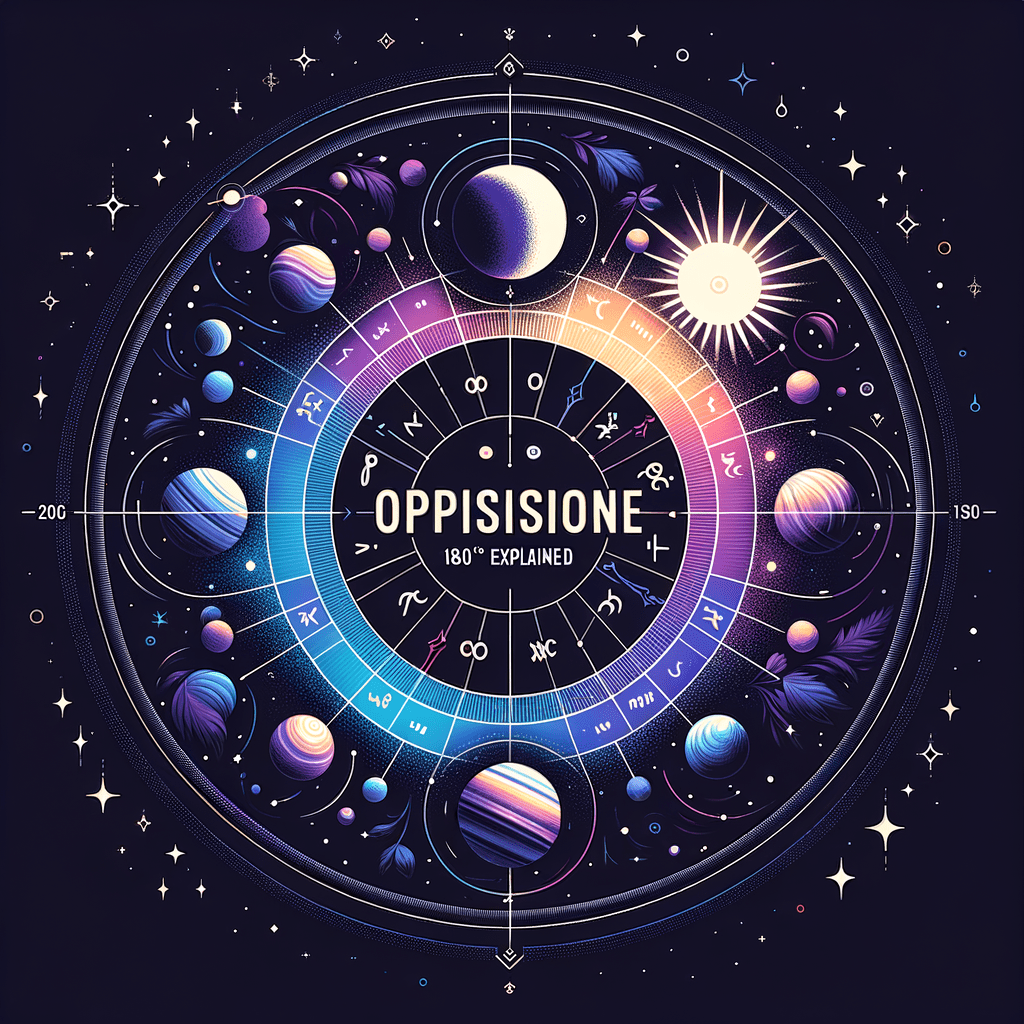
An opposition is the angle of 180° between two planets. They sit on opposite sides of the chart, facing each other.
The number comes from cutting the circle in half. 360 divided by two is 180. Claudius Ptolemy built the list of major angles this way in the second century, in the four books called the Tetrabiblos: cut the circle by two, three, four and six, and keep what you get. The opposition is the halving cut, and the widest angle there is. Two planets cannot be more than 180° apart, because past that point the gap starts closing again from the other side.
Charts never give a clean 180°. They give 176°, or 183°. So readers allow a margin around the exact figure, called the orb. With an orb of 6°, any gap from 174° to 186° counts as an opposition. When the gap lands on 180° to the degree, the aspect is called exact — partile, in the older texts.
Why the opposition is the rarest of the five
Two forces work against it. Both are simple.
The first is the edge of the scale. A gap between two planets runs from 0° to 180° and no more. A square at 90° has room on both sides: 84° to 96°, a full 12° wide. An opposition at 180° has room on one side only. Anything past 180° folds back and becomes less than 180°. So the opposition gets half the window a square gets. That halves its odds before any planet moves.
The second is Mercury and Venus. Both orbit inside the orbit of Earth, so from where we stand they stay near the Sun. They crowd the small gaps and starve the large ones. Most charts hold a knot of planets in one part of the sky, which pushes the counts toward 0° and away from face-offs.
Here is the result, from the same sixty years of sky, at an orb of 6°.
| Aspect | Angle | Charts with at least one |
|---|---|---|
| Sextile | 60° | 99.4 % |
| Square | 90° | 91.3 % |
| Trine | 120° | 90.9 % |
| Conjunction | 0° | 88.4 % |
| Opposition | 180° | 65.5 % |
The gap between the opposition and everything else is not small. It is 23 points below the next aspect up. Our page on the five major aspects sets out the full comparison.
The method, so you can check it
We checked the sky at a fixed step, every six hours from 1 January 1950 to 1 January 2010, which gives every day and every hour of those sixty years the same weight. At each moment we computed the tropical longitude of ten bodies: Sun, Moon, Mercury, Venus, Mars, Jupiter, Saturn, Uranus, Neptune and Pluto. Ten bodies make 45 pairs. For every pair we measured the gap and tested it against 180°, with an orb of 6°. Positions come from the Swiss Ephemeris. A second run with the astronomy-engine library, every five hours, gave the same figures to within 0.05 points.
That is the whole recipe. Change the orb and the numbers move, which is itself a finding — our guide to planetary orbs walks through the effect.
How many oppositions does a chart hold?
| Oppositions in the chart | Share of people |
|---|---|
| 0 | 34.5 % |
| 1 | 29.8 % |
| 2 | 21.3 % |
| 3 | 9.6 % |
| 4 or more | 4.7 % |
The average chart holds 1.22 oppositions. Two thirds of charts hold one or none.
Read that against the square, where the average is 2.66 and the most common count is two or three. The two get lumped together as the hard ones. They are not close in how often they turn up.
Three oppositions puts you in the top 14 %. Four puts you in the top 5 %. If your chart has none, you share that with about one person in three.
Which planets oppose each other, and which never can
Six pairs out of forty-five returned a count of zero. Not “rare” — zero, at every moment checked from 1950 to 2010.
Three of them are the inner planets. Mercury never appears more than about 28° from the Sun as seen from Earth; from 1950 to 2010 the widest gap was 27.79°. Venus never passes about 47°; the widest we saw was 47.15°. An opposition needs 180°. So Sun and Mercury cannot oppose. Sun and Venus cannot oppose. Mercury and Venus cannot oppose. If a report hands you a Sun opposite Mercury, the software is broken.
The other three are the outer planets. Uranus, Neptune and Pluto move so slowly that across the whole 1950–2010 window they never came close to facing each other. Uranus–Neptune, Uranus–Pluto and Neptune–Pluto all returned zero. Uranus and Neptune will not oppose for centuries.
Three more pairs are rare rather than impossible, and the reason is the same one that rules out Mercury and Venus.
| Pair | Charts with this opposition |
|---|---|
| Mars–Jupiter | 5.09 % |
| Mars–Saturn | 4.47 % |
| Saturn–Uranus | 3.86 % |
| Saturn–Neptune | 3.69 % |
| Sun–Moon | 3.27 % |
| Mercury–Mars | 1.21 % |
| Venus–Mars | 1.16 % |
| Sun–Mars | 1.14 % |
Sun–Mars sits at the bottom at 1.14 %. Mars is the first planet outside the orbit of Earth, so it can reach 180° from the Sun. But that happens only in the few weeks every two years when Earth passes between the two. One chart in 88 catches it.
A Sun–Moon opposition, at 3.27 %, means you were born within about half a day of a full moon. That is what a full moon is: the Moon opposite the Sun.
Oppositions between slow planets are dated events
When two slow planets oppose, they hold the angle for months, sometimes years. Everyone born in that stretch carries it.
We measured this. 19.2 % of charts from 1950 to 2010 hold at least one opposition between Jupiter, Saturn, Uranus, Neptune and Pluto. One person in five shares an opposition with their whole birth cohort. That aspect says something about an age group, not about one person.
You can watch one form, on a date you can check. On 28 September 2028, Jupiter reaches 7°27′ Libra while Neptune sits at 7°32′ Aries. That is a Jupiter–Neptune opposition, exact to five arcminutes, and it comes with the pair drifting through the angle for months on either side.
Two faster ones to compare. On 29 August 2027, Mars reaches 27°33′ Libra opposite Saturn at 27°33′ Aries: an exact Mars–Saturn opposition that lasts days, not months. On 4 October 2026, the Sun sits at 11°18′ Libra opposite Saturn at 11°18′ Aries.
Watching one unfold teaches the idea faster than any chart diagram. Note the date, note the pair, and read the sky against your own week.
Does an opposition always join opposite signs?
The usual claim is that it joins two signs exactly across the wheel: Aries with Libra, Taurus with Scorpio, Gemini with Sagittarius. We measured how often that holds.
Of all the oppositions found from 1950 to 2010, 91.28 % joined signs exactly six apart. The other 8.72 % joined signs only five apart.
| Signs apart | Share of oppositions | Facing signs? |
|---|---|---|
| 5 signs | 8.7 % | No |
| 6 signs | 91.3 % | Yes |
The cause is the orb again. Six signs of 30° each make exactly 180°. A 6° orb lets the aspect reach past a sign boundary, so a planet in the last degrees of one sign can face a planet in the last degrees of the sign before its true match. About one opposition in eleven is of this kind.
The same logic holds for the houses — the twelve slices of a chart, each covering an area of life. Houses pair off across the wheel: the first faces the seventh, the fourth faces the tenth. When the aspect falls across a house axis, the old texts read the two areas of life as pulling on each other. But that reading holds only when both planets sit well inside their houses. Near a house boundary, the axis is not the one it looks like. Our guide to the twelve houses sets out each pair.
What the tradition actually says
The 180° angle has been called hard since the start, and the reasons changed along the way.
Vettius Valens, writing in Greek in the second century in his Anthologies, uses the opposition in charts of conflict and reversal. The Hellenistic writers — the Greek-speaking readers whose work, from roughly 100 BC to 600 AD, is where Western astrology begins — treated facing signs as signs that see each other without agreeing.
William Lilly, in Christian Astrology, published in London in 1647, calls the opposition an aspect of “perfect hatred”. Lilly answered paying clients about lawsuits, debts and missing goods. Words of conflict suited the work he did. It was not a theory of who you are. Nobody was asking him for one.
The modern reading is different. It is not a softening. Robert Hand set it out in Planets in Aspect in 1976: the opposition puts two planets in full view of each other, which is exactly what a square does not do. A square grinds inside a person. The 180° angle shows up between a person and something outside them — a partner, a rival, a job. Hand’s point was that it is the most visible aspect in a chart, not the most painful.
Liz Greene works the same ground from psychology: what sits at the far end of an opposition is the part of yourself you meet through other people. Demetra George and Chris Brennan, both reading from the Hellenistic sources, add the caution that matters most here — the old texts were written to answer questions about property and survival. Reading them as a forecast of your inner life asks them to do a job they were never built for.
So “hard” names the texture of the angle. It is not a grade on your chart, and it is not a claim about how your life will go.
Square and opposition are not the same aspect
The two get bundled together constantly. On the measurements, they behave differently at every level.
| Square | Opposition | |
|---|---|---|
| Angle | 90° | 180° |
| Signs apart | 3 | 6 |
| Charts with at least one | 91.3 % | 65.5 % |
| Average per chart | 2.66 | 1.22 |
| Share of all major aspects | 21.9 % | 10.0 % |
| Sign link | Same modality | Same modality, facing |
| Pairs that cannot form it | 4 | 6 |
One detail in that table repays attention. Facing signs share a modality too — Aries and Libra are both cardinal, Taurus and Scorpio both fixed. So a square and an opposition both join signs of one modality. What separates them is distance, not tempo. Our guide to the three modalities explains what each one does, and the page on the square covers its side in detail.
Applying and separating
An aspect moves. The two planets travel at different speeds, so the gap shifts every day.
When the gap is closing toward the exact 180°, the opposition is applying. When it has passed 180° and is opening again, the opposition is separating. Older practice reads the applying one as the stronger, because what it describes has not finished arriving. Valens built much of his timing work on this split.
Your birth chart is frozen, so an opposition in it applies or separates for life. Compare the speeds of the two planets to know which.
How to read an opposition in your own chart
- Find every pair sitting 174° to 186° apart. If there are none, stop — you are in the 34.5 %, and nothing is missing.
- Write the orb next to each one. A 1° opposition speaks louder than a 6° one.
- Mark which pairs are slow planets. Those are shared with everyone born near your date.
- Check whether the two signs are really six apart, or only five.
- Note which house axis the pair falls across, and whether both planets sit well inside their houses.
- Only then ask what the two planets mean together.
Frequently asked questions
What does an opposition mean in astrology?
An opposition is a 180° angle between two planets, placed across the chart from each other. The tradition reads it as a face-off: two drives that each need the other to make sense. Robert Hand described it as the aspect a person meets through other people rather than inside themselves.
Is an opposition in astrology bad?
No. It is called a hard aspect because it describes a pull in two directions, not because it forecasts trouble. William Lilly wrote in 1647 for clients with lawsuits and debts, and his vocabulary reflects that. Two thirds of charts hold at least one opposition.
How common is an opposition in a birth chart?
Less common than any other major aspect. Among people born from 1950 to 2010, 65.5 % have at least one and 34.5 % have none. The average chart holds 1.22.
What does it mean if I have no oppositions in my chart?
It means you are in a third of all people. One chart in three has no opposition at all, which makes an empty result normal rather than odd.
Which planets cannot form an opposition?
Six pairs. Sun–Mercury, Sun–Venus and Mercury–Venus are ruled out because Mercury and Venus stay near the Sun. Uranus–Neptune, Uranus–Pluto and Neptune–Pluto returned zero across 1950 to 2010 because those planets move too slowly to reach 180° in that window.
What is the difference between a square and an opposition?
A square is 90° and joins signs three apart. An opposition is 180° and joins signs six apart. The square is far more common: it appears in 91.3 % of charts against 65.5 % for the opposition, and the average chart holds 2.66 squares against 1.22 oppositions.
Which planets are in opposition in 2027 and 2028?
Mars opposes Saturn on 29 August 2027, at 27°33′ Libra and 27°33′ Aries. Jupiter opposes Neptune on 28 September 2028, at 7°27′ Libra and 7°32′ Aries. The Sun opposes Saturn each October, on 18 October 2027 and 30 October 2028.
Does an opposition always join opposite signs?
In 91.3 % of cases, yes. The other 8.7 % join signs five apart, because a 6° orb lets the aspect reach across a sign boundary.
See the oppositions in your own chart
Counting oppositions by hand is slow, and reading them well takes practice. An Astrovision natal chart analysis finds every opposition in your chart, names the orb of each one, marks which are shared with your generation and which are yours alone, and explains what the pair is doing together — in writing and in a personal audio guide.