



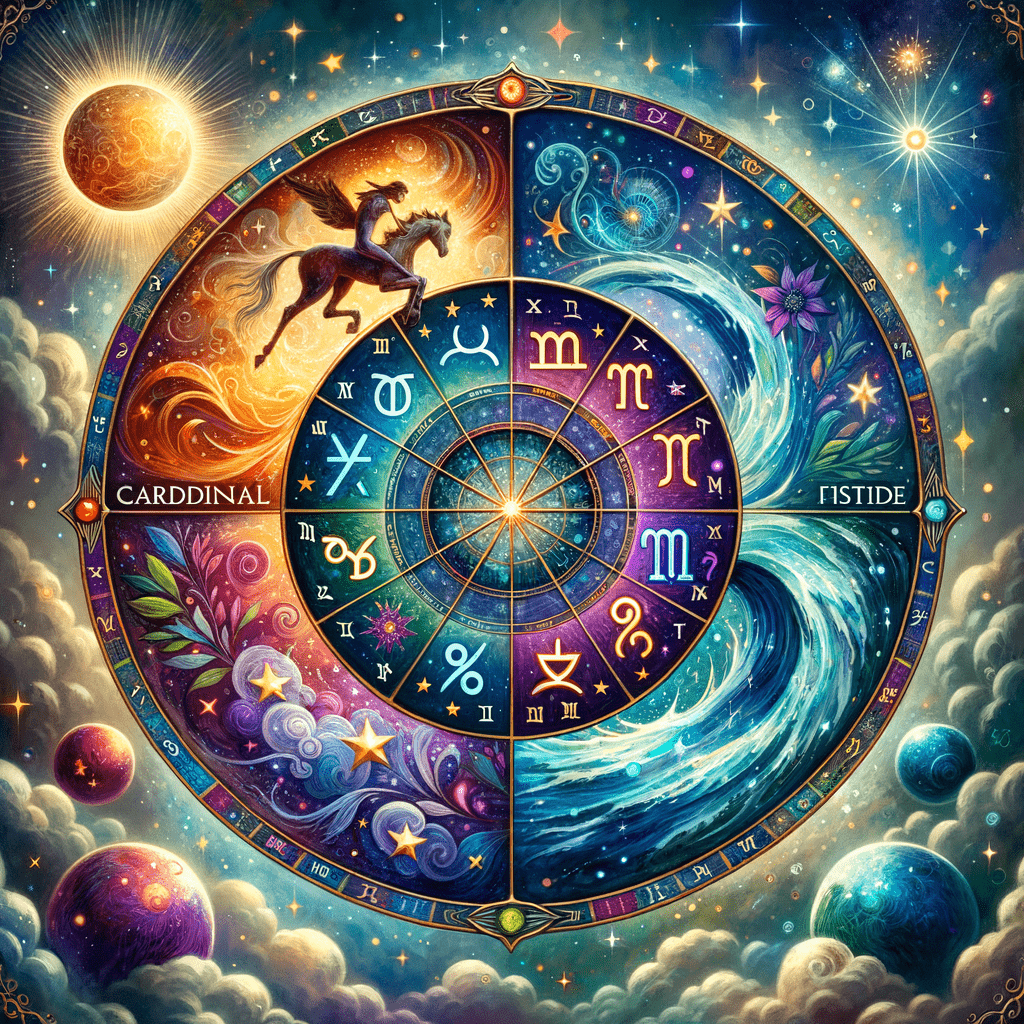
Open a calendar instead of a chart. Spring starts on one date. Summer starts on another. Nobody picked those dates. They are the four moments when the Sun crosses a line in the sky. And each one opens a cardinal sign.
That is the whole idea behind the three modes of the zodiac. Astrologers call them modalities. A modality is the quality that says how a sign moves, and there are three of them. Cardinal starts. Fixed holds. Mutable adapts. Each of the twelve signs carries one.
Modes and elements cut across each other, and the twelve zodiac signs are the grid where those two systems meet.
This page is the map of the system. Three guides go deeper, one per mode: Cardinal, Fixed, and Mutable.
What are cardinal, fixed and mutable signs?
Here is the short answer. The zodiac splits into three groups of four signs. Each group shares a way of handling time.
Modality sorts the signs one way; element sorts them another, and the 60 degree angle known as the sextile joins two signs whose elements agree.
Cardinal signs open a season. They are Aries, Cancer, Libra and Capricorn. Their job is to start.
Fixed signs sit in the middle of a season. They are Taurus, Leo, Scorpio and Aquarius. Their job is to hold.
Mutable signs close a season. They are Gemini, Virgo, Sagittarius and Pisces. Their job is to hand over.
The full grid looks like this.
| Mode | Signs | Place in the season | Verb |
|---|---|---|---|
| Cardinal | Aries, Cancer, Libra, Capricorn. | First month. | Start. |
| Fixed | Taurus, Leo, Scorpio, Aquarius. | Second month. | Hold. |
| Mutable | Gemini, Virgo, Sagittarius, Pisces. | Third month. | Adapt. |
Read the table down a column and a pattern shows up. Fire runs Aries, Leo, Sagittarius. That is one start, one hold, one handover. Every element does the same. Four elements crossed with three modes give twelve signs. No two are alike. The four elements cover the other half of that grid.
The calendar built this, and you can check the dates
Few guides say where the three groups come from. The answer is the Sun.
Twice a year, day and night run equal. Those are the equinoxes. Twice a year, the Sun rides highest or lowest at noon. Those are the solstices. Four turning points, four seasons.
Now watch what the Sun does on those four dates. Each one is an ingress: the moment a body crosses from one sign into the next. Here are the next four. They come from an ephemeris, which is a table of where each body sits at a given time.
| Date, UTC | The Sun enters | Turning point |
|---|---|---|
| 23 September 2026, 00:05. | Libra. | Autumn equinox. |
| 21 December 2026, 20:50. | Capricorn. | December solstice. |
| 20 March 2027, 20:24. | Aries. | March equinox. |
| 21 June 2027, 14:10. | Cancer. | June solstice. |
All four are cardinal signs. Never anything else. A cardinal ingress is an equinox or a solstice. They are the same event under two names.
The fixed signs land one step later. The Sun enters Scorpio on 23 October 2026, Aquarius on 20 January 2027, Taurus on 20 April 2027, and Leo on 23 July 2027. Each of those falls near the middle of its season. Deep winter. High summer. That is the fixed month, when the weather stops shifting and just holds.
The mutable signs take the last stretch. Sagittarius, Pisces, Gemini and Virgo each end a season and hand the next one over.
One more detail that the trait lists never mention. The seasons are not equal. Between those four ingress dates the gaps run 89.9 days, 89.0 days, 92.7 days and 93.7 days. Earth moves faster when it is closer to the Sun. So autumn and winter run shorter than spring and summer. The four cardinal points are sky first and meaning second.
I counted the three modes over 800 years of sky
Trait lists are easy to write. Numbers are harder, so here are some.
I checked the sky every six hours for 800 years, from 1600 to 2400, so every day and every hour counts the same. At each step I worked out the sign of ten bodies: the Sun, the Moon, Mercury, Venus, Mars, Jupiter, Saturn, Uranus, Neptune and Pluto. I used the tropical zodiac, the one tied to the seasons and not to the stars. Then I sorted every hit into cardinal, fixed or mutable and added it up. I ran it twice, with the Swiss Ephemeris and with the astronomy-engine library on a different time step. The two agree to within 0.05 points.
The first result is a flat line. Cardinal took 33.1 percent of all hits. Fixed took 33.4 percent. Mutable took 33.5 percent. A third each, as the geometry demands.
The next question is what happens inside one chart. Below I use five bodies only: the Sun, the Moon, Mercury, Venus and Mars. That keeps the count in line with our element guides, which use the same five.
| Score out of five | Cardinal | Fixed | Mutable |
|---|---|---|---|
| None. | 13.44 % | 13.47 % | 13.41 % |
| One. | 32.76 % | 32.77 % | 32.82 % |
| Two. | 32.61 % | 32.57 % | 32.57 % |
| Three. | 16.54 % | 16.49 % | 16.49 % |
| Four. | 4.21 % | 4.26 % | 4.24 % |
| All five. | 0.43 % | 0.44 % | 0.47 % |
Three figures are worth pulling out.
About 13.4 percent of charts hold no cardinal at all. The same goes for fixed, and for mutable. So one person in seven is missing any given mode, and about four in ten are missing at least one of the three.
About 21 percent of charts hold three or more in any given mode. Only one mode can reach three at a time, so add the three together: 63.6 percent of charts have a mode with three or more. That is the point where the trait list starts to fit. Below three, you are a mix.
Roughly one chart in 215 to one in 232 runs all five bodies through a single mode, depending on which mode you pick. Those are the pure cases, and they are rare.
One last figure. The Sun and the Moon share a mode in 33.3 percent of charts. That is one in three, which is what chance predicts. Your Sun and Moon pull the same way a third of the time, and apart the rest.
Modes are not elements, and the gap is wider than you think
Here is the fact nobody prints. Modes and elements act in very unlike ways in a real chart, and the reason is plain counting.
There are four elements and only three modes. One extra box changes the whole picture. Spread five bodies across four boxes and gaps open up. Spread the same five across three boxes and they fill.
The same 800 years, counted both ways:
| Question | Modes, three groups | Elements, four groups |
|---|---|---|
| Missing a given group entirely. | 13.4 % | 26.4 % |
| Holding every group. | 61.0 % | 18.4 % |
| Three or more in a given group. | 21.2 % | 12.0 % |
| All five in one group. | 1 in 215 to 1 in 232. | 1 in 556 to 1 in 607. |
| Sun and Moon matched. | 33.3 % | 25.0 % |
Read the first two rows together, because they carry the whole story.
A missing element is normal. Around 26 percent of people have no air in those five bodies, and the same holds for fire, earth and water. A missing mode is half as common. Only 13.4 percent of people have none of a given mode.
Now flip it. Three people in five carry all three modes. Fewer than one in five carry all four elements. So a full set of modes is normal. A full set of elements is rare.
What does that mean when you read a chart? Two things.
First, a missing element says more than a missing mode. Fewer people are missing one, so the gap stands out.
Second, a mode leans harder than an element does. A clear lead of two or more shows up in 38.7 percent of charts for modes, against 33.9 percent for elements. When someone reads as pure cardinal, the chart agrees.
Count your own score in five minutes
Do what I did, for one chart instead of 800 years of sky. You need your birth chart. Any free calculator will draw one from a date, a time and a place.
Find five bodies: the Sun, the Moon, Mercury, Venus and Mars. Write down the sign of each. Then mark each sign C, F or M using the first table on this page. Add up the letters.
Your highest letter is your leading mode. Here is how to read the result.
| Your score | Where that puts you |
|---|---|
| 0 in a mode. | With 13.4 % of people. That mode is a blind spot. |
| 1 or 2. | The crowd. Two thirds of charts sit here. |
| 3. | A real lean. About 16.5 % sit here. |
| 4 or 5. | The top 5 %. The label fits you. |
One warning. Your Sun sign is one body out of five. A Capricorn Sun is cardinal, but a chart with the Moon in Gemini, Mercury in Sagittarius and Venus in Pisces reads mutable, not cardinal. A horoscope column sees one body. Your chart holds ten.
Where the three modes came from
The scheme is old, and it was always tied to the seasons.
Around 150 AD in Alexandria, the Greek scholar Claudius Ptolemy wrote the Tetrabiblos. It went on to shape Western star lore for 1,400 years. Ptolemy set out the three groups and grounded them in the solar year. In his account the cardinal signs mark the turn of a season. The fixed signs hold its full strength. The mutable signs sit between two seasons and share in both. His case rests on the Sun from the first line.
Vettius Valens wrote his Anthologies in the same century. He used the same three groups for timing, not for character. He asked whether a period of life would begin something, hold it, or break it up.
Jump to 1647. In London, William Lilly published Christian Astrology. It was the first great English handbook of the craft. Lilly kept the three groups and called them movable, fixed and common. His word choice tells you the old reading: the point was motion, not personality.
The modern reading arrived in the twentieth century. Liz Greene, a Jungian analyst, recast the modes as ways of meeting change. Robert Hand pushed the same idea into transit work, where the mode of a sign shapes the tempo of an event. Demetra George and Chris Brennan went back to the Greek sources. They showed how much of the old timing craft had dropped out along the way.
So two traditions sit side by side. The Hellenistic reading, from the Greek-speaking astrologers working between roughly 100 BC and 600 AD, treats the modes as a clock. The modern reading treats them as a set of traits. Neither cancels the other. Knowing which one a writer means saves a lot of muddle.
What happens when two modes meet
Signs in the same mode sit either 90 or 180 degrees apart on the wheel. In the old language those are the hard angles, and they are the ones that make friction. Two cardinal signs both want to lead. Two fixed signs both refuse to move. Two mutable signs both change the plan.
The 90° angle between two signs of one mode is the aspect astrologers call a square, and 89.4 % of squares fall this way among people born from 1950 to 2010.
The 180° angle between two facing signs of the same mode is an opposition, and it turns up in only 65.5 % of charts for the same births.
That shape answers a question people ask a lot: can a fixed sign work with a cardinal one? Yes, and the mix beats a same-mode pair. Cardinal supplies the start. Fixed supplies the follow-through. The friction is real but it is useful friction.
A quick reading of the three pairings:
| Pairing | What it produces |
|---|---|
| Cardinal with fixed. | Plans that get finished. One pushes, one carries. |
| Cardinal with mutable. | Fast movement, loose ends. Both like a fresh start. |
| Fixed with mutable. | Steady work, quiet drift. One holds, one edits. |
The same logic runs inside one chart. If your count reads four cardinal and one fixed, that single fixed body is the part of you that finishes things. It is worth knowing which one it is.
Frequently asked questions
What are the three modalities in astrology?
Cardinal, fixed and mutable. Cardinal signs open a season and start things. Fixed signs sit mid-season and hold them. Mutable signs close a season and adapt. Each mode covers four of the twelve signs.
Which signs are cardinal, fixed and mutable?
Cardinal: Aries, Cancer, Libra, Capricorn. Fixed: Taurus, Leo, Scorpio, Aquarius. Mutable: Gemini, Virgo, Sagittarius, Pisces.
Why do cardinal signs start the seasons?
Because the Sun enters them at the equinoxes and the solstices. The Sun reaches Libra at the autumn equinox on 23 September 2026, and Capricorn at the December solstice on 21 December 2026. That link comes from the sky, not from a rule book.
How do the three modes work with the four elements?
Elements describe what a sign is made of. Modes describe how it moves. Three modes crossed with four elements produce the twelve signs. Fire gives Aries the start, Leo the hold and Sagittarius the handover.
Is one modality better than another?
No. Over 800 years of sky, the three modes split it evenly, at roughly 33 percent each. Any project needs all three: one to start it, one to hold it, one to adjust it.
Can someone have more than one modality in their chart?
Nearly all of us do. In my count, 61.0 percent of charts hold all three modes among the Sun, Moon, Mercury, Venus and Mars. The other 39 percent are missing one.
What does it mean to have no cardinal, fixed or mutable signs?
You share that with about one person in seven. A missing mode is a blind spot rather than a flaw. With no fixed bodies, finishing is the work. With no cardinal, starting is.
Can a fixed sign be compatible with a cardinal sign?
Yes. That pairing is the one that gets the most done. Cardinal opens, fixed sustains. Same-mode pairs compete, because both people reach for the same role.
Glossary
| Term | Plain meaning |
|---|---|
| Modality, or mode. | The quality that says how a sign moves: cardinal, fixed or mutable. |
| Quadruplicity. | The old name for a mode, because each one holds four signs. |
| Element. | What a sign is made of: fire, earth, air or water. |
| Ingress. | The moment a body crosses from one sign into the next. |
| Tropical zodiac. | The zodiac tied to the seasons, starting at the March equinox. |
| Ephemeris. | A table giving the position of each body at a given time. |
| Birth chart. | A map of the sky at your moment of birth. |
Go deeper with your personal Astrovision report
Counting your five bodies takes five minutes. It gives you your leading mode. It cannot tell you what that mode does across the twelve areas of your life. That is the job of a full reading.
Our users like our audio-first approach. They call it warm, clear and easy to follow. This page gives you the what. A full report gives you the so what, as a written guide and as a podcast built for your chart alone.