

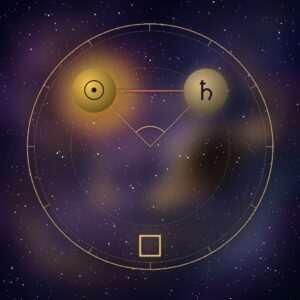
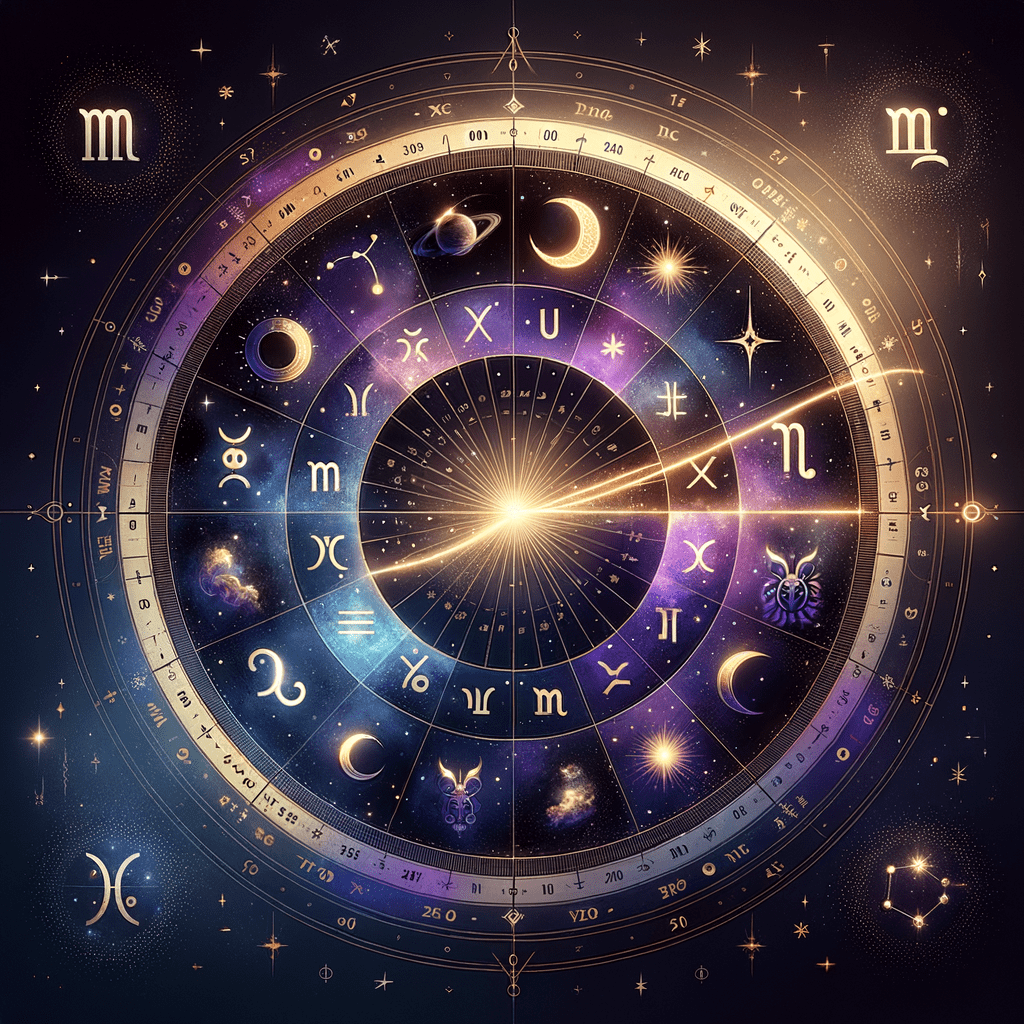
The sextile is sold as a lucky break. A gift. A quiet piece of luck sitting in your chart. We checked sixty years of sky and counted. Sextiles showed up in 99.4 % of charts. An aspect that nearly all of us own is not a gift. It is a floor. This page gives you the count, the shape behind it, and what the tradition claims.
What is a sextile in astrology?
A sextile is a 60° angle between two planets, measured along the ring of the zodiac. Picture the chart as a clock face, with the twelve signs set around the rim. Each sign covers 30°. Two signs apart is 60°. That gap is a sextile.
No two planets sit at a clean 60°. They sit at 58°, or 63°, or 56°. So a margin is allowed around the exact angle. That margin is called the orb. With an orb of 6°, any gap from 54° to 66° counts as a sextile. When the gap hits 60° to the degree, the aspect is exact. Older texts call that partile.
The angle also moves. Planets move at different speeds, so the gap between any two of them shifts daily. A gap closing toward 60° is an applying sextile. A gap opening away from it is a separating sextile. Your birth chart freezes one moment, so each sextile in it stays applying or separating for life.
That is the whole definition. A sextile is a gap of about 60°, nothing more. What is read into it is a second question, and this page keeps the two apart.
Almost every chart has one: the count
Here is the method, so you can repeat it. We checked the sky every 15 minutes from 1 January 1950 to 1 January 2010. That is about 2.1 million moments, spread evenly, with no random draw. The window matters for the slow planets, so we kept to the birth years of most adults alive today. For each one we worked out the tropical longitude of ten bodies: Sun, Moon, Mercury, Venus, Mars, Jupiter, Saturn, Uranus, Neptune and Pluto. Ten bodies make 45 pairs. We measured every pair and checked it against 60°, with an orb of 6°. Positions come from the Swiss Ephemeris, checked against a second library, astronomy-engine, the same pair used for the wider aspect counts on this site.
| Sextiles in a chart | Share of charts |
|---|---|
| None | 0.6 % |
| At least one | 99.4 % |
| At least two | 92.9 % |
| At least three | 76.9 % |
| At least five | 32.3 % |
The average chart holds 3.84 sextiles. That beats every other major aspect. The sextile takes 31.6 % of all major aspects, ahead of the square at 21.9 % and the trine at 20.2 %.
Read the first row again. Six charts in a thousand have no sextile at all. If a reading tells you that your sextile marks you out, the number says no. Six people in a thousand are marked out. The rest of us are ordinary.
One pair of planets explains most of it
The 99.4 % figure has a cause, and it is odd. We counted sextiles pair by pair. One pair dwarfs the rest.
| Pair | Sextiles per 100 charts | Share of all sextiles |
|---|---|---|
| Neptune–Pluto | 82.5 | 21.5 % |
| Uranus–Pluto | 12.6 | 3.3 % |
| Mercury–Venus | 11.7 | 3.0 % |
| Sun–Mars | 9.4 | 2.4 % |
| Venus–Mars | 9.1 | 2.4 % |
| Mercury–Mars | 8.0 | 2.1 % |
Neptune and Pluto alone make one sextile in every five. Eight charts in ten contain that single pairing. Why? Because the two planets are locked together. Across our whole 60-year window, the Neptune–Pluto gap never left the range 51.06° to 65.28°. The mean was 58.73°. They have been sitting in a sextile for the entire modern era.
The cause sits in the orbits, not in magic. Pluto circles the Sun twice for every three circuits Neptune makes. Astronomers call that a 3:2 resonance. It holds the two at a near-fixed angle for hundreds of years at a stretch. Everyone born between 1950 and 2010 shares it.
So we ran the count again with Neptune–Pluto removed. Charts with at least one sextile fell from 99.4 % to 94.8 %. Still almost everyone. The drop shows where a fifth of the world’s sextiles come from: one resonance, shared by a whole age group, saying nothing about one person.
Which planets form your sextiles, and which never can
Two pairs came back at exactly zero, across 2.1 million moments.
Mercury and Venus orbit inside the orbit of Earth. From where we stand, neither strays far from the Sun. From 1950 to 2010, the largest Sun–Mercury gap was 27.79°. The largest Sun–Venus gap was 47.15°. A sextile needs 60°. Neither planet can reach it. A Sun sextile Mercury does not exist. A Sun sextile Venus does not exist. If an app reports one, the app is wrong.
That same crowding works the other way for the two of them together. They stay near the Sun, so they stay near each other, and small gaps are easy for them. Mercury–Venus sextiles run at 11.7 per 100 charts, third highest of all 45 pairs.
Everything else sits between 5 and 9 per 100 charts. Saturn–Uranus sits at the bottom of the live pairs, at 5.02. There is no rare sextile to hunt for. The spread is flat.
Two signs apart means two elements that get along
Count two signs on from any sign and you land on a matching element. Aries is fire; two signs on is Gemini, which is air. Taurus is earth; two signs on is Cancer, which is water. Fire pairs with air. Earth pairs with water. The tradition has read those pairs as friendly since ancient times.
We checked whether the rule holds. It mostly does. Of all the sextiles we counted, 89.8 % joined two matching elements. The other 10.2 % did not, and the reason is the orb. A planet at 29° of a sign and another at 27° of the sign two along are 58° apart, which counts as a sextile. Widen the orb and one end slides across a sign line, so the neat element match breaks.
One sextile in ten therefore fails the rule that is supposed to define it. Nobody mentions this, because nobody counts. The upshot: check the signs, not just the degrees. An aspect list that gives the angle alone hides the break. Our guide to the three modalities covers the other half of the sign relationship, the one the sextile ignores.
Why 60° and not some other angle
The list of major angles is old and it is not arbitrary. Claudius Ptolemy set it out in the second century, in the four books known as the Tetrabiblos. His case rested on clean division. Cut the circle in two and you get 180°. Cut it in three, 120°. In four, 90°. In six, 60°. The sextile is the circle cut by six, which is why it draws a hexagon on the chart wheel.
Try dividing by five. You get 72°, which is two signs and twelve degrees. It lands nowhere. Ptolemy left it out, and the tradition followed him for eighteen centuries.
Orbs were never fixed. William Lilly, writing in London in 1647 in Christian Astrology, gave the orb to the planet, not to the angle. The Sun got 17°. Mercury got 7°. A Sun sextile under Lilly’s rules is a far looser thing than a Mercury one. Most working astrologers now use 6° for a sextile and 8° for the lights. Our page on planetary orbs walks through the choice and what it costs you.
The “opportunity” reading, and what it is worth
Ask what a sextile does and you get one word back: opportunity. A door that opens if you walk through it. That reading has roots worth naming.
Greek-speaking astrologers, working from roughly 100 BC onward, already sorted the angles into helpful and hard. Vettius Valens, in his Anthologies, treated the 60° angle as helpful but weaker than the 120° trine. Lilly kept the same ranking in 1647. The modern wording arrives with Robert Hand, whose Planets in Aspect came out in 1976 and called the sextile a chance that needs action. Liz Greene has argued for decades that an easy aspect builds nothing by itself. Chris Brennan and Demetra George, both working from those Greek sources, stress that the ranking was a claim about texture, never a forecast.
Set those roots beside the count and the picture settles. The sextile is the most common major aspect in the zodiac. Ninety-nine charts in a hundred hold one. What a sextile marks, it cannot be what sets you apart, since you share it with nearly all of us. Treat it as background, not as a verdict.
A sextile you can watch in the sky
Aspects are not confined to birth charts. Planets form them overhead, on dates you can check.
On 15 September 2026, Neptune sits at 3°18′ Aries and Pluto at 3°17′ Aquarius. The gap is 60°01′. That is the exact sextile of the pair that rules the whole count above, on one dated afternoon. Both are retrograde, meaning each looks to drift backwards against the stars as seen from Earth.
Watching one aspect close teaches the idea faster than any chart drawing. Note the pair, note the date, then read your own week against it.
How to read the sextiles in your own chart
Work in this order and the sextile stops being a slogan.
Count them first. Write the orb beside each one. A sextile at 1° of orb speaks louder than one at 6°. That gap is real, not for show.
Cross out Neptune–Pluto. You share it with your whole age group, so it marks an era, not a person. The same goes for Uranus–Neptune and Uranus–Pluto.
Look at what is left. Sextiles that take in the Sun, Moon, Mercury, Venus or Mars are the ones that shift from chart to chart.
One of them, Venus sextile Mars, turns up in about one birth chart in nine, more often than the trine.
Check the elements at both ends. If the two signs do not pair up, you are in the 10.2 % where the orb stretched the rule, and the aspect is weaker than its label.
Compare with the harder angles. A sextile between two planets that also hold a square in another spot reads unlike one standing alone, and the trine is its closest cousin.
The semi-sextile is not a small sextile
Search for the sextile and you meet its neighbour, the semi-sextile. The name invites a guess. The guess is wrong. A semi-sextile is a 30° angle: one sign apart, half the sextile’s gap.
The two are not cousins. One sign apart joins signs that share no element and no mode. Aries is fire and cardinal; Taurus is earth and fixed. They share nothing, which is why Ptolemy left 30° off his list of major angles. The sextile joins signs that agree. The semi-sextile joins signs that do not.
Give the semi-sextile a tight orb of 2° or 3° if you use it at all. Read it at 6° and a chart fills with noise. That one choice is the best case for weighing orbs with care, rather than taking what your app ships with.
What a sextile looks like in a real chart
Take a birth moment of 12:00 UTC on 15 September 2026. Jupiter stands at 16°40′ Leo, a fire sign. Saturn stands at 12°45′ Aries, also fire. The gap between them is 123°55′, so that pair forms a trine, not a sextile.
Look instead at Neptune, at 3°18′ Aries, and Pluto, at 3°17′ Aquarius. Aries is fire. Aquarius is air. The gap reads 60°01′. Orb: one arcminute. That is as exact as a sextile gets, and it sits in the chart of all who were born that day.
Frequently asked questions
What is a sextile in astrology?
A 60° angle between two planets, or two signs apart on the zodiac wheel. Most readers allow an orb of 6°, so any gap from 54° to 66° counts. It is the most common of the five major aspects.
Are sextiles good or bad?
Neither. The tradition files the sextile as helpful, and has done since Vettius Valens. That is a claim about how the two planets blend, not a forecast. With 99.4 % of charts holding at least one, no outcome can hang on having one.
How rare is a sextile?
It is the opposite of rare. Across every quarter hour from 1950 to 2010, 99.4 % of charts held at least one and 76.9 % held three or more. The average chart holds 3.84.
What zodiac signs are sextile each other?
Signs two apart: Aries and Gemini, Taurus and Cancer, Gemini and Leo, Cancer and Virgo, on around the wheel. Fire signs sextile air signs. Earth signs sextile water signs.
Which planets can never form a sextile?
The Sun with Mercury, and the Sun with Venus. Both circle inside Earth’s own path and never stray far from the Sun. From 1950 to 2010, Mercury reached 27.79° at most, Venus 47.15°. A sextile needs 60°, so the count for both was zero.
What is the difference between a sextile and a trine?
The angle and the element. A sextile is 60° and joins two matching elements, such as fire with air. A trine is 120° and joins two signs of the same element. The tradition reads the trine as the stronger of the two.
Does the orb change whether I have a sextile?
Yes, and by more than most people expect. Widening the orb from 5° to 8° lifts the mean count of major aspects in a chart from 10.2 to 16.1. Whether you “have” a given sextile can come down to one setting in your app.
See the sextiles in your own chart
Counting aspects by hand is slow. Telling the shared ones from your own takes practice. An Astrovision natal chart analysis maps every sextile in your chart, gives the orb of each one, and spells out what the pair is doing together, in writing and in a personal audio guide.