
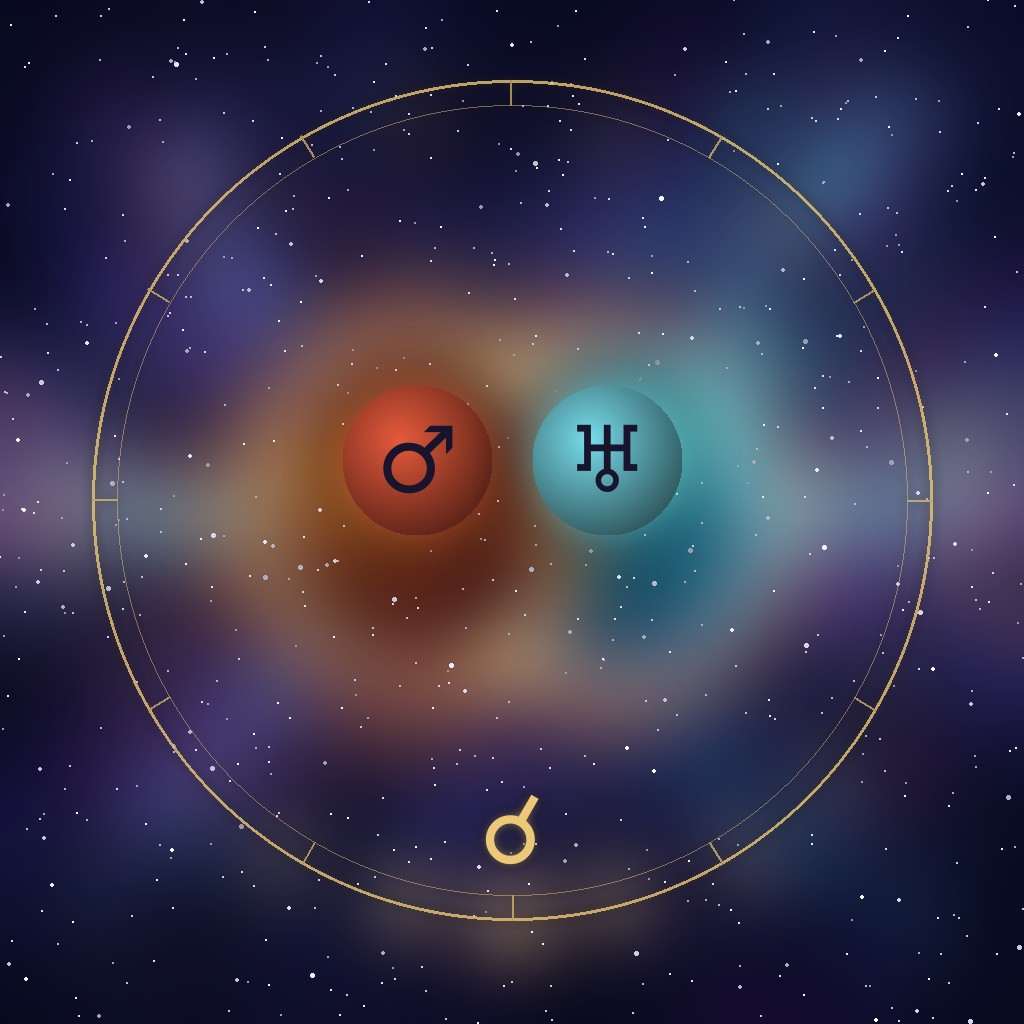
On July 4, 2026, Mars caught up with Uranus at 3°52′ Gemini. It was a fast meeting. Mars came within 8° of Uranus on June 22 and was gone by July 16. That is how Mars conjunct Uranus works most of the time: a short burst, about three and a half weeks, once every two years. But about one meeting in 15 is different. Mars turns back on its path, sits on top of Uranus, and the meeting stretches to four or five months. We timed every Mars–Uranus meeting from 1600 to 2400 to show which births and which years carry the long version.
A few words first. An aspect is an angle between two planets, measured along the band of sky that the Sun, Moon and planets travel. A conjunction is the aspect of 0°: the two planets stand at the same spot in that band. Our page on the conjunction and why 0° is the strongest bond explains it in full. The orb is the gap an astrologer allows around the exact angle before the link stops counting. We use two orbs here. An orb of 8° is wide, and an orb of 3° is tight.
Mars conjunct Uranus: a short meeting with rare long ones
Mars circles the zodiac in about 1.9 years. Uranus needs about 84 years. So Mars does all the chasing. It catches Uranus, passes it, laps the whole zodiac, and catches it again a little under two years later.
From 1600 to 2400, we counted 416 of these meetings. In the middle case, Mars stays within 8° of Uranus for about 26 days. Most of them last between three and four and a half weeks. That is the short version.
Then there are the long ones. In 28 of the 416 meetings, Mars lingered for 60 days or more. The longest ran past five months. These long meetings are only one in 15 of the total. Yet they hold about a quarter of all the time the two planets spend together.
The reason is a trick of where we stand. Every 26 months or so, Earth overtakes Mars on the inside track. For a few weeks, Mars seems to slow down, stop and drift backward against the stars. Astrologers call this backward drift retrograde motion. The planet does not really reverse. It only looks that way from Earth. The point where it seems to stop and turn is called a station.
Most of the time, this loop happens far from Uranus. But now and then Mars makes its loop right on top of Uranus. Then Mars crosses Uranus going forward, crosses it again going backward, and crosses it a third time going forward. Astronomers and astrologers both call that a triple conjunction. In our count, 15 of the 416 meetings had three exact crossings.
The long meetings, year by year
Here are the long meetings of the last hundred years and the next few decades. Each row gives the exact crossings, in UTC, which is five hours ahead of New York in winter and four in summer.
| Meeting | Exact crossings | Sign and length. |
|---|---|---|
| Meeting of 1943–44. | Sept 9, 1943, then Dec 30, 1943, then Jan 16, 1944. | Gemini, about 115 days within 8°. |
| Meeting of 1964–65. | Dec 6, 1964, then Mar 29, 1965, then May 8, 1965. | Virgo, about 132 days within 8°. |
| Meeting of 2003. | June 23, 2003, then a near miss on Sept 25, 2003. | Pisces, about 132 days within 8°. |
| Meeting of 2041–42. | Nov 2, 2041, then Mar 5, 2042, then Mar 28, 2042. | Leo, about 120 days within 8°. |
The meeting of 2003 is the odd one. Mars passed Uranus on June 23. Then it turned retrograde at the end of July and slid back toward Uranus. It came within half a degree on September 25, stopped, and turned forward again two days later. It never touched. So 2003 had one exact crossing but a long stay all the same.
These long meetings explain a pattern in our sample of births. We drew 200,000 random birth moments from 1950 to 2010. In the 1960s, 6.88% of them had Mars within 8° of Uranus. In the 2000s, the share was 6.4%. In the 1950s, 1970s, 1980s and 1990s, it sat between 3.44% and 3.88%. The two high decades are the decades of 1965 and 2003.
How common is Mars conjunct Uranus in a birth chart?
Across all 200,000 sample births from 1950 to 2010, 4.68% had Mars within 8° of Uranus. That is about one chart in 21. Within the tight orb of 3°, the share was 1.9%, or about one chart in 53.
Sixty years is a short window, so we checked a longer one. From 1600 to 2400, measured every six hours, the two stood within 8° of each other 4.52% of the time. That is about one chart in 22. Within 3°, the share was 1.72%, or about one chart in 58. The short window runs a little high because it holds two of the long meetings.
Here is how we got these numbers. Planet positions come from the Swiss Ephemeris, the standard planet table used by astrology software. We used the tropical zodiac, which starts the signs at the spring equinox. For the long window, we checked the gap between the two planets every six hours for 800 years. We then rechecked it with a second, independent planet library, Astronomy Engine, at a step of twelve hours. It gave the same 4.52%. Both routes also agree on every exact date in this article to within a few minutes.
You do not need a birth time for this aspect. Mars moves less than one degree a day, and Uranus far less. A birth date is enough to know if you have it. A birth time is only needed for the Moon, the rising sign and the houses.
What Mars conjunct Uranus means in a natal chart
Picture a birth chart as a house with twelve rooms. Each room covers one part of life, and the planets are the furniture. Your natal chart is the plan of that house at the moment you were born. With this aspect, two pieces that both carry a charge sit side by side in one room.
Mars is the engine. In astrology it stands for drive, action, courage, desire and anger. It asks, “What do I want, and how do I go after it?” Our page on Mars as the planet of drive and courage covers its full role.
Uranus is the lightning switch. It stands for change, freedom, shock, invention and the break from the old way. It asks, “What would happen if I did it differently?” Our page on Uranus, the planet of change and freedom goes through it in depth.
Join them and you get an engine wired to a switch. The drive of Mars fires in sudden bursts. It goes after the new, the untried and the free. Sue Tompkins, in Aspects in Astrology (2002), reads the conjunction as a blend in which two planets act as one. Here the blend is speed plus surprise.
The oldest sources are silent on this pair. Claudius Ptolemy wrote the Tetrabiblos, the Greek textbook that shaped Western astrology, around 150 AD. He knew only the planets the eye can see. Uranus was found by the astronomer William Herschel in 1781. William Lilly, the English astrologer who wrote Christian Astrology in 1647, gave each planet its own orb. He never had a chance to give one to Uranus.
Modern writers fill the gap. In The Combination of Stellar Influences (1940), the German astrologer Reinhold Ebertin tied the Mars–Uranus pair to sudden, forceful action and high tension. Stephen Arroyo, a modern astrologer who links astrology to psychology, describes Uranus as the urge to break free of what holds us. Put that urge next to Mars, and the wish for freedom turns into action.
The bright side
In the modern tradition, people with this aspect are quick starters. They are read as people who move first and think on the way. They act fast when something needs to change. They like to try a new method before the old one has failed. Many of them like to work alone or set their own pace. They can be brave in a way that looks careless from the outside.
The tradition also links this pair with skill in fast or technical work. Mars rules tools and effort. Uranus rules invention. Together, they point to someone who wants to build or fix things in a new way.
The hard side
The same wiring that makes quick starts makes quick stops. A plan can be dropped as fast as it was begun. Anger can flash and pass before anyone sees it coming. Rules feel tight, and being told “no” can set off a strong push back.
Astrologers in this line read the task as learning to aim the spark. The aspect does not make anyone reckless. It gives a strong pull toward speed and change. What you do with that pull is the real story.
Wide orb or tight orb?
The orb changes the volume. At 1° or 2°, the two planets act as one. At 7° or 8°, they are more like two people in one room who still talk to each other but keep their own voices. If Mars is ahead of Uranus in the zodiac, Mars has already passed it. Some astrologers read that as a person who acts first and finds the new angle after. If Mars is behind, the urge for change comes first.
Sign, house and the other aspects
The sign tells you how the pair works. In a fire sign, the spark is open and loud. In an earth sign, it goes into practical change. The meetings of 2026, 2028 and 2030 all fall in Gemini, an air sign. There the pair works through ideas, talk and travel. If your Mars sits in Gemini, our page on Mars in Gemini and the 2028 meeting has more.
The house tells you where it shows up. In the tenth room, the room of career, it points to work that changes direction. In the seventh room, the room of partners, it points to a need for space inside a bond. You need a birth time to know the house.
Other aspects to the pair add or take away. A trine is an angle of 120°, read as easy and smooth. A square is an angle of 90°, read as tense and pushy. Our guide to how astrological aspects work lays out every angle and its orb.
Transiting Mars conjunct Uranus: when the sky does it again
A transit is the position of a planet in the sky today, read against your birth chart. Mars conjunct Uranus is also a transit for everyone at once, since the two planets meet in the sky about every two years. Here are the recent and coming exact meetings, in UTC.
| Date of the exact meeting | Where. |
|---|---|
| Jan 20, 2021, 20:37 UTC. | 6°44′ Taurus. |
| Aug 1, 2022, 23:53 UTC. | 18°42′ Taurus. |
| July 15, 2024, 14:04 UTC. | 26°19′ Taurus. |
| July 4, 2026, 06:07 UTC (2:07 a.m. in New York). | 3°52′ Gemini. |
| June 23, 2028, 20:44 UTC. | 11°24′ Gemini. |
| June 15, 2030, 13:28 UTC. | 19°01′ Gemini. |
Each of these is a short meeting. Mars stays within 8° of Uranus for about three and a half weeks: June 11 to July 6 in 2028, and June 3 to June 28 in 2030. None of the meetings from 2005 to 2040 is a long one. The next long meeting is the triple crossing of 2041–42 in Leo.
Notice that the dates step back by about ten days each time. That is because the gap between two meetings is a little shorter than two full years.
Transiting Mars over your natal Uranus
Mars also crosses the spot where Uranus stood when you were born. That happens about every two years and lasts a few days at a tight orb. Tradition reads it as a short spell of restless energy and a wish to shake things up in the area of life where your Uranus sits.
Transiting Uranus conjunct natal Mars
The reverse is a much bigger event. Uranus moves so slowly that it reaches your natal Mars only once in about 84 years. Most people meet it once in a lifetime, and some never do. We tested 119 points around the zodiac from 1900 to 2100. When Uranus came within 2° of a point, the window lasted about 21 months from start to end. In 110 of the 119 cases, Uranus crossed the exact degree three times, because it turns retrograde every year.
Astrologers read this transit as a long season of change in how you act and what you want. Old ways of getting things done stop working. New ones feel urgent. It is the slow, deep version of the two-week burst above.
Mars conjunct Uranus in synastry
Synastry is the art of laying two birth charts on top of each other to read a relationship. Here the aspect means that one person’s Mars sits on the other person’s Uranus. Our page on how synastry charts work explains the method.
The Mars person brings drive and desire. The Uranus person brings surprise and the unusual. Tradition reads the bond as exciting, quick to start and hard to predict. The spark is real. Steady routine is the harder part.
How often does it happen? We paired 40,000 random births from 1950 to 2005 with partners born up to five years apart. In 8.85% of these couples, one partner’s Mars was within 8° of the other’s Uranus. That is about one couple in 11. Uranus moves only about 4° a year. So if you have Mars conjunct Uranus in your own chart, your Mars also lands near the Uranus of most people born within a year or two of you.
The composite chart is a different tool. It builds one chart from the midpoints of two. A Mars–Uranus conjunction there is read as a bond that runs on change and adventure. It is not the same as the synastry link, and the two should not be mixed up.
Uranus conjunct Mars: is the order important?
No. “Mars conjunct Uranus” and “Uranus conjunct Mars” name the same aspect in a birth chart. By custom, astrologers name the faster planet first, so Mars comes first. The order only matters for transits. “Transiting Uranus conjunct natal Mars” is the slow, once-in-a-lifetime event. “Transiting Mars conjunct natal Uranus” is the quick one that comes back every two years.
FAQ
How often does Mars conjunct Uranus happen?
Mars and Uranus meet in the sky a little under every two years. From 1600 to 2400, we counted 416 meetings. Most last about 26 days within an orb of 8°. About one in 15 lasts two months or more, because Mars turns retrograde close to Uranus.
When is the next Mars conjunct Uranus?
The last exact meeting was on July 4, 2026, at 3°52′ Gemini. The next ones fall on June 23, 2028, at 11°24′ Gemini, and June 15, 2030, at 19°01′ Gemini. The next long, triple meeting runs from late 2041 to spring 2042 in Leo.
Is Mars conjunct Uranus rare in a birth chart?
It is uncommon but not rare. About one chart in 22 has it within 8°, and about one in 58 has it within 3°. People born in 1964–65 or in 2003 have it at a higher rate, because those years held long meetings.
What does it mean to have Uranus in your natal chart?
Everyone has Uranus somewhere in the natal chart. Its sign is shared by everyone born over about seven years. What makes it personal is its house and its aspects to fast planets like Mars, the Moon or the Sun. A conjunction with Mars ties the urge for change to the way you act.
Which zodiac sign is ruled by Uranus?
Modern astrology gives Uranus the rule of Aquarius. Before Uranus was found in 1781, Aquarius was ruled by Saturn, and traditional astrologers still use Saturn.
Go deeper with your personal Astrovision report
Reading about astrological concepts is a great start, but nothing compares to hearing how they apply directly to you. Our users love our audio-first approach, calling it “friendly, personal, and easy to understand.” While this article gives you the “what,” a personal report gives you the “so what.” Discover your unique path with an Astrovision report—your personal ‘user manual’ delivered in our celebrated podcast format.