
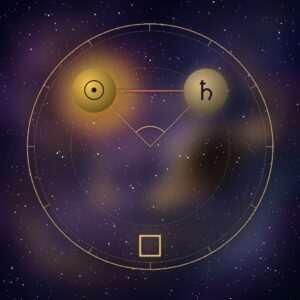
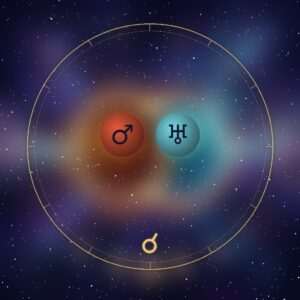

Two planets at the same degree of the same sign are not two planets any more. They act as one. That is a conjunction. It is the only aspect where the angle between two bodies is zero.
This page counts conjunctions. Which pairs meet, how many charts hold each one, and which pair has never met in living memory. Every number here comes from sixty years of births we worked out ourselves. The method is written out below, so you can check it.
What does a conjunction mean in astrology?
A conjunction is two planets at, or very near, the same point of the zodiac. The symbol is ☌. Charts write it as “Mars conjunct Jupiter” or “Mars ☌ Jupiter”.
The gap between the two is the orb: the margin of error allowed around the exact angle. With a 6° orb, Mars at 20° Leo and Jupiter at 25° Leo count as conjunct. Our page on orbs in astrology sets out how much that choice changes.
Here is what matters when you read a chart. The other four major aspects put two planets in other signs, so each keeps its own voice. A square is an argument. A trine is a deal. A conjunction is neither. No gap is left for either one to speak across, so the two blend.
Blending is not the same as ease. Venus conjunct Jupiter mixes warmth with scale. Mars conjunct Saturn mixes drive with brakes, and those two pull against each other in one spot. Older texts call this aspect neutral for that reason. The flavour comes from the planets, not from the angle.
Claudius Ptolemy, writing in the second century in the work known as the Tetrabiblos, did not class it with the aspects at all. An aspect for him was a ray cast across the circle. Two planets in one spot cast no ray. Later writers folded it in. That old split still explains why this angle acts unlike the other four.
How we counted sixty years of births
The method is short. Repeating it is the point.
We took everyone born between 1 January 1950 and 1 January 2010, the people alive today. We stepped through those sixty years at a fixed pace, one reading every 47 minutes. At each step we worked out where ten bodies stood in the tropical zodiac: Sun, Moon, Mercury, Venus, Mars, Jupiter, Saturn, Uranus, Neptune and Pluto. Ten bodies give 45 pairs. For each pair we took the gap. A gap of 6° or less counted as a conjunction. We ran the whole count twice, on two separate engines: the Swiss Ephemeris and the astronomy-engine library. The two agree to the first decimal on every pair.
One number anchors the rest. A 6° orb covers 12° of the 360° circle, one part in thirty. Two bodies with no tie between them would meet 3.3 % of the time. That is the chance rate. Any pair above it is held close by the way it orbits. Any pair below it is kept apart.
Which planets meet most, and why
The 45 pairs are nowhere near equal. Here are the ten we met most, with the share of charts holding each one at a 6° orb.
| Pair | Share of charts (orb 6°) | At orb 3° | At orb 8° | Reason |
|---|---|---|---|---|
| Sun-Mercury | 17.4 % | 8.6 % | 23.5 % | Mercury never leaves the Sun’s side |
| Uranus-Neptune | 10.3 % | 5.2 % | 13.7 % | Both crawl; they stayed close for years |
| Mercury-Venus | 9.9 % | 5.3 % | 13.3 % | Both locked near the Sun |
| Sun-Venus | 9.2 % | 4.6 % | 12.3 % | Venus never leaves the Sun’s side |
| Uranus-Pluto | 7.9 % | 4.1 % | 10.3 % | Two slow bodies, a long shared passage |
| Venus-Mars | 6.8 % | 3.6 % | 9.0 % | Close orbits, frequent catch-ups |
| Mercury-Mars | 5.6 % | 2.7 % | 7.5 % | Mercury is fast and keeps lapping Mars |
| Sun-Mars | 5.4 % | 2.7 % | 7.2 % | Mars moves slowly against the Sun |
| Jupiter-Uranus | 4.6 % | 3.0 % | 5.3 % | Slow pair, long conjunctions |
| Jupiter-Neptune | 4.2 % | 1.9 % | 5.2 % | Slow pair, long conjunctions |
Now look at the bottom of the same list.
| Pair | Share of charts (orb 6°) | Reason |
|---|---|---|
| Neptune-Pluto | 0.00 % | Last conjunction in 1892; none in our window |
| Saturn-Pluto | 2.3 % | Roughly 33 years between meetings |
| Saturn-Uranus | 2.6 % | Roughly 45 years between meetings |
| Mars-Neptune | 2.8 % | Below chance: Mars laps Neptune quickly |
Neptune-Pluto answers a question Google is asked a great deal. The rarest pairing among the ten bodies is Neptune with Pluto, and nobody born since 1950 has one. The two met at the close of the 1800s and will not meet again before the 2400s. Across all sixty years the count was zero.
Every pair holding the Moon landed between 3.27 % and 3.35 %. That is the chance rate, give or take a few hundredths. The Moon rounds the zodiac in 27 days and meets each body on its own clock, tied to none of them. The Moon is the control group hiding inside the data.
Two forces explain the whole table. Mercury and Venus orbit inside the orbit of the Earth. From here they never stray far from the Sun, so meetings with it are forced. Uranus, Neptune and Pluto crawl. Once they line up they stay lined up for years, and everyone born in those years carries the same pair. Uranus met Neptune in 1993, and every chart from the early 1990s shows it. A whole cohort shares that spot. That is why the slow pairs are read as marks of an era, not of a person.
Five of these pairs have their own pages: Sun conjunct Mercury, Sun conjunct Venus, Mercury conjunct Venus, Venus conjunct Neptune and Saturn conjunct Neptune.
The Great Conjunction, and why it got a name
One pair has carried its own title for centuries: Jupiter with Saturn, the Great Conjunction. The two meet about every twenty years, and each meeting has been used to date an age.
Our count puts it in 3.2 % of charts at a 6° orb, a touch under the chance rate. The name has nothing to do with how common it is. It comes from the pair’s role in medieval and Persian astrology, where the cycle of these two slowest visible planets marked shifts of rule and of fortune for whole countries. The 2020 meeting in Aquarius drew the same attention for the same reason.
Keep the scale in mind when you read your own chart. A Jupiter-Saturn conjunction is shared with everyone born within about a year of you. A Moon-Mars conjunction is yours, since the Moon moves 13° a day and shifts by a full degree in two hours. The faster the pair, the more personal the placement.
That rule runs the other way as well, and it explains the opposition and the rest of the family. Speed decides how rare an angle is, and rarity decides how much of it belongs to you alone.
Cazimi and combustion: the Sun’s conjunctions are a special case
The Sun is not one planet among ten here. It burns whatever stands next to it, and the old texts have two exact words for what follows.
A planet within about 8°30′ of the Sun is combust, which means burned up. Older texts read it as weakened, its business lost in the Sun’s glare. A planet within 17 arcminutes of the Sun’s centre is cazimi, from the Arabic for “in the heart”. That planet sits inside the Sun rather than beside it, and the verdict flips. Cazimi is the strongest place a planet can hold.
Seventeen arcminutes is a tiny window. It is about half the width of the full Moon.
The counts follow the shape of the sky. In our count, 24.2 % had Mercury combust and 0.81 % had Mercury cazimi. For Venus the figures were 12.65 % combust and 0.43 % cazimi. One chart in four holds a burned Mercury. About one in 120 holds one in the heart of the Sun.
The share is not the same all year: with the Sun in Capricorn, Mercury is burned in more than one chart in four.
William Lilly set out both states in Christian Astrology in 1647. He warned his readers not to mix them up, since one degree flips the reading from ruined to raised up. Chris Brennan and Demetra George, both working from Hellenistic sources, have put cazimi back into common use over the last twenty years.
You can watch one happen. On 4 November 2026 at 14:25 UT, the Sun and Mercury both stand at 12°11′ Scorpio. The gap at that moment is one thousandth of a degree. Mercury is retrograde, which means it runs backwards against the stars from where we watch, so it passes between the Earth and the Sun.
Applying or separating: which way the conjunction is moving
A conjunction is a moment in a move, not a fixed state.
Two planets travel at their own speeds, so the gap between them shifts every day. While that gap is still closing toward 0°, the aspect is applying. Once it opens again, the aspect is separating. An applying pair is read as the stronger of the two, because what it names has not finished arriving.
Vettius Valens built much of his timing work on this split, in his Anthologies, written in Greek in the second century. Lilly used it as the spine of his judgements in 1647. An applying pair promised the matter would come about. A separating pair said it was already done.
Your birth chart is frozen at one instant, so a conjunction in it applies or separates for life. To tell which, compare the daily speeds of the two and see whether the faster one is closing on the slower or leaving it behind.
A conjunction you can check yourself
Writing on this subject is full of vague meetings in the sky. Here is one with a time stamp.
Mars and Jupiter meet exactly on 16 November 2026 at 06:22 UT, both at 25°53′ Leo. An exact aspect is one where the angle is right to the arcminute. Mars moves about half a degree a day, Jupiter a tenth of that, so Mars closes the gap and then pulls ahead.
How long the pair counts as conjunct rests wholly on the orb you keep. At a 1° orb the conjunction runs six days, from 13 to 19 November. At a 3° orb it runs seventeen days. At 6° it runs thirty-three days, from 31 October to 3 December. At 10° it runs fifty-seven days, and you are reading the same meeting across most of two months. Our page on orbs lays the full table out.
Same two planets, same sky, and a span running from under a week to close to two months. The sky did not change. The rule did.
How to find the conjunctions in your own chart
- List your ten bodies with their sign and degree. Any chart tool gives you this.
- Look for two bodies in the same sign. Subtract the smaller degree from the larger.
- If the gap is 6° or less, you have a conjunction at the standard orb. Under 3° it is tight and carries real weight. Under 1° the old texts call it partile, which means exact to the degree.
- Watch the sign borders. Mercury at 28° Taurus and Venus at 2° Gemini are 4° apart and conjunct, though they sit in two signs. This is called an out-of-sign, or dissociate, pair. Chart software handles it in different ways.
- Count how many bodies are in it. Three or more bunched together stop being a pair and make a stellium, which is read as one block.
- Name the planets before you name the angle. Mercury conjunct Saturn and Venus conjunct Jupiter share a shape and nothing else. Our pages on Mercury and Venus say what each one brings.
Robert Hand made that sixth step the rule of his 1976 book Planets in Aspect. The angle sets the manner, the planets set the matter. Liz Greene reads the same way: one knot, in which two parts of the mind cannot be pulled apart.
Frequently asked questions
What is a conjunction in astrology?
Two planets at or near the same degree of the zodiac, an angle of 0°. They fuse and act as one spot rather than two. Most charts count a gap of up to 6° or 8°.
Is a conjunction good or bad?
Neither on its own. The angle gives the fusion, the planets give the content. Venus with Jupiter reads as ease. Mars with Saturn reads as strain. Same angle, other texture.
What is the rarest conjunction in astrology?
Neptune conjunct Pluto. It last fell in 1892 and shows up in no birth between 1950 and 2010. Saturn conjunct Pluto is the rarest that living people hold, at 2.3 % of charts.
Which conjunction is the most common?
Sun conjunct Mercury, in 17.4 % of charts at a 6° orb. Mercury never shows up more than about 28° from the Sun, so this is the only major aspect the two can form.
Which planets are in conjunction in 2026?
Mars meets Jupiter on 16 November 2026 at 25°53′ Leo, exact at 06:22 UT. Before that, the Sun and Mercury meet exactly on 4 November 2026 at 12°11′ Scorpio. That one is a cazimi.
What does cazimi mean?
A planet within 17 arcminutes of the Sun’s centre, in the heart of the Sun. The old texts read it as the strongest spot there is. Combustion is the burned state, from 17 arcminutes out to about 8°30′.
Can a conjunction cross two signs?
Yes. Two planets 4° apart across a sign border are conjunct by degree. Older texts call this dissociate and read it as weaker, since the two no longer share an element or a mode.
How many conjunctions does a chart normally hold?
Two, on average. We counted 1.98 per chart at a 6° orb, and 88.4 % of charts held at least one. Widen the orb to 8° and the average climbs to 2.63.
See your own conjunctions read properly
Counting is easy. Reading is the work. An Astrovision natal chart study names every conjunction you hold, gives the exact orb of each, says whether it applies or separates, and sets out what those two planets do as one voice. You get it in writing and as a personal audio guide.