
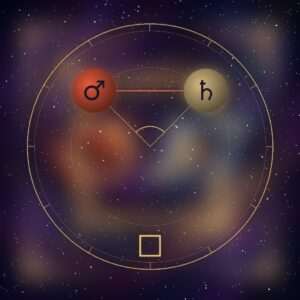
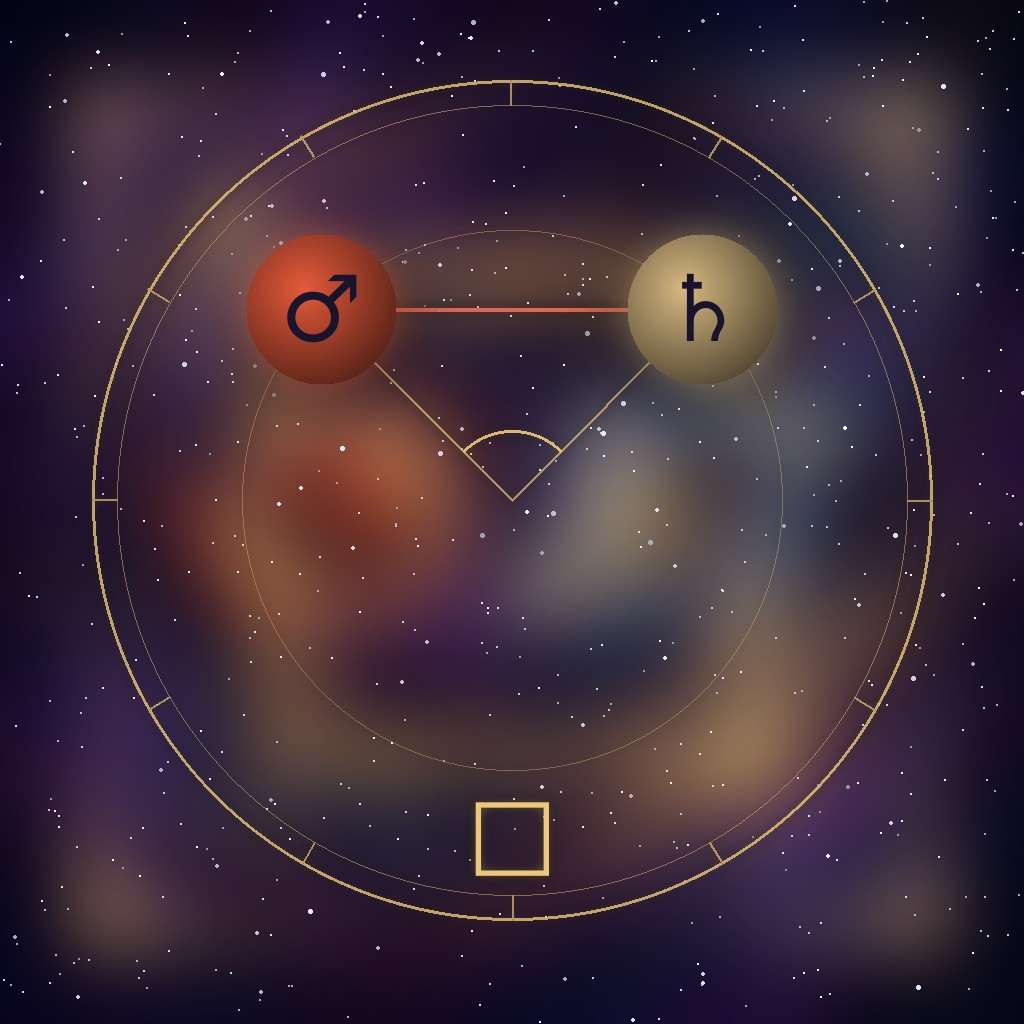
Mars square Saturn is the aspect of the foot on the gas and the foot on the brake. Most years, the sky forms it for about three weeks and moves on. But in some years, Mars turns back while the square is still in force. Then the same clash returns three times and stays in orb for about four months, spread over six or seven.
We measured how rare those long passes are, and how many people are born with the square. The answer changes the usual story. Our 60-year sample of births from 1950 to 2010 shows the square in 7.4 percent of charts. Over 800 years, the figure is 9.0 percent. Much of the gap comes from those rare triple passes, and the second half of the 20th century had none.
First, the words. An aspect is an angle between two planets, seen from Earth. A square is an angle of 90 degrees, a quarter of the circle. The orb is the gap we accept on each side of the exact angle. With an 8 degree orb, a square counts any gap from 82 to 98 degrees. Our guide to astrological aspects covers the other angles.
What Mars square Saturn means in a natal chart
A natal chart is a map of the sky at the moment you were born. Start with the two planets. Mars is the planet of drive, anger, courage and the urge to act now. Our guide to the planet Mars explains how it works in a chart. Saturn is the planet of limits, time, duty and the slow work that lasts. You can read more in our guide to the planet Saturn.
The square links them with friction. In the old texts, this pair was the hardest one to read. Ptolemy, the Greek astronomer who wrote the Tetrabiblos in the second century, counted Mars and Saturn as the two malefics. That word means the planets that bring trouble when they are poorly placed. Mars was too hot and dry. Saturn was too cold. When they meet at a hard angle, the tradition sees heat pressed against cold.
Modern writers turned that into a picture of the inner life. Reinhold Ebertin, in The Combination of Stellar Influences (1940), linked Mars and Saturn contacts with held-back energy, and also with endurance and toughness. Liz Greene, in Saturn: A New Look at an Old Devil (1976), read Saturn as the place where we feel blocked and then build real skill. Sue Tompkins, in Aspects in Astrology (2002), treats a square as a source of tension that pushes for action. None of them reads it as a curse.
Put together, the tradition reads Mars square Saturn like this:
- A strong drive that meets a wall, inside or outside the person.
- Anger that is held in, then let out in a burst.
- Bursts of effort followed by doubt, then a second, more careful start.
- A slow build of stamina, because each push meets resistance.
- Respect for rules and fear of them, at the same time.
That is a reading, not a fact about any person. Two people with the same square can live it in very different ways. The signs, the houses and the other aspects in the chart change the tone.
Waxing or waning: which way the square faces
There are two kinds of Mars square Saturn. Mars moves faster, so it laps Saturn about once every two years. On the way out from their meeting, Mars reaches 90 degrees ahead of Saturn. That is the waxing square. Later, Mars comes back around to 90 degrees behind Saturn. That is the waning square.
Some modern astrologers read the waxing square as a crisis of action: the new push meets its first test. They read the waning square as a crisis of belief: an old way of working must be cleared out. This is a modern layer. Ptolemy did not draw that line.
Do you need a birth time?
Mostly, no. Mars moves less than one degree a day. Saturn moves even less. So the date of birth tells you if the square is there. A birth time matters only for the houses, which are the twelve areas of life in a chart. It also matters if you were born on the very day the orb opened or closed.
How common is Mars square Saturn in a birth chart?
We counted it two ways. First, we drew 200,000 moments at random between 1950 and 2010. For each one, we took the place of Mars and Saturn from the Swiss Ephemeris, a standard tool for planet positions. We used the tropical zodiac, the one tied to the seasons. Then we checked the gap between the two planets.
Second, we stepped through the same years every six hours and counted the share of time in orb. Both routes agree.
| Orb | Share of births, 1950 to 2010 | Roughly |
|---|---|---|
| Within 8 degrees | 7.4 percent | One chart in 13. |
| Within 3 degrees | 3.0 percent | One chart in 34. |
A tight orb of 3 degrees is the one most astrologers would call strong. So about one person in 34 born in those years has a close Mars square Saturn.
Why your birth decade matters
The share was not flat across the years. With an 8 degree orb, it moved like this:
| Birth decade | Share with the square |
|---|---|
| The 1950s | 6.9 percent of births. |
| The 1960s | 5.8 percent of births. |
| The 1970s | 7.1 percent of births. |
| The 1980s | 9.5 percent of births. |
| The 1990s | 5.8 percent of births. |
| The 2000s | 9.3 percent of births. |
A ten-year slice holds only about ten passes. The speed of Mars at each pass changes its length, and one long pass lifts a whole decade. That is what happened in the 2000s, as a later section shows.
The long view: 800 years
Sixty years is a short window for a pair like this. So we ran the same count from 1600 to 2400, one step a day. Over those 800 years, the square holds 9.0 percent of the time with an 8 degree orb, and 3.4 percent with a 3 degree orb.
We also split the 800 years into blocks of 50 years. The lowest block of all was 1950 to 1999, at 7.1 percent. The highest blocks reach about 11.1 percent, in 2050 to 2099 and again in 2250 to 2299. Anyone born from 1950 to 1999 was born in the quietest stretch for this aspect in eight centuries.
Three weeks most years: the rhythm of the square
Mars and Saturn meet about every two years. Each lap gives one waxing square and one waning square. That works out to about one Mars square Saturn per year.
Most of the time, the pass is short. Mars sweeps through the 16 degree window and leaves. From 1950 to 2009, we found 62 separate stretches in orb. The shortest lasted 19 days. The middle value, the median, was 24.5 days. In plain terms, a normal Mars square Saturn lasts three to four weeks from start to end of the 8 degree orb.
The exact moment, when the angle is 90 degrees to the minute, falls near the middle. Astrologers pay most attention to the days on either side of it.
When Mars turns back: the triple passes
From Earth, planets sometimes appear to move backwards against the stars. That is what retrograde means. It is an effect of our point of view, as Earth passes a slower planet. Mars turns retrograde for about ten weeks, roughly every 26 months.
If Mars turns back while it sits near the square, it crosses the exact angle again. Then it turns forward and crosses a third time. Astrologers call this a triple pass. The clash that normally lasts three weeks now runs for months.
We listed every exact square from 1900 to 2100. Then we grouped the ones that come back within a few months. Here is what we found:
| Triple pass | Exact dates in UTC | Signs |
|---|---|---|
| 2005 into early 2006 | July 31, November 18 and December 28, 2005. | Mars in Taurus, Saturn in Leo. |
| 2020 into early 2021 | August 24 and September 29, 2020, then January 13, 2021. | Mars in Aries and Taurus, Saturn in Capricorn and Aquarius. |
| The next one, 2039 into 2040 | September 22, 2039, then January 2 and March 16, 2040. | Mars in Cancer, Saturn in Libra. |
In those 200 years, there are ten triple passes. They come in clumps. There is one in 1939, then none until 2005. Then come 2020, 2039 and 2054, and five more between 2073 and 2093. Only one of the ten falls inside the 1950 to 2009 window. That is the main reason our 60-year share sits below the 800-year share.
The time in orb grows a lot. In 2020 and 2021, Mars and Saturn spent about 127 days within 8 degrees of the square. The run began on August 4, 2020, and ended on February 2, 2021, with a break of about eight weeks in late autumn. In 2005, the total was about 120 days, between mid-July 2005 and mid-January 2006, again with a break. A normal pass gives 20 to 30 days.
For births, this has a plain meaning. A child born in the second half of 2005, or between August 2020 and January 2021, had a much better chance of Mars square Saturn than a child born in a quiet year.
Mars square Saturn transit: dates for 2024 to 2030
A transit is the real sky today, compared to your birth chart or to itself. When the moving Mars squares the moving Saturn, astrologers talk about a collective Mars square Saturn transit. When it squares your own natal Saturn, the transit is personal.
Here are the exact sky-to-sky squares, with the time in UTC and in New York:
| Exact square | New York time | Signs |
|---|---|---|
| August 16, 2024, at 05:30 UTC. | 1:30 a.m. EDT, the same day. | Mars in Gemini, Saturn in Pisces, at 17 degrees. |
| December 9, 2025, at 00:15 UTC. | 7:15 p.m. EST on December 8. | Mars in Sagittarius, Saturn in Pisces, at 25 degrees. |
| September 1, 2026, at 09:58 UTC. | 5:58 a.m. EDT, the same day. | Mars in Cancer, Saturn in Aries, at 13 degrees. |
| December 23, 2027, at 04:00 UTC. | 11:00 p.m. EST on December 22. | Mars in Capricorn, Saturn in Aries, at 21 degrees. |
| September 21, 2028, at 11:58 UTC. | 7:58 a.m. EDT, the same day. | Mars in Leo, Saturn in Taurus, at 10 degrees. |
| January 5, 2030, at 12:42 UTC. | 7:42 a.m. EST, the same day. | Mars in Aquarius, Saturn in Taurus, at 18 degrees. |
| October 16, 2030, at 01:06 UTC. | 9:06 p.m. EDT on October 15. | Mars in Virgo, Saturn in Gemini, at 8 degrees. |
Each of these is a single pass. Mars does not turn back near the square in any of them. So each one lasts about three weeks in an 8 degree orb. The September 2026 square, for example, ran in orb from about August 21 to September 13.
Look at the gaps between passes. They alternate: about nine months, then about 16. After September 2026, the next exact square comes on December 23, 2027. Saturn sits in Aries for both the 2026 and the 2027 passes. Our page on Saturn in Aries explains what the tradition sees in that placement.
Transit Mars square your natal Saturn
The personal transit is far more frequent. Mars goes around the whole zodiac in about two years. On the way, it squares your natal Saturn twice: once from each side. Each contact lasts a few days in a tight orb. If Mars turns retrograde nearby, you get three hits instead of one.
The tradition reads these days as a time of delays and friction. Tasks take longer. Patience runs short. Many astrologers suggest slow, steady work during the pass, rather than a fight with the wall. It is a reading of the sky, not a forecast of events.
The reverse transit, Saturn square your natal Mars, is much slower. Saturn needs about 29 years to circle the zodiac. It squares your Mars about twice in that time, and each contact can last months, with up to three exact hits. Some astrologers read it as a long test of stamina.
Mars square Saturn in synastry
Synastry is the comparison of two birth charts, to see how two people interact. Here, the Mars of one person sits about 90 degrees from the Saturn of the other. Our guide to synastry charts shows how these contacts are read.
The tradition sees friction of pace. The Mars person wants to move now. The Saturn person wants to wait, check and plan. The Mars person can feel held back. The Saturn person can see the Mars person as rash. Over time, the same contact can teach both: one learns to pace, the other learns to act.
How common is it? We paired 60,000 random birth moments from 1950 to 2010. One person’s Mars squared the other’s Saturn within 8 degrees in 8.9 percent of pairs. Counting both directions, the contact appeared in 17.0 percent of pairs. For people born within five years of each other, the figure was 15.8 percent. So about one couple in six has it one way or the other. It is a common contact, not a rare warning sign.
Reading it well: what changes the tone
A square is one thread in a whole chart. Our guide to the square aspect gives the general rules. Here are the points astrologers check first for this pair.
- The orb. A square within 2 or 3 degrees is read as strong. One at 7 or 8 degrees is read as faint.
- The signs. Mars in Aries or Scorpio is at home, and so is Saturn in Capricorn or Aquarius. Planets at home are read as steadier.
- The houses. Mars in the tenth house, the house of career, squaring Saturn in the first, puts the friction in work and self-image.
- Other aspects. A trine from Jupiter to either planet is read as a release valve.
- Waxing or waning. As above, the direction of the square sets the kind of test.
William Lilly, in Christian Astrology (1647), gave each planet its own orb rather than one rule for all. Modern astrologers mostly use a fixed orb for each aspect. We used 8 and 3 degrees here, and we said so, so you can redo the count.
Stephen Arroyo, a modern astrologer, reads the planets as kinds of energy rather than as fate. Seen that way, this square does not promise ease. It points to the place where steady work pays most.
One last reminder. Astrology is not a science. These are readings drawn from a long tradition, not proven facts about character or health. The counts and dates above are astronomy. What they mean is up to the tradition and to you.
Frequently asked questions
What does Mars square Saturn mean in astrology?
It means Mars and Saturn sit about 90 degrees apart. The tradition reads it as drive meeting a limit, like a foot on the gas and a foot on the brake. It is linked with frustration, held-in anger and, over time, real stamina.
How common is Mars square Saturn in a birth chart?
About 7.4 percent of births from 1950 to 2010 have it within an 8 degree orb, or one chart in 13. Within 3 degrees, the figure is 3.0 percent. Over 800 years, the share with an 8 degree orb is 9.0 percent.
How long does a Mars square Saturn transit last?
Most passes last three to four weeks in an 8 degree orb. The median from 1950 to 2009 was 24.5 days. When Mars turns retrograde near the square, the contact repeats three times and can stay in orb for about four months in total.
When is the next Mars square Saturn?
After the pass of September 1, 2026, the next exact square is on December 23, 2027, at 04:00 UTC. That is 11:00 p.m. EST on December 22 in New York. The next triple pass begins on September 22, 2039.
Is Mars square Saturn bad in synastry?
It is not a verdict. The tradition reads it as a clash of pace between someone who acts fast and someone who waits. About one couple in six born from 1950 to 2010 has it in one direction or the other, so it is a common contact.
Go deeper with your personal Astrovision report
Reading about astrological concepts is a great start, but nothing compares to hearing how they apply directly to you. Our users love our audio-first approach, calling it “friendly, personal, and easy to understand.” While this article gives you the “what,” a personal report gives you the “so what.” Discover your unique path with an Astrovision report—your personal ‘user manual’ delivered in our celebrated podcast format.