
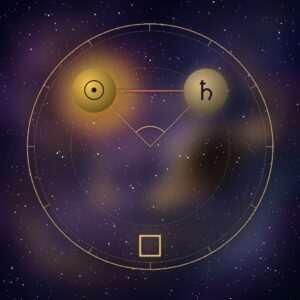
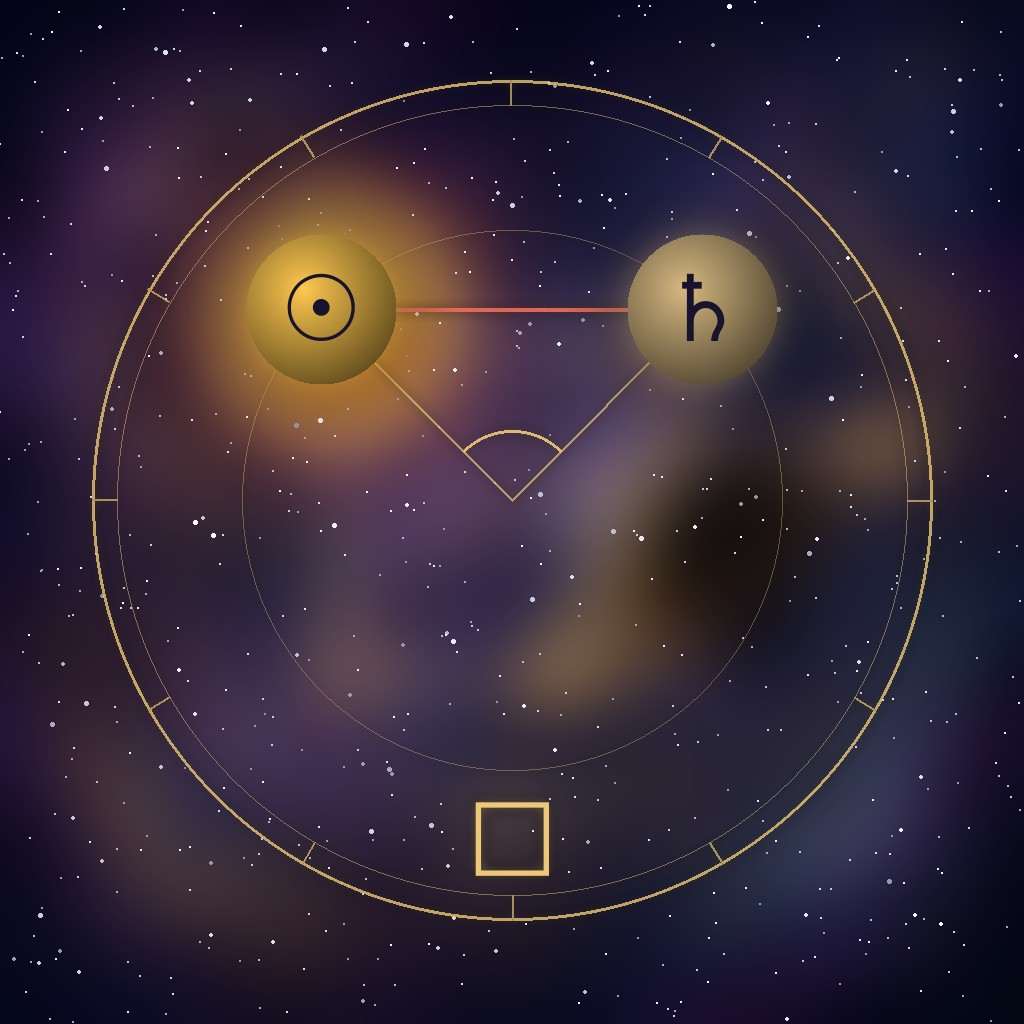
On the morning of July 6, 2026, New York time, the Sun reached 14°23′ Cancer. Saturn stood at 14°23′ Aries, exactly a quarter of the sky away. Astrologers call this Sun square Saturn. Anyone born that week carries it in their birth chart. The sky forms it again on December 29, 2026, with the Sun in Capricorn.
The two birthday windows for this square are not fixed. They slide about two weeks later every year. Over Saturn’s 29-year lap around the zodiac, they sweep past every date. So no birthday owns this square. Your birth year decides, not your birth date alone.
An aspect is an angle between two planets, measured along the band of sky where the Sun, Moon and planets travel. A square is the 90° aspect: the two bodies sit a quarter of the circle apart. The orb is the gap an astrologer allows around the exact angle before the link stops counting. We use two orbs here: 8°, a wide one, and 3°, a tight one. William Lilly gave each planet its own orb in Christian Astrology (1647), so the choice has always varied by school. Our guide to how astrological aspects work lays them all out in one place.
What Sun square Saturn means in a birth chart
Picture your chart as a house with twelve rooms. Each room covers one area of life, and the planets are the furniture. Your birth chart, cast for the moment you were born, is the floor plan of that house.
The Sun is the main lamp. It stands for your core self, your will and the way you want to shine. It asks: “Who am I, and what am I here to do?” Our page on the Sun’s role in your chart explains it in full.
Saturn is the load-bearing wall. It stands for limits, time, duty and the slow work that makes things last. It asks: “What is real, and what will it cost?” Our page on Saturn’s meaning and purpose covers the planet itself.
Put the lamp at a right angle to the wall, and the light keeps hitting a hard surface. The wish to shine meets a voice that says “not yet” or “prove it first.”
The old writers saw squares this way too. In the Tetrabiblos, written in the second century, the Greek astronomer Ptolemy sorted the angles into harmonious ones and discordant ones. He placed the square with the discordant angles. Sue Tompkins, in Aspects in Astrology (2002), reads the square as friction that demands action. Our page on the square and how it works goes deeper.
The gifts, as the tradition describes them
Liz Greene, in Saturn: A New Look at an Old Devil (1976), reads it as the place where we feel lack or fear, and where steady effort can turn that weak spot into real strength. Applied to the Sun, this gives the best side of the square. People with it are said to earn their confidence instead of borrowing it. They know how to wait, plan and finish.
Reinhold Ebertin, in The Combination of Stellar Influences (1940), links Sun and Saturn with restraint, a sense of duty and endurance. Stephen Arroyo writes of Saturn as a teacher of reality.
The hard side
The same wall can feel like a ceiling. The tradition links this square with self-doubt, a harsh inner critic and a fear of being seen to fail. Some feel they need permission to shine. Others push too hard to prove their worth. The old books also tie the Sun to the father and Saturn to authority, so this square has long been read as a strained or distant tie with a parent or boss. That is a reading, not a forecast.
On forums where people share their charts, two stories come back: a slow start with a late bloom, and a stamina that showed up after years of effort. Both fit Saturn as the planet of time.
How common is Sun square Saturn? About one chart in eleven
About 9 births in 100 have the Sun within 8° of a square to Saturn. In the tight 3° orb, the share drops to about 3 in 100, or roughly one chart in thirty.
| How we counted | Orb of 8° | Orb of 3° |
|---|---|---|
| 200,000 random moments, 1950 to 2010 | 8.97% of births | 3.31% of births. |
| Every 12 hours, 1950 to 2010, second code library | 8.90% of births | 3.35% of births. |
| Every day, 1613 to 2408, 27 Saturn laps | 8.90% of births | 3.33% of births. |
Here is how we got these numbers, so anyone can check them. We used the Swiss Ephemeris, the planet tables behind most astrology software, with the tropical zodiac. We drew 200,000 moments at random between 1950 and 2010 and counted how many had the Sun within the orb of a square to Saturn. A second draw gave 8.93% and 3.32%. Then we checked by another route. A different set of planet formulas, the free astronomy-engine library, sampled the sky every 12 hours over the same years. A daily count over 27 full Saturn laps, from 1613 to 2408, agrees too.
Your birth decade barely moves the odds. The share ranged from 8.55% for births of the 1990s to 9.51% for births of the 1970s.
Why the answer is close to 9%
You can work the number out on the back of an envelope. The Sun gains on Saturn by a little less than one degree a day. It takes about 17 days to cross the 16° band around each square, 8° on each side. The Sun passes two squares in each lap around Saturn. A full lap takes about 378 days. Two windows of 17 days in a cycle of 378 days come to about 9% of the time.
From 1950 to 2010, the 8° window lasted 16.2 to 17.4 days, the 3° window 6.1 to 6.5 days, and a full lap 378.1 days on average.
You do not need a birth time to know if you have this square. Both bodies move slowly, so your birth date is enough, except at the very edge of the orb. The Moon is different: its aspects need a birth time.
Why every birthday gets a turn
The lap takes 378 days, not 365. So each window opens about 13 days later than it did the year before. In our list, the shift ranges from 11 to 15 days, because Saturn’s speed changes along its orbit.
The windows tour the whole calendar in about 29 and a half years, the length of Saturn’s own lap around the zodiac. Over a long span, each calendar date falls inside a window in about 9% of years. We tested four dates spread across the year, from 1600 to 2400. Each one came out between 8.75% and 9.13% of years.
So the real question is “Was my birthday inside a window in my birth year?” The table below answers it for births from 1982 to 2006. Dates use the 8° orb and Universal Time (UTC), the clock astronomers use.
| Year of birth | First window | Second window |
|---|---|---|
| 1982 | January 4 to January 20 | June 29 to July 17. |
| 1983 | January 16 to February 1 | July 12 to July 30. |
| 1984 | January 28 to February 13 | July 24 to August 10. |
| 1985 | February 8 to February 24 | August 6 to August 23. |
| 1986 | February 20 to March 8 | August 18 to September 4. |
| 1987 | March 3 to March 20 | August 30 to September 16. |
| 1988 | March 14 to March 30 | September 10 to September 27. |
| 1989 | March 26 to April 11 | September 22 to October 9. |
| 1990 | April 6 to April 23 | October 4 to October 21. |
| 1991 | April 18 to May 5 | October 16 to November 1. |
| 1992 | April 29 to May 17 | October 27 to November 12. |
| 1993 | May 12 to May 29 | November 8 to November 24. |
| 1994 | May 25 to June 11 | November 20 to December 6. |
| 1995 | June 7 to June 24 | December 2 to December 19. |
| 1996 | June 19 to July 7 | December 14 to December 30. |
| 1997 | July 3 to July 20 | December 27 to January 12, 1998. |
| 1998 | July 17 to August 4 | No second window. See the row for 1997. |
| 1999 | January 9 to January 25 | August 1 to August 18. |
| 2000 | January 23 to February 8 | August 14 to September 1. |
| 2001 | February 4 to February 21 | August 29 to September 15. |
| 2002 | February 19 to March 7 | September 13 to September 30. |
| 2003 | March 5 to March 21 | September 28 to October 14. |
| 2004 | March 18 to April 4 | October 11 to October 28. |
| 2005 | April 2 to April 19 | October 25 to November 11. |
| 2006 | April 16 to May 3 | November 8 to November 25. |
If your birthday sits on the first or last day of a window, your birth time decides. Notice the drift down each column: a window that opened on June 29 in 1982 opened on July 12 in 1983.
The two squares are not evenly spaced
The two squares do not fall six months apart. From 1950 to 2010, the gap from the first square to the second averaged 176.6 days. The gap from the second square back to the first averaged 201.5 days.
The reason is retrograde motion. Seen from Earth, planets sometimes seem to move backwards for a while. That is what retrograde means. It is a trick of viewpoint, like a slow car that seems to roll back as you pass it. Saturn turns retrograde for about four and a half months each year, and that stretch is centered on the date when the Sun stands opposite it. While Saturn backs up, the Sun closes the gap faster, so that half of the lap is shorter.
At the squares themselves, Saturn is always moving forward, and slowly. In all 116 squares from 1950 to 2010, Saturn was direct, moving only about a thirtieth of a degree a day.
Opening square, closing square
The square that follows the Sun’s meeting with Saturn is the opening, or waxing, square. The one that follows the opposition is the closing, or waning, square.
A common modern reading treats the opening square as a push to build, and the closing square as a push to take stock. In July 2026, the Sun in Cancer stood 90° ahead of Saturn in Aries: an opening square. In December 2026, the Sun in Capricorn stands 90° behind it: a closing square.
Reading your own Sun square Saturn
Start with the signs. A square usually links two signs three apart, such as Cancer and Aries. Both start a season, so the clash is between two styles of the same drive.
Then check how strong Saturn is in its sign. By the old rules followed by Ptolemy and by Lilly, Saturn is at home in Capricorn and Aquarius. It is exalted, meaning at its best, in Libra. It is weak in Cancer and Leo, the signs opposite its homes, and at its weakest in Aries, its sign of fall. The four squares from July 2026 to January 2028 all have Saturn in Aries. Our page on Saturn in Aries and what it means covers that placement.
Next, look at the houses, the rooms of the chart. The Sun’s house shows where you want to shine, and Saturn’s house shows where the wall stands. Houses need a birth time.
Last, look for help. By the usual reading, a trine or sextile from Jupiter or Venus softens the picture. One square never tells the whole story of a chart.
Sun square Saturn transit: when the sky forms it again
A transit is a planet’s current place in the sky, read against your birth chart or against the sky itself. The Sun squares Saturn in the sky twice a year. Each time, the 8° window lasts about 17 days. Here is each exact square from 2025 to 2030, found with the Swiss Ephemeris and narrowed to the minute.
| Exact moment, UTC | Sun | Saturn |
|---|---|---|
| June 22, 2025, 18:35 | 1°35′ Cancer | 1°35′ Aries. |
| December 17, 2025, 04:33 | 25°28′ Sagittarius | 25°28′ Pisces. |
| July 6, 2026, 10:47 | 14°23′ Cancer | 14°23′ Aries. |
| December 29, 2026, 23:27 | 8°15′ Capricorn | 8°15′ Aries. |
| July 20, 2027, 10:48 | 27°31′ Cancer | 27°31′ Aries. |
| January 12, 2028, 01:33 | 21°21′ Capricorn | 21°21′ Aries. |
| August 2, 2028, 17:57 | 10°57′ Leo | 10°57′ Taurus. |
| January 24, 2029, 11:06 | 4°45′ Aquarius | 4°45′ Taurus. |
| August 17, 2029, 06:41 | 24°39′ Leo | 24°39′ Taurus. |
| February 7, 2030, 04:17 | 18°25′ Aquarius | 18°25′ Taurus. |
For readers in the United States, the next one falls on the evening of December 29, 2026, at 6:27 pm New York time. The tradition reads these days as a reality check, when plans meet limits and effort counts more than charm. A sky transit matters most when it lands on a planet in your own chart.
Transit Saturn square your natal Sun
A slower, more personal version happens when Saturn in the sky squares the Sun in your birth chart. Saturn takes about 29 and a half years to circle the zodiac. On each lap, it squares your Sun twice, and it also meets it and opposes it.
Right now, Saturn is in Aries, so it squares the Sun of people born with the Sun in Cancer or Capricorn, at the same degree. Saturn re-entered Aries on February 14, 2026, at 00:11 UTC, which was the evening of February 13 in New York. It turned retrograde at 14°44′ Aries on July 26, 2026. It turns direct at 7°55′ Aries on December 10, 2026. It turns retrograde at 27°52′ Aries on August 9, 2027, direct at 21°01′ Aries on December 24, 2027, and leaves for Taurus on April 13, 2028.
So if your Sun sits between about 8° and 14° of Cancer or Capricorn, Saturn crosses the square three times in 2026 and 2027. Between about 21° and 27°, it crosses three times in 2027 and early 2028. Other degrees get a single pass.
If you were born with the square, there is a bonus pattern. Your Sun sits 90° from your Saturn. So when Saturn in the sky opposes its birth place, at about age 14 and a half, and when it returns there, at about age 29, it squares your Sun.
Sun square Saturn in synastry
Synastry is the art of laying one person’s chart over another’s to see how they get along. Our guide to synastry charts and how to read them walks through the method. Here, the timing rules no longer apply. Your Sun and your partner’s Saturn belong to two different moments, so any birth dates can produce the square.
We drew 100,000 random pairs of birth moments between 1950 and 2010. The first person’s Sun was within 8° of a square to the second person’s Saturn in 8.82% of pairs. Within 3°, it was 3.35%. The link can also run the other way, from the second person’s Sun to the first person’s Saturn, so the odds of having either one are higher.
By the tradition, the Saturn person acts like a teacher or a judge, and the Sun person can feel held back or not fully seen. Yet many astrologers count Saturn contacts among the signs of a lasting tie, because Saturn is the planet of time and commitment.
Frequently asked questions
What does Sun square Saturn mean in astrology?
It means the Sun and Saturn sat about 90° apart when you were born. By the tradition, your wish to shine meets a sense of limits, duty and doubt. The hard side is self-criticism and a slow start. The gift is confidence that is earned, patience and the power to build things that last.
How rare is Sun square Saturn in a birth chart?
It is fairly common. Among births from 1950 to 2010, about 9% had it within an 8° orb, or about one chart in eleven. Within a tight 3° orb, the share was about 3.3%, or roughly one chart in thirty.
What age is your Saturn square?
Saturn in the sky squares its own birth place twice per lap. In our sample of births from 1950 to 2010, the first square came at about age 7 and the second at about age 22. Saturn opposes its birth place at about age 14 and a half, and returns to it at about age 29.
What is considered a strong Saturn placement?
By the old rules used by Ptolemy and by William Lilly, Saturn is strongest in Capricorn and Aquarius, its home signs, and in Libra, its sign of exaltation. It is weakest in Cancer and Leo, its signs of detriment, and in Aries, its sign of fall.
When is the next Sun square Saturn transit?
The next exact square falls on December 29, 2026, at 23:27 UTC, with the Sun at 8°15′ Capricorn and Saturn at 8°15′ Aries. In New York, that is 6:27 pm the same evening. The one after that falls on July 20, 2027, at 10:48 UTC.
Go deeper with your personal Astrovision report
Reading about astrological concepts is a great start, but nothing compares to hearing how they apply directly to you. Our users love our audio-first approach, calling it “friendly, personal, and easy to understand.” While this article gives you the “what,” a personal report gives you the “so what.” Discover your unique path with an Astrovision report—your personal ‘user manual’ delivered in our celebrated podcast format.