
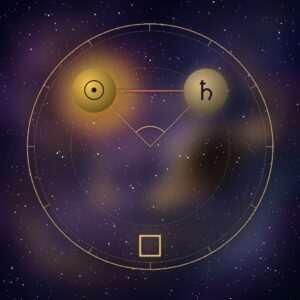
A synastry chart lays two birth charts on top of each other and lists every angle between them. Most guides treat each line of that list as a sign of fate. We did something else first. We asked what the list looks like for two people who have nothing to do with each other.
The answer surprised us. Take any two strangers. Compare only their Sun, Moon, Mercury, Venus and Mars. Use the orbs most chart tools use. On average, the two charts share about eight major aspects. More than half of all random pairs have a Sun and Moon link. More than half have a Venus and Mars link. Only about one pair in 5,000 has no major aspect at all.
So a synastry chart full of aspects is normal. What makes a chart stand out is not how many links it has. It is which ones, and how tight they are. This guide shows you how to read a synastry chart with that baseline in mind. It does not claim that a chart can predict how a couple will do. No test has ever shown that.
What is a synastry chart?
Your birth chart is a map of the sky at the time and place you were born. It shows where the Sun, the Moon and the planets stood in the twelve signs of the zodiac. For the signs and their true dates, see our guide to the zodiac signs.
A synastry chart is two of these maps drawn on one wheel. One chart sits on the inner ring. The other sits on the outer ring. Chart tools call this a bi-wheel, which just means a wheel with two rings. The word synastry comes from Greek. It means “stars together.” In synastry astrology, this chart is the main tool for comparing two people.
The chart gives you two kinds of facts. The first kind is aspects. An aspect is a set angle between two points on the wheel, such as 90 or 120 degrees. In a synastry chart, you look at the angles between one person’s planets and the other person’s planets. The second kind is house overlays. A house is one of twelve slices of the chart, each tied to a part of life, like home or work. A house overlay tells you where one person’s planet lands in the other person’s houses.
Synastry is not the only way to compare two people. A composite chart blends two charts into one new chart for the pair. That is a different tool with a different question. Synastry keeps the two people apart and asks how each one touches the other.
An old method with a clear first rule
The idea is far older than modern chart software. Ptolemy, the Greek astronomer, wrote the Tetrabiblos in the second century. In book four, in the chapter on marriage, he compares the charts of husband and wife. His rule is short. The Sun and the Moon are the two lights of a chart. When the lights of the two charts stand in trine or sextile to each other, he says, marriages last. When they stand in square, in opposition, or in signs that cannot see each other, the bond breaks on small pretexts.
Ptolemy adds one more line. The best case, he says, is the husband’s Moon in good aspect to the wife’s Sun. That is the root of the Sun and Moon link that every synastry guide still puts first. Our page on the luminaries explains why the Sun and Moon carry that weight.
Later writers built on this. Vettius Valens, a second century astrologer, read love and friendship through Venus. William Lilly, in his 1647 book Christian Astrology, judged marriage from the seventh house and its ruler. In the twentieth century, Ronald Davison wrote a whole book called Synastry. Liz Greene, Stephen Arroyo and Robert Hand read the planets of two people as a talk between two minds, not as a verdict.
What a normal synastry chart contains
Here is the core of this guide. We wanted a fair baseline. So we drew two birth moments at random from eight hundred years of sky, from 1600 to 2400. We found each person’s Sun, Moon, Mercury, Venus and Mars. Then we counted the major aspects between the two sets. We did this for 300,000 pairs, and then for 200,000 more by a second route. The method is at the end of this page.
First, a word on orbs. An orb is the room you allow around an exact angle. A trine is 120 degrees. With an orb of 8 degrees, anything from 112 to 128 degrees counts. We used 8 degrees for the conjunction, square, trine and opposition, and 6 degrees for the sextile. Those are the orbs most chart tools use.
Five personal points in one chart, times five in the other, make 25 links to check. Here is how many aspects a random pair gets, on average, for each type.
| Aspect | Angle | Average count for two strangers |
|---|---|---|
| Conjunction | 0 degrees, the same spot | About 1.1 per pair. |
| Sextile | 60 degrees | About 1.7 per pair. |
| Square | 90 degrees | About 2.2 per pair. |
| Trine | 120 degrees | About 2.2 per pair. |
| Opposition | 180 degrees, across the wheel | About 1.1 per pair. |
| All five | Any of the above | About 8.3 per pair. |
The total is 8.3 aspects. The middle value, or median, is 8. Nearly three pairs in four land between 6 and 10. Only about one pair in 20 has four or fewer. Three pairs in ten have ten or more.
A few more facts from the same count:
- 95 percent of random pairs have at least one square or opposition between their personal planets.
- 98 percent have at least one trine or sextile.
- 57 percent have at least one conjunction.
- About one pair in 5,000 has no major aspect at all.
This is why two readings of the same couple can sound so different. Almost every pair has both easy and hard links. A reader who lists only the trines sees a dream match. A reader who lists only the squares sees a war. Both are looking at a normal chart.
Why the numbers come out this way
There is a simple reason. Two people born at random have no link between their skies. So the gap between one person’s Venus and the other’s Mars can be any angle, with equal odds. Our five aspects, with those orbs, cover 60 degrees out of every 180. That is one third of the circle. One third of 25 links is 8.3. The sky count and this simple math agree to the first decimal place.
That match matters. It means the count is not a quirk of our code. It is what the rule itself produces. Any reader who uses 8-degree orbs on five points will find about eight links between any two people, lovers or not.
Sun and Moon: Ptolemy’s rule, put to the test
The Sun and Moon link is the one most guides call a sign of deep bond. How rare is it? In our count, 55.6 percent of random pairs have a major aspect between one person’s Sun and the other’s Moon, in one direction or the other. For a conjunction or opposition alone, the figure is 17 percent. That is about one pair in six.
We then tested Ptolemy’s own rule, sign by sign, the way he wrote it. He asked for the two lights in trine or sextile, which means four or two signs apart. He warned against a square, an opposition, or signs one or five apart, which he called disjunct. Disjunct signs are signs that cannot see each other.
| Case, for two people picked at random | Share of pairs |
|---|---|
| His best case: husband’s Moon in trine or sextile to wife’s Sun | 33.3 percent, one pair in three. |
| A good link in at least one direction | 55.6 percent, more than half. |
| A good link in both directions, his “exchange” | 11.1 percent, one pair in nine. |
| A bad link in at least one direction | 82.6 percent, four pairs in five. |
| A good link one way and a bad link the other way | 38.9 percent, two pairs in five. |
| At least one good link and no bad link at all | 16.7 percent, one pair in six. |
Look at the fifth row. Two pairs in five carry both Ptolemy’s sign of a lasting bond and his sign of a split. His rule, read strictly, gives a clean answer for only one pair in six. For the rest, the reader has to choose which line to trust. That choice comes from the reader, not from the chart.
The Moon side of this story has its own page. Our guide to moon sign compatibility shows how a Moon sign read from a noon chart gets the pair wrong for about one couple in five. If you want the phase of the Moon at each birth, see moon phase compatibility.
Venus and Mars: the pull everyone looks for
After the Sun and Moon, most people search for Venus and Mars. Venus is the planet of love and pleasure. Mars is the planet of drive and desire. A link between one person’s Venus and the other’s Mars is read as physical pull.
It is common. In our count, 55.6 percent of random pairs have a major Venus and Mars aspect, in one direction or the other. A conjunction, the link most guides rate highest, turns up in 8.6 percent of pairs. That is about one pair in 12.
Here is how the Venus and Mars link breaks down for two strangers, one direction at a time.
| Her Venus to his Mars, or the reverse | Chance for one direction |
|---|---|
| Conjunction | About 4.4 percent. |
| Sextile | About 6.7 percent. |
| Square | About 8.9 percent. |
| Trine | About 8.9 percent. |
| Opposition | About 4.4 percent. |
A square is twice as likely as a conjunction. That is not a mark of bad luck. There are two ways to be 90 degrees apart, and only one way to sit on the same spot. The same holds for the trine and the sextile.
Venus has its own rules that shape these odds inside one chart. It never strays more than about 47 degrees from the Sun. Our guide to Venus sign compatibility shows what that does to two Venus signs. For example, opposite Sun signs never share a Venus sign.
Tight orbs change the picture
Orbs are the one setting that most changes a synastry chart. Many readers take them from a tool without a thought. Yet the count moves a lot.
- With 8-degree orbs, two strangers share about 8.3 aspects.
- With 3-degree orbs, they share about 3.3.
So a tight orb cuts the list by more than half. What is left is closer to what the old writers meant by an aspect. A Venus and Mars link at 1 degree is a rare thing. The same link at 7 degrees is one of eight or so loose links that any two people share.
A good habit is to sort the list by orb, with the tightest at the top. Read the top five first. Treat the loose ones as background.
Tight orbs matter most for fast points such as the Vertex, which moves about one degree for every four minutes of birth time, as our page on the Vertex in astrology explains.
Outer planets and people your own age
We counted only five points so far. Chart tools add Jupiter, Saturn, Uranus, Neptune and Pluto. Ten points times ten make 100 links. Then two strangers share about 33 major aspects.
Age changes this in a quiet way. The slow planets stay in one sign for years. Pluto can stay for more than 20. So two people born close in time share the same slow planets. We ran a second count with partners born no more than five years apart. The personal-planet total barely moved, at 8.3. The ten-point total rose to 34. The number of conjunctions rose from about 4.5 to 6.4.
Those extra conjunctions come from Uranus, Neptune and Pluto. You share them with most people in your class at school. They say something about a generation, not about a couple. Read them last, or not at all, unless they touch a personal planet or an angle.
How to read a synastry chart, step by step
With the baseline in hand, here is a clear order of work. It follows the tradition, from Ptolemy’s lights to the modern house overlays.
- Get both birth times. Without a time, you have no houses and no rising sign. The Moon moves about 13 degrees a day, so even its sign can be wrong.
- Set your orbs before you look. Pick them and keep them. Changing orbs after you see a result is how a reader finds what they hoped to find.
- Start with the Sun and Moon. Note each link, both ways, and its orb.
- Look at the rising signs. The rising sign, or Ascendant, is the sign on the eastern horizon at birth. A planet within a few degrees of the other person’s Ascendant is a strong link, because it needs an exact time to happen.
- Move to Venus and Mars, then Mercury. Mercury is the planet of speech and thought, so it shows how two people talk.
- Check the house overlays. Note where each person’s Sun, Moon and Venus fall in the other’s chart. A planet in the other person’s seventh house, the house of partners, gets extra weight in every school.
- Add Saturn and Jupiter. Saturn links are read as tests and staying power. Jupiter links are read as growth and good will.
- Read the slow planets last, for the reasons above.
- Compare what you found with the baseline. Eight links between personal planets is normal. A tight link between two lights, or between a light and an angle, is what stands out.
Which synastry aspects matter most?
Every school has a list. Most agree on a short core, drawn from Ptolemy and the modern writers.
- Sun and Moon links: the old root of synastry, read as a sense of fit.
- Moon and Moon links: read as a shared way of feeling at home.
- Venus and Mars links: read as pull and desire.
- Planets on the other person’s Ascendant or Descendant: read as instant notice. The Descendant is the point opposite the Ascendant.
- Saturn on a personal planet: read as weight, duty and time.
Keep the base rates in view. More than half of random pairs have a Sun and Moon link. More than half have a Venus and Mars link. None of these is rare at wide orbs. Tight orbs and links to the angles are what make a chart unusual.
Is synastry accurate?
Astrology is not a science, and synastry has been tested more than most of it. The results are plain.
In 2007, the social scientist David Voas looked at the 2001 census of England and Wales. He had the birth dates of 10.3 million married couples. He found no link between Sun signs and who married whom. A small excess of couples with the same sign came from errors in how forms were filled in.
In 2020, Jonas Helgertz and Kirk Scott used Swedish records from 1968 to 2001. They scored couples for astrological fit and followed them over time. They found no consistent sign that better-scored couples married more or divorced less.
Carl Jung tried a small test in the early 1950s, with a few hundred married couples. He looked at classic links such as the Sun and Moon conjunction. He did not claim a cause. He used the result to frame his idea of meaningful chance, which he called synchronicity.
So a synastry chart is best used as a language for talking about two people. It can give you words for what you already feel. It cannot tell you whether to stay.
Synastry vs composite, and what a synastry calculator does
People who look up synastry also look up the composite chart. The two answer different questions. Synastry shows how each person reacts to the other. A composite chart treats the pair as one thing and draws a chart for it. We compare the two in detail in our guide to synastry vs composite charts. There is also a third method, the Davison chart, and you can read how composite charts are calculated and where the Davison chart parts ways with them.
A synastry calculator is a tool that builds the bi-wheel for you. You enter two birth dates, two birth times and two birth places. It returns both charts, the list of cross aspects and the house overlays. This page does not have a calculator. When you use one, check two settings before you read a single line: the orbs, and whether it counts the slow planets.
If you only have two birth dates, start with our guide to birth chart compatibility, which shows what a date alone can fix.
Synastry chart FAQ
What does a synastry chart show?
It shows how the planets in one birth chart line up with the planets in another. It lists the aspects between them and the houses where each person’s planets land in the other’s chart.
How many aspects are normal in a synastry chart?
With the usual orbs and the five personal points, two strangers share about eight major aspects. With all ten planets, they share about 33. With 3-degree orbs, the personal count falls to about three.
Which synastry is best for a relationship?
Tradition puts the Sun and Moon first. Ptolemy wanted the two lights in trine or sextile, best of all with the husband’s Moon on the wife’s Sun. But one pair in three already has that by chance, so no single link settles the question.
What are the worst synastry aspects?
Readers point to hard links from Saturn, Mars or Pluto onto the other person’s Sun, Moon or Venus. Yet 95 percent of random pairs have at least one square or opposition between personal planets. A hard link is part of a normal chart, not a warning sign.
Can synastry show past life connections?
Some astrologers read the lunar nodes or Saturn as signs of a past bond. There is no way to test such a claim. Treat it as a story that can help some people, not as a fact about the couple.
What are the fated aspects in synastry?
The phrase has no fixed meaning. It is used for links to the lunar nodes, the Vertex, or Pluto. These are modern ideas, not part of Ptolemy’s rules.
How we measured this
All places are tropical, seen from the center of the Earth. Route one used the open astronomy-engine library. We drew 300,000 pairs of birth moments at random between 1 January 1600 and 1 January 2400, with a secure random number tool. We found the Sun, Moon, Mercury, Venus and Mars for each moment and counted the aspects between the two charts. Route two used the Swiss Ephemeris, a separate set of planet math, with 200,000 new pairs and a different, well-tested random number tool. For the same-generation count, the second partner was born up to five years before or after the first.
The two routes agree. The average count came out at 8.34 and 8.33. The Sun and Moon link came out at 55.7 and 55.6 percent. The Venus and Mars link came out at 55.6 and 55.7 percent. The simple math in this guide gives 8.33 and 55.6 percent. Ptolemy’s sign test was run on 200,000 more pairs, and every figure in its table matches the simple math to within 0.1 of a point.
These are pairs of strangers. Real couples are not random, and this page does not claim they are. The count shows what any two charts share by chance. That is the line a reading has to rise above.
Go deeper with your personal Astrovision report
Reading about astrological concepts is a great start, but nothing compares to hearing how they apply directly to you. Our users love our audio-first approach, calling it “friendly, personal, and easy to understand.” While this article gives you the “what,” a personal report gives you the “so what.” Discover your unique path with an Astrovision report—your personal ‘user manual’ delivered in our celebrated podcast format.