

Two planets in a birth chart are never only two planets. They sit at an angle to each other, and that angle carries meaning. Astrologers call it an aspect.
This is the one part of a chart that is pure geometry. You can measure it. You can count it. So we counted it, across sixty years of sky, and the results are on this page.
What are aspects in astrology?
An aspect is the angle between two planets, measured along the ring of the zodiac.
Picture the chart as a clock face. Each planet sits somewhere on the rim. Take any two of them and measure the gap between them in degrees. That gap runs from 0° to 180°. When the gap lands on one of a few special values, the two planets are said to be in aspect.
Five values carry the most weight. Astrologers call these the major aspects, meaning the angles the tradition reads first and trusts most. Everything else is a minor aspect: a smaller, sharper angle that shades a reading without steering it.
Here are the five.
| Aspect | Angle | Signs apart | What the tradition reads in it |
|---|---|---|---|
| Conjunction | 0° | same sign | Two planets fused. One voice, not two. |
| Sextile | 60° | 2 | An offer. Useful, but you have to pick it up. |
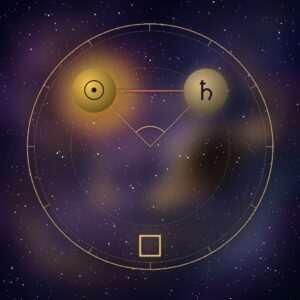
| Square | 90° | 3 | Friction. Two drives that will not take turns. |
| Trine | 120° | 4 | Flow. A skill that costs you nothing. |
| Opposition | 180° | 6 | A face-off. Each side needs the other. |
Each one has its own page on this site, with the detail this overview leaves out: the conjunction, the sextile, the square, the trine, and the opposition.
Why these five angles and no others
The choice is not arbitrary, and it is old.
Claudius Ptolemy set it out in the second century, in the four books known as the Tetrabiblos. His argument was musical. Take the circle and cut it by small whole numbers. Cut it in two and you get 180°. Cut it in three, 120°. In four, 90°. In six, 60°. Those cuts also land on whole counts of signs, since each sign is 30° wide.
Now try cutting the circle in five. You get 72°, which is two signs and twelve degrees. It fits nothing. Ptolemy left it out, and the tradition followed him for eighteen centuries. Johannes Kepler put the fifth back in the 1600s, and modern astrologers who use the quintile are working from Kepler, not Ptolemy.
So the list of major aspects is the list of clean cuts. That is the whole reason.
Orb: the word that decides whether you have a square
No two planets sit at a perfect 90° apart. They sit at 88°, or 93°, or 86°.
Astrologers allow a margin around each angle. That margin is the orb. A square with an orb of 6° counts any gap from 84° to 96°. When the gap is exact to the degree, the aspect is called exact, or partile in older texts.
Orbs are a convention, not a law. Different astrologers use different ones, and this matters more than beginners expect.
William Lilly, writing in London in 1647 in Christian Astrology, gave each planet its own orb rather than each aspect. The Sun got the widest. Mercury got one of the narrowest.
| Planet | Orb given by Lilly, 1647 |
|---|---|
| Sun | 17° |
| Moon | 12°30′ |
| Jupiter | 12° |
| Saturn | 10° |
| Venus | 8° |
| Mars | 7°30′ |
| Mercury | 7° |
Most working astrologers today use something tighter and simpler: 8° for the Sun and Moon, 6° for the rest, 3° for a minor aspect. Our own page on planetary orbs walks through how to choose.
What sixty years of sky say about how common each aspect is
Here is the method, so you can repeat it.
We checked the sky every 15 minutes from 1 January 1950 to 1 January 2010. That is about 2.1 million moments, spread evenly, with no random draw. The window matters for the slow planets, so we kept to the birth years of most adults alive today. For each one we computed the tropical longitude of ten bodies: Sun, Moon, Mercury, Venus, Mars, Jupiter, Saturn, Uranus, Neptune and Pluto. Ten bodies make 45 pairs. For every pair we measured the gap and checked it against the five major angles. The positions come from the Swiss Ephemeris. A second run with the astronomy-engine library, on a grid shifted by seven and a half minutes, gave the same figures to within 0.02 points.
At an orb of 6°, the average chart holds 12 major aspects. The lowest count we saw was 3. The highest was 36. Half of all charts fall between 10 and 14.
The five are nowhere near equally common.
| Aspect | Share of all major aspects | Average per chart | Charts with at least one |
|---|---|---|---|
| Sextile (60°) | 31.6 % | 3.84 | 99.4 % |
| Square (90°) | 21.9 % | 2.66 | 91.3 % |
| Trine (120°) | 20.2 % | 2.46 | 90.9 % |
| Conjunction (0°) | 16.3 % | 1.98 | 88.4 % |
| Opposition (180°) | 10.0 % | 1.22 | 65.5 % |
Two things explain the gap between the top and the bottom of that table.
First, 0° and 180° sit at the two ends of the scale. A gap cannot be less than 0° or more than 180°. So a conjunction and an opposition get only one side of their orb, while a square or a trine gets both sides. That halves their room straight away.
Second, Mercury and Venus stay close to the Sun. They crowd the small gaps and starve the large ones. This is why the opposition is the rarest of the five, and why one chart in three has no opposition at all.
That last number is worth keeping. If you have no opposition in your chart, you are not unusual. You are in a third of the population.
Some aspects can never happen at all
This one is a hard fact, and no beginner guide mentions it.
Mercury and Venus orbit inside the orbit of Earth. From where we stand, they never wander far from the Sun. Between 1950 and 2010, the largest Sun-Mercury gap was 27.79°. The largest Sun-Venus gap was 47.15°.
Look at what that rules out.
A Sun-Mercury sextile needs 60°. Mercury cannot reach it. A Sun-Mercury square needs 90°, a trine 120°, an opposition 180°. Mercury reaches none of them, ever. Across 2.1 million moments, the count for each was zero.
The same goes for Venus, with one small extension. Venus can reach 47°, so a semi-sextile at 30° is possible and a sextile at 60° is not.
So Sun and Mercury have exactly one aspect available to them: the conjunction. It showed up 17.4 % of the time at a 6 degree orb. Sun and Venus have the conjunction and a handful of minor angles, nothing more. If a report tells you that you have a Sun trine Mercury, the software is wrong.
Change the orb, change the chart
Orbs decide what shows up. Here is the size of that effect, from the same sixty years of sky.
| Orb used | Major aspects per chart | Charts with at least one opposition |
|---|---|---|
| 5° | 10.2 | 59.4 % |
| 6° | 12.2 | 65.5 % |
| 8° | 16.1 | 75.0 % |
Widen the orb from 5° to 8° and the average chart gains six aspects. That is a 58 % increase, and not one planet moved.
Read that line twice. Whether you “have” a Mars square Saturn can come down to which orb your app was built with. An astrologer who works tight sees a clean chart. One who works wide sees the same chart full of pressure. Neither is lying.
Applying and separating: which way is it going?
An aspect is a moving thing. The two planets travel at different speeds, so the gap between them changes every day.
When the gap is closing toward the exact angle, the aspect is applying. When the gap is opening again, it is separating.
Traditional astrology weights these differently. An applying aspect is read as the stronger of the two, because the event it describes has not finished arriving. A separating aspect is read as something already worked through. Vettius Valens, writing in Greek in the second century in his Anthologies, built a great deal of his timing work on this distinction.
Your birth chart is frozen, so an aspect in it is applying or separating for life. Check the speeds of the two planets to know which.
Hard and soft: a tradition of reading, not a verdict on you
Squares and oppositions get called hard. Trines and sextiles get called soft. The labels are ancient. Hellenistic astrologers already split the angles this way, and Ptolemy sorted them by whether the two signs involved shared a gender or a mode.
The labels describe how the energy behaves, not whether your life goes well.
A square puts two planets in signs of the same mode, three signs apart. They want the same tempo and pull in different directions. The result is friction, and friction produces movement. Robert Hand, in Planets in Aspect in 1976, argued that squares are where a chart does most of its actual work.
A trine puts two planets in signs of the same element, four signs apart. They agree without effort. The result is ease, and ease produces nothing on its own. Liz Greene has made the same point for decades: a talent that costs you nothing is a talent you rarely develop.
So the hard and soft split is a guide to texture. It is not a forecast, and it is not a grade.
Aspects you can watch in the sky
Aspects are not confined to birth charts. Planets form them overhead, on dates you can check.
On 3 April 2027, Jupiter sits at 17°08′ Leo and Saturn at 17°08′ Aries. That is a trine, exact to the arcminute.
Two more, both computed the same way. On 16 October 2026, Mars reaches 10°28′ Leo while Saturn sits at 10°22′ Aries: a Mars-Saturn trine. On 10 September 2027, Jupiter and Uranus come to an exact square.
Watching one of these unfold teaches the concept faster than any chart diagram. Pick a date, note what the pair is said to mean, and read the sky against your own week.
How to read the aspects in your own chart
Start by counting, not interpreting.
- List every major aspect in the chart. Write the orb next to each one. Tight aspects speak louder.
- Find the busiest planet. The one with the most aspects runs more of the chart than its sign alone suggests.
- Look for shapes. Three or more aspects can lock into a figure, such as a grand trine or a T-square. Our guide to chart patterns covers the main ones.
- Check for a stellium. Three or more planets bunched in one sign form a cluster rather than a single aspect, and they are read as a block.
- Only then interpret. An aspect between two planets means nothing until you know which planets, in which signs, in which houses.
That last step is where the chart stops being geometry and starts being a reading. Demetra George and Chris Brennan, both working from the Hellenistic sources, insist on the same order: structure first, meaning second.
Frequently asked questions
What are the five major aspects in astrology?
The conjunction at 0°, the sextile at 60°, the square at 90°, the trine at 120° and the opposition at 180°. Ptolemy defined them as the clean divisions of the circle, and every major tradition since has kept the list.
How many aspects does a normal birth chart have?
About 12, using ten bodies and a 6° orb. We measured an average of 12.2 across every quarter hour from 1950 to 2010. The middle half of charts hold between 10 and 14.
What does orb mean in astrology?
The orb is the margin of error allowed around an exact angle. With a 6° orb, a gap of 86° still counts as a square. Narrow orbs give fewer, stronger aspects. Wide orbs give more, weaker ones.
Is a square in my chart bad news?
No. A square marks friction between two planets that want different things at the same speed. The tradition calls it hard because it demands effort, not because it predicts misfortune. Nine charts in ten contain at least one.
Can the Sun and Mercury form a trine?
No, and this one is certain. Mercury never appears more than about 28° from the Sun as seen from Earth. A trine needs 120°. Across every quarter hour from 1950 to 2010, the count of Sun-Mercury trines was zero.
What is the difference between an applying and a separating aspect?
An applying aspect is still closing toward its exact angle. A separating aspect has passed it and is opening again. Traditional practice reads the applying one as the stronger of the two.
Do minor aspects matter?
They add detail. A quincunx at 150° or a semi-sextile at 30° refines a reading once the major aspects are in place. Use a tight orb of 2° or 3° for them, or the chart fills with noise.
Two whole signs can sit in a quincunx too, and our page on Pisces and Libra compatibility shows Venus tying such a pair anyway.
See the aspects in your own chart
Counting aspects by hand is slow, and reading them well takes practice. An Astrovision natal chart analysis maps every major aspect in your chart, names the orb of each one, and explains what the pair is doing together, in writing and in a personal audio guide.