
Every guide to the trine says the same thing. Two planets 120° apart, same element, easy flow, natural talent. The element part is presented as a law. We tested it on every hour of sixty years of sky. It holds nine times out of ten. The tenth time it breaks, and the reason it breaks tells you more about reading a chart than the rule itself.
What is a trine in astrology?
A trine is a 120° angle between two planets on the zodiac wheel. Each sign covers 30°, so 120° is four signs. Count four signs on from any planet and you reach its trine.
Planets rarely land on a clean 120°. They land on 117°, or 124°, or 116°. So a margin is allowed around the exact angle, and that margin is called the orb. At an orb of 6°, any gap from 114° to 126° counts as a trine. A gap of exactly 120° makes the aspect exact, or partile in older texts.
The gap keeps moving, because the two planets move at different speeds. A gap closing toward 120° is an applying trine. A gap opening away from it is a separating trine. Your birth chart holds one frozen moment, so each trine in it stays applying or separating for good.
Four signs apart. That is the whole of it. Everything else on this page is either geometry or interpretation, and the two are kept apart.
The element rule, stated plainly
Four signs on from a fire sign is another fire sign. Aries, Leo, Sagittarius. Four signs on from an earth sign is another earth sign. Taurus, Virgo, Capricorn. The twelve signs split into four sets of three, and each set draws a triangle on the wheel. Astrologers call each set a triplicity, which is simply the old word for a group of three signs sharing one element.
| Element | The three signs | Shared quality in the tradition |
|---|---|---|
| Fire | Aries, Leo, Sagittarius | Drive and display |
| Earth | Taurus, Virgo, Capricorn | Work and holding on |
| Air | Gemini, Libra, Aquarius | Talk and comparing |
| Water | Cancer, Scorpio, Pisces | Feeling and memory |
This is where the trine’s reputation comes from. Two planets in the same element are said to want the same kind of thing, so they work together without being asked. The claim is old, and it rests on that geometry rather than on any promise about your life. Our pages on the fire element and the earth element set out what each group covers.
Where the rule breaks: 9.2 % of all trines
Nobody checks whether the element rule survives the orb. So we checked.
Here is the method. We took every hour from 1 January 1950 to 31 December 2009, the birth years of most adults alive today. For each hour we worked out the tropical longitude of ten bodies: Sun, Moon, Mercury, Venus, Mars, Jupiter, Saturn, Uranus, Neptune and Pluto. Ten bodies make 45 pairs. We measured each pair against 120° with an orb of 6°, and for every trine we found, we also recorded the element at each end. Positions come from Swiss Ephemeris, and we ran the whole count a second time with the astronomy-engine library, the same source used for the aspect counts across this site. The two runs agree to the first decimal on every figure below.
| Result | Share of all trines |
|---|---|
| Same element at both ends | 90.8 % |
| Different elements | 9.2 % |
| Exactly four signs apart | 90.8 % |
Nine trines in a hundred join two signs of different elements. The cause is the orb, and the arithmetic is easy to follow. Put one planet at 28° of Taurus and another at 25° of Libra. The gap is 117°, which is inside a 6° orb, so the pair counts as a trine. Taurus is earth. Libra is air. The element rule is broken, and no aspect list will tell you.
When the elements differ, the mean distance from exact 120° is 4.03°. These are the wide, loose trines, the ones at the far edge of the orb. Tighten the orb and they vanish. Widen it and there are more of them.
The practical reading: a trine at 1° of orb is doing what the tradition describes. A trine at 5° might not be. Check the two signs before you accept the label, because roughly one in ten of your own trines is a trine in angle only.
How many trines a chart holds
The trine is common, though nowhere near as common as the sextile. It takes 20.2 % of all major aspects, and 90.9 % of charts hold at least one.
| Trines in a chart | Share of charts |
|---|---|
| None | 9.1 % |
| Exactly one | 19.9 % |
| Exactly two | 25.8 % |
| Exactly three | 22.1 % |
| Four or more | 23.0 % |
Two trines is the single most common outcome. Seven charts in ten hold two or more. Almost half hold three or more, and 9.6 % hold five or more. The average chart carries 2.46.
So having several trines is normal. If you were told that three trines mark you out as gifted, the number says 45.1 % of people are in that group. The highest count we found in those sixty years was 14, and even that reflects a wide orb more than a special fate.
Which pairs form trines, and which never can
Start with the arithmetic you would expect from chance alone. Two planets scattered at random across 180° of possible gap, with a 6° orb on each side of 120°, should form a trine about 6.7 times in 100 charts. That is the baseline.
Most pairs land on it almost exactly. Sun–Moon, Moon–Venus, Moon–Mars, Moon–Neptune and Moon–Uranus all sit at 6.7 per 100. The Moon moves fast and sweeps the whole zodiac every month, so its trines are as close to random as astronomy gets.
| Pair | Trines per 100 charts |
|---|---|
| Saturn–Pluto | 8.1 |
| Saturn–Uranus | 7.3 |
| Jupiter–Neptune | 7.2 |
| Venus–Neptune | 6.8 |
| Sun–Moon | 6.7 |
| Sun–Mercury | 0.0 |
| Sun–Venus | 0.0 |
| Mercury–Venus | 0.0 |
The three zeros are hard facts, not rounding. Mercury and Venus circle inside Earth’s own path, so from here they never stray far from the Sun. From 1950 to 2009 the widest Sun–Mercury gap was 27.79°, and the widest Sun–Venus gap 47.15°. A trine needs 120°. Neither planet can reach it, and Mercury and Venus cannot reach it with each other either. In sixty years of hourly checks the count for all three pairs was zero. A report showing you a Sun trine Mercury is a report with a bug.
A trine between slow planets belongs to an era
Jupiter, Saturn, Uranus, Neptune and Pluto crawl. A trine between two of them stands for years, so everyone born in that stretch shares it.
These pairs produce 46.2 trines per 100 charts, and 39.8 % of charts hold at least one. That is common, not rare, and it is the part of your chart you share with millions of people born around you.
The far outer planets are a different case. Uranus, Neptune and Pluto formed a trine with each other at no hour of our count. Their mutual gaps never reached 120° at any point between 1950 and 2010. If you were born in that window, you do not have one, and neither does anybody else.
This matters when you read your own chart. Cross out the slow pairs first. What remains, the trines that involve the Sun, Moon, Mercury, Venus or Mars, is the part that differs from person to person.
Two Venus trines have their own pages: Venus trine Mars, which skipped all of 2026, and Venus trine Neptune.
Why 120°, and why the tradition called it lucky
Claudius Ptolemy laid out the major angles in the second century, in the four books known as the Tetrabiblos. His case rested on cutting the circle by small whole numbers. Cut it in two and you get 180°. Cut it in three and you get 120°. The trine is the circle divided by three, which is why it draws an equal-sided triangle on the wheel.
Dividing by three also lands on a whole count of signs, four of them, and on one element. Geometry and element agree. That agreement is the entire basis for the trine’s good name.
Vettius Valens, writing in Greek in the second century in his Anthologies, ranked the 120° angle as the most favourable of the five. William Lilly kept that ranking in London in 1647, in Christian Astrology, though he attached his orbs to planets rather than to angles: 17° for the Sun, 7° for Mercury. Under Lilly’s rules a Sun trine covers a far wider stretch of sky than a Mercury trine.
The modern reading is more careful. Robert Hand, in Planets in Aspect in 1976, argued that the hard angles are where a chart does its work, and that trines supply ability without any push to use it. Liz Greene has made the point for decades: a talent that costs nothing is a talent rarely developed. Demetra George and Chris Brennan, both working from the Greek sources, stress that the old ranking described how two planets combine and was never a forecast of a life.
So “lucky trine” is a dated reading, still repeated because it is easy to sell. The geometry is real. The promise attached to it is not part of the geometry.
The grand trine is a different thing
Searches for the trine keep running into the grand trine, and the two get mixed up.
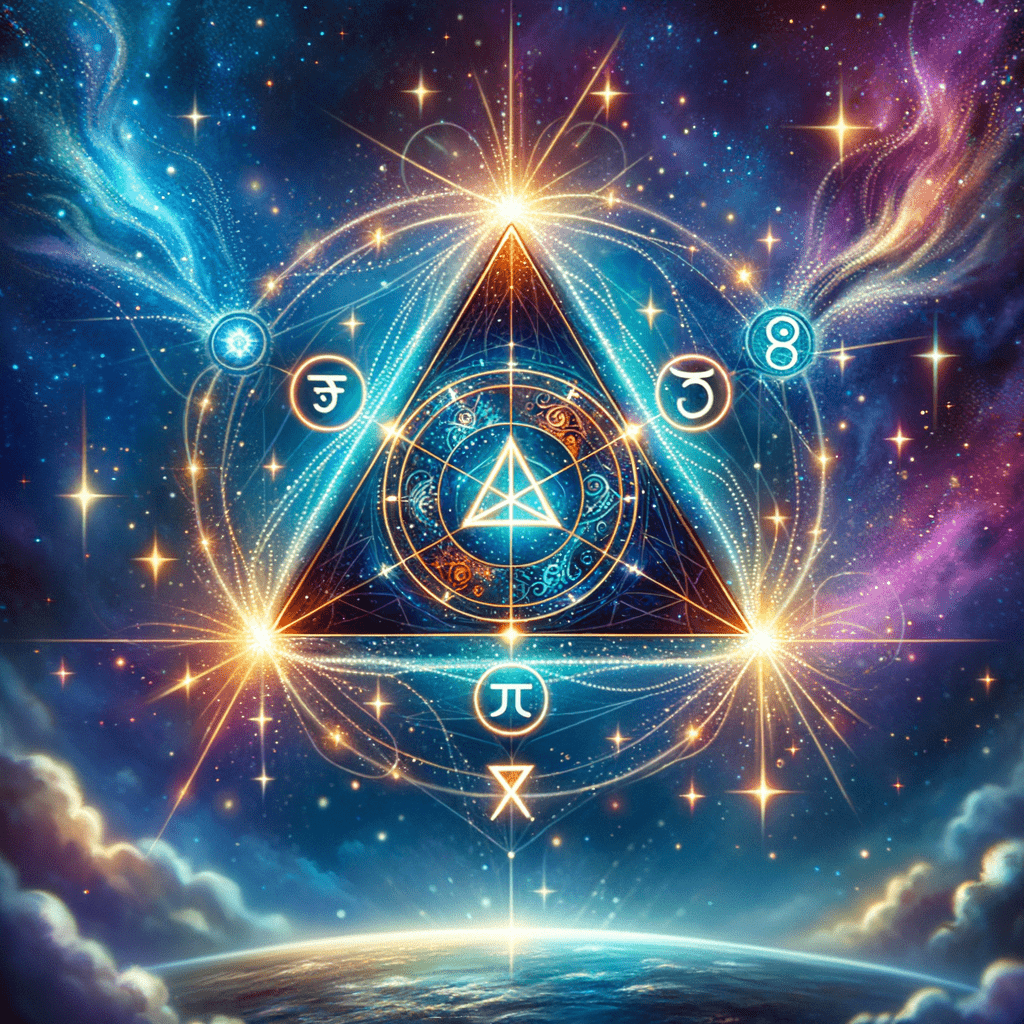
A trine is one angle between two planets. A grand trine is a figure made of three planets, each 120° from the other two, drawing a closed triangle across one element. Three separate trines have to line up at once for it to exist.
That makes it far less common than a single trine, and it is read as a self-contained circuit rather than as one link. Our guide to the grand trine covers the figure and how rare it is. If you are looking for a triangle, that is the page. If you are looking for a single 120° link, you are on the right one.
A trine you can date
Trines happen overhead as well as in birth charts, and the dates are checkable.
On 3 April 2027, Jupiter sits at 17°08′ Leo and Saturn at 17°08′ Aries. The gap is 120° to the arcminute: a Jupiter–Saturn trine, exact, in fire at both ends. That one satisfies the element rule perfectly.
Compare it with a snapshot from 15 September 2026. Jupiter stands at 16°40′ Leo and Saturn at 12°45′ Aries. The gap reads 123°55′, so the trine already counts at a 6° orb, with the two planets still closing. That is an applying trine, and it takes them until April 2027 to reach exact. Watching one pair cross that stretch shows you what an orb really buys you.
Reading the trines in your own chart
Take them in this order.
List every trine with its orb beside it. A trine at 1° and a trine at 6° are not the same claim.
Check the element at both ends. If the two signs disagree, you are in the 9.2 %, and the aspect is an angle without the rule behind it.
Cross out any pair made of slow planets. Those belong to your age group.
Look at what survives. A tight trine between two personal planets, in one element, is the version the tradition is actually describing.
Read it beside the hard angles. A planet that holds a trine and a square at once behaves unlike a planet with a trine alone, which is why counting comes before meaning.
Frequently asked questions
What is a trine in astrology?
A 120° angle between two planets, which is four signs apart on the wheel. Most readers allow an orb of 6°, so any gap from 114° to 126° counts. It takes 20.2 % of all major aspects.
What signs are trine each other?
Signs of the same element, four apart. Aries with Leo and Sagittarius. Taurus with Virgo and Capricorn. Gemini with Libra and Aquarius. Cancer with Scorpio and Pisces.
Is a trine always in the same element?
No, and this is the part nobody states. Across every hour from 1950 to 2009, 90.8 % of trines joined two signs of one element. The other 9.2 % did not, because the orb stretched the gap across a sign line. Those loose trines sat an average of 4.03° away from exact.
Is a trine lucky?
The tradition ranks it as the most helpful of the five major angles, from Vettius Valens through William Lilly. That is a claim about how two planets blend, not a forecast. With 90.9 % of charts holding at least one, no outcome can rest on having a trine.
How many trines does a normal chart have?
About two or three. The average is 2.46, using ten bodies and a 6° orb. Around 71 % of charts hold two or more, and 45.1 % hold three or more.
What is better, a trine or a sextile?
The tradition ranks the trine higher, and it is the rarer of the two: 90.9 % of charts hold a trine against 99.4 % holding a sextile. A trine joins one element, a sextile joins two that match, such as fire with air.
Can the Sun and Mercury form a trine?
No. Mercury never appears more than about 28° from the Sun as seen from Earth, and a trine needs 120°. In sixty years of hourly checks the count was zero. The same holds for the Sun with Venus, and for Mercury with Venus.
What is the difference between a trine and a grand trine?
A trine links two planets. A grand trine links three, each 120° from the other two, forming a closed triangle in one element. The grand trine is a pattern built from three trines at once.
See the trines in your own chart
Listing trines by hand is slow, and telling a tight one from a loose one takes practice. An Astrovision natal chart analysis maps every trine in your chart, gives the orb and the element at each end, and spells out what the pair is doing together, in writing and in a personal audio guide.