



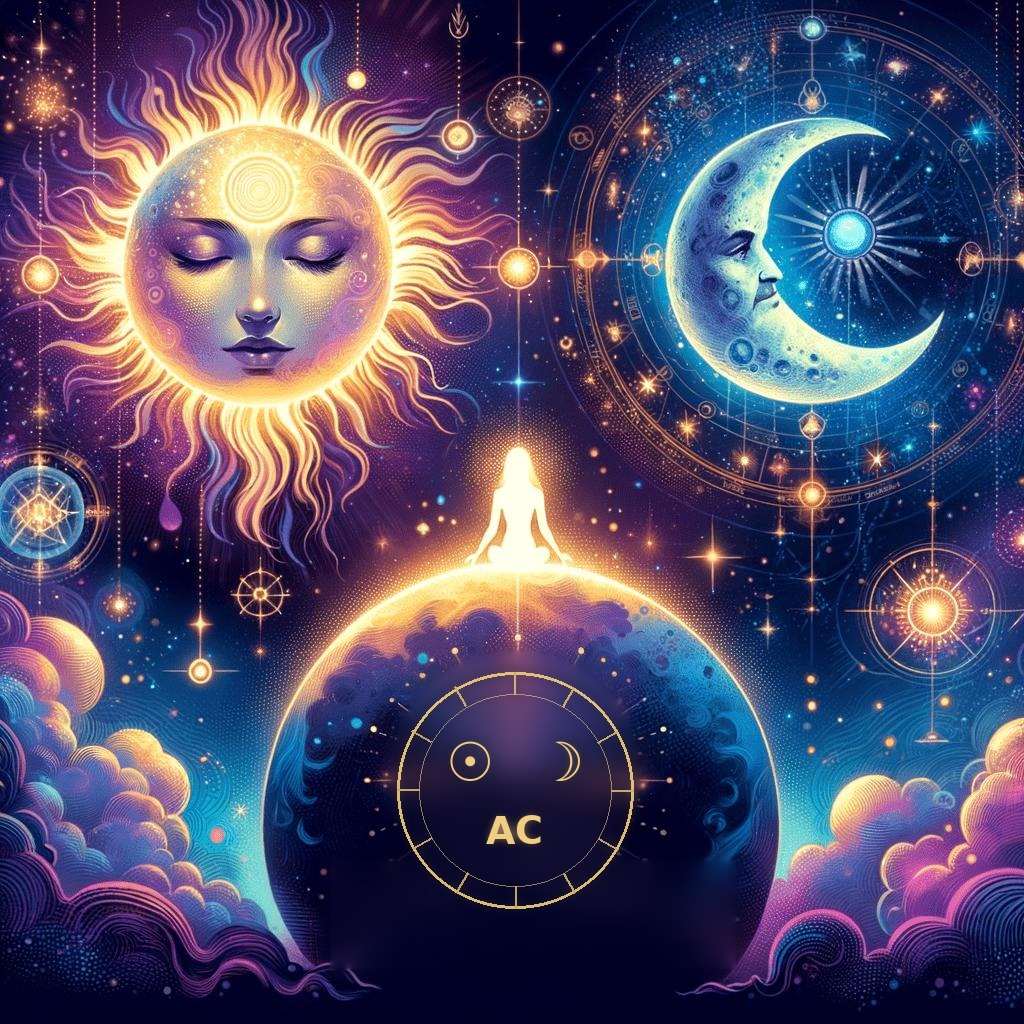
Ask someone for their sign and you get one word. Ask an astrologer and you get three: the Sun, the Moon and the rising sign. People call this trio the Big 3. It is the short form of a birth chart, the map of the sky at the minute you were born. This guide shows how to find all three yourself, what each one does, and how rare your own mix is. We counted. Only about one person in 146 has the same sign in all three places.
What is my Big 3? Sun, Moon and rising in one line each
Your Big 3 is three signs, each read from its own clock.
- The Sun sign is the sign the Sun was in on your birth date. It speaks to drive and purpose: what you aim at.
- The Moon sign is the sign the Moon was in at your birth. It speaks to needs and comfort: what makes you feel safe.
- The rising sign is the sign coming up over the eastern skyline at your birth. Its other name is the Ascendant. It speaks to manner: what people meet first.
A sign is one of the twelve equal slices of the Sun’s yearly path, from Aries to Pisces. Each slice is 30 degrees wide. The three signs are not three versions of you. Think of your chart as a house with twelve rooms. The rising sign is the front door. The Sun is the main light in the house. The Moon is the room you go to when the day goes wrong. Our guides to the Sun in astrology and the Moon in astrology cover each light on its own.
How to find your Sun, Moon and rising sign in three steps
You do not need a special sun moon rising calculator. Any free birth chart tool will do the math. What counts is what you feed it.
- Get your birth date. That alone gives your Sun sign, except on the 12 days a year when the Sun moves into a new sign.
- Get your birth time, to the minute if you can. A birth certificate or a hospital record is best. A family memory such as “around lunch” is weak.
- Get your birth place, meaning the town or city. The tool turns it into a point on the map.
Enter all three. Then read the Sun line, the Moon line and the line marked ASC. That is your Big 3.
Why does the hour matter so much? The three move at very different speeds. A wrong date is rare. A wrong hour is common, and it hits the fast movers first.
| Placement | Changes sign every | What you need to find it |
|---|---|---|
| Sun sign | About 30 days | Your date, plus the hour on the day the Sun changes sign. |
| Moon sign | About 2.3 days | Your date and your hour. |
| Rising sign | About 2 hours | Your exact minute and your birth place. |
One real day in New York: January 16, 1990
Take every baby born in New York on January 16, 1990. All of them have the Sun in Capricorn.
The Moon is not settled. At 7:17 a.m. New York time, which is 12:17 UTC, the Moon left Virgo and entered Libra. A baby born at 7:00 a.m. has a Virgo Moon. A baby born at 7:30 a.m. has a Libra Moon. Same day, same city, two different Moons.
The rising sign moves faster still. At 6:00 a.m. it was Capricorn. At 9:00 a.m. it was Aquarius, in its very last degree. By 9:03 a.m. it was Pisces. At noon it was Taurus, and at 6:00 p.m. it was Leo. Over that one day, all twelve signs took their turn on the eastern skyline.
We worked out these times with the Swiss Ephemeris, the standard software astrologers use to place the planets.
Why the Moon needs your birth hour
The Moon goes once around the zodiac in about 27 days and 8 hours. So it spends a little over two days in each sign. We measured 2.28 days on average. At its fastest it crossed a sign in 1.95 days, and at its slowest in 2.55 days. Its speed changes because its orbit is an oval. It moves faster when it is closer to Earth.
We listed every Moon sign change from 1950 to 2010, then checked which calendar days held one. 44% of days did. The share was the same in UTC and in New York time. It was the same again from 1600 to 2400. So if you know your date but not your hour, there is close to an even chance that your Moon could be one of two signs.
There is a simple test if your hour is lost. Look up the Moon at the start and at the end of your birth day. If both give the same sign, your Moon sign is safe. If they differ, you have two candidates, and you need the hour to choose.
Why the rising sign needs the minute
The rising sign is the fastest of the three. As Earth turns, all twelve signs climb over the eastern skyline once a day. On average, a sign takes two hours to rise. But the signs do not take equal turns.
Seen from the United States, the Sun’s path meets the skyline at a slant. Some signs come up steep and slow. Others come up flat and fast. Astrologers call the slow ones signs of long ascension, and the fast ones signs of short ascension. We measured how long each sign takes to rise in three cities.
| Rising sign | New York | Seattle | Miami |
|---|---|---|---|
| Aries or Pisces | 1 h 11 min | 1 h 00 min | 1 h 29 min. |
| Taurus or Aquarius | 1 h 26 min | 1 h 16 min | 1 h 41 min. |
| Gemini or Capricorn | 1 h 54 min | 1 h 50 min | 2 h 01 min. |
| Cancer or Sagittarius | 2 h 22 min | 2 h 27 min | 2 h 16 min. |
| Leo or Scorpio | 2 h 33 min | 2 h 43 min | 2 h 18 min. |
| Virgo or Libra | 2 h 31 min | 2 h 43 min | 2 h 14 min. |
In New York, Aries rises in just over an hour. Leo takes more than twice as long. The farther north you go, the wider the gap. In Seattle, Aries and Pisces race up in one hour flat. Each sign from Leo to Scorpio takes 2 hours and 43 minutes there. Near the equator, the gap nearly closes. We checked these times two ways, with the Swiss Ephemeris and with the textbook formula, and both gave the same minutes.
So a birth time that is half an hour off can move your rising sign. Our guide to the rising sign and how to find it shows how many charts that puts at risk for each margin of doubt.
Big 3 astrology by the numbers: 1,728 combinations
Twelve Sun signs, times twelve Moon signs, times twelve rising signs, gives 1,728 possible Big 3s. If all were equal, each would belong to one person in 1,728. They are not equal.
Here is how we counted. We drew 120,000 birth moments at random, spread evenly over the years 1950 to 2010. Each got a birthplace drawn from 16 large US cities. For each one we worked out the Sun, the Moon and the rising sign with the Swiss Ephemeris. We used the tropical zodiac, the one tied to the seasons, which most Western astrologers use. Then we checked the result by a second route. We swept more than 3 million moments at regular steps over the same years, and 4 million more from 1600 to 2400. The headline numbers below held on all three counts.
One limit is worth knowing. Our moments are spread evenly around the clock. Real births are not, so real shares shift a little.
| Pattern | Share of US charts |
|---|---|
| All three in one sign, a “triple” | 0.68%, about 1 in 146. |
| Two of the three in one sign | 22.8%, nearly 1 in 4. |
| All three in different signs | 76.5%, about 3 in 4. |
| Sun and Moon in the same sign | 8.2%, about 1 in 12. |
So a “triple Leo” or a “triple Scorpio” is rare. Three people in four carry three different signs. That is the normal case, and it is the reason the Big 3 is worth reading. Most people are a blend.
Which triple is rarest? Triples follow the rising sign. A triple Leo is the most common, about 1 in 1,360. A triple Aries or a triple Pisces is the rarest, about 1 in 2,800. That is half as likely.
All 1,728 combinations follow the same rule. The most common Big 3s pair a summer Sun, from Gemini to Leo, with Leo or Scorpio rising. Each of those reaches about one chart in 1,300. The rarest pair a late fall or winter Sun, from Scorpio to Aquarius, with Aries or Pisces rising. Each of those sits near one chart in 2,900. The top and the bottom differ by a factor of about 2.3.
The rising sign does most of that work. The Sun adds a little: it moves slower in the northern summer, so it spends more days in Cancer than in Capricorn. We do not name one single rarest Big 3. The bottom ten sit within a hair of each other, and their order changed between our time windows.
Big three astrology: what the tradition says
Why these three, and not Mars or Venus? The choice is old. In the second century, the Greek astronomer Ptolemy wrote the Tetrabiblos, the book that shaped Western astrology for fifteen hundred years. In its third book, he judges the length of a life. To do so, he names the Sun, the Moon and the rising degree among the chief places of the chart. Later astrologers kept that short list at the core of their readings.
Modern astrology gave the three a reading of the inner life. Dane Rudhyar, in The Astrology of Personality (1936), treated the chart as one whole person, not a list of traits. He read the Sun as the source of life force, and the Moon as the way that force takes shape day by day. Liz Greene and Howard Sasportas gave the two lights a full book, The Luminaries (1992). They tied the Sun to the long work of becoming yourself. They tied the Moon to needs, instinct and early comfort.
How to read your Sun, Moon and rising together
According to the tradition, each of the three answers its own question.
- The Sun: what am I aiming at?
- The Moon: what do I need to feel safe?
- The rising sign: how do I meet the world, and how does it meet me?
Read them in pairs. Start with the Sun and the Moon. There are four elements: fire, earth, air and water, with three signs each. When the Sun and Moon share an element, aim and need pull the same way. A fire Sun with a water Moon tells a different story. The drive is quick, while the need is slow and deep. Our guide to the Sun and Moon signs counts how common each of the 144 pairs is.
Then add the rising sign, the front door of the house. People meet the door before the rooms. A Capricorn Sun with Leo rising comes across warmer and louder than the Sun alone would suggest. A Leo Sun with Capricorn rising arrives buttoned up, then warms up later.
The rising sign does one more job. It sets the order of the twelve rooms, which astrologers call houses. In whole sign houses, a simple and old method, the rising sign is the first house. The next sign is the second house, and so on round the wheel. Our guide to the 12 astrological houses explains what each room covers.
Because the rising sign sets the rooms, the planet that rules it gets a special role. Astrologers call it the chart ruler. Our page on how to find your chart ruler shows how to look it up in one table.
Each of the three also sits at an exact degree inside its sign. A guide to reading astrological degrees tells you how much a shaky birth time puts that spot at risk.
The Big 3 is a starting point, not the whole map. A complete natal chart reading places every planet in its sign and its house, then reads them as one story.
The Big 3 in love and friendship
Couples compare Sun signs first. The Moon tells you more about daily life together: how each person rests, eats, argues and makes up. Our guide to Moon sign compatibility reads two Moons side by side. The rising sign shows the first spark. It is the part of each other you meet on day one.
Which rising sign is the most attractive?
No data can answer that. A count of charts cannot measure attraction, and no rising sign wins it. What a count can tell you is how rare each rising sign is. In our 120,000 US charts, the shares fell into three groups.
| Group | Rising signs and their share of US charts |
|---|---|
| Most common | Leo 10.4%, Scorpio 10.3%, Libra 10.2%, Virgo 10.1%. |
| In the middle | Cancer 9.9%, Sagittarius 9.8%, Gemini 8.2%, Capricorn 8.1%. |
| Rarest | Aquarius 6.4%, Taurus 6.2%, Pisces 5.3%, Aries 5.2%. |
Leo rising is about twice as common as Aries rising in US births, because Leo takes about twice as long to rise. If you have Aries or Pisces rising, you hold one of the rarest front doors in the country, about one person in 19.
What are the rarest placements in a birth chart?
For the Big 3, our count gives a clear answer. Aries and Pisces rising are the rarest rising signs. A triple Aries or a triple Pisces is the rarest triple, about 1 in 2,800. For the Sun and Moon alone, our Sun and Moon guide finds the rarest pair: a Capricorn Sun with a Cancer Moon, about 1 in 152.
Beyond the Big 3, rare features come from clusters. A stellium is three or more planets packed into one sign or one house. It turns that sign or that room into the loudest part of the chart. Our guide to the stellium in a natal chart explains how astrologers count one.
What if you do not know your birth time?
You still have something to work with. Your Sun sign is safe on all but about 12 days a year. Your Moon sign is safe on 56 days in 100. Your rising sign is lost: a chart cast for sunrise or noon shows one, but it is a stand-in, not yours.
Tracking down the real time is worth the effort. Try the long-form birth certificate or the hospital that holds your records. Even a time to the nearest quarter hour narrows your rising sign to one or two candidates.
Frequently asked questions
What is my Big 3?
Your Big 3 is your Sun sign, your Moon sign and your rising sign. To find it, enter your birth date, exact birth time and birth place in any birth chart tool. The date gives the Sun, the hour gives the Moon, and the minute and place give the rising sign.
Which rising sign is the most attractive?
No data can say. What a count can show is rarity. In our sample of 120,000 US births, Leo rising was the most common at 10.4%, and Aries rising was the rarest at 5.2%.
What is a stellium?
A stellium is a cluster of three or more planets in one sign or one house. According to the tradition, it makes that sign or house a main theme of the chart.
What are the rarest placements in a birth chart?
Among Big 3s, a triple Aries or a triple Pisces is the rarest, about 1 in 2,800 US charts. Aries and Pisces are the rarest rising signs, at 5.2% and 5.3% of charts.
Can I find my Big 3 without a birth time?
Only in part. The date gives your Sun sign, except on the 12 days a year when the Sun changes sign. The Moon changes sign on 44% of days, so it can be one of two. The rising sign needs the time.
Go deeper with your personal Astrovision report
Reading about astrological concepts is a great start, but nothing compares to hearing how they apply directly to you. Our users love our audio-first approach, calling it “friendly, personal, and easy to understand.” While this article gives you the “what,” a personal report gives you the “so what.” Discover your unique path with an Astrovision report—your personal ‘user manual’ delivered in our celebrated podcast format.