

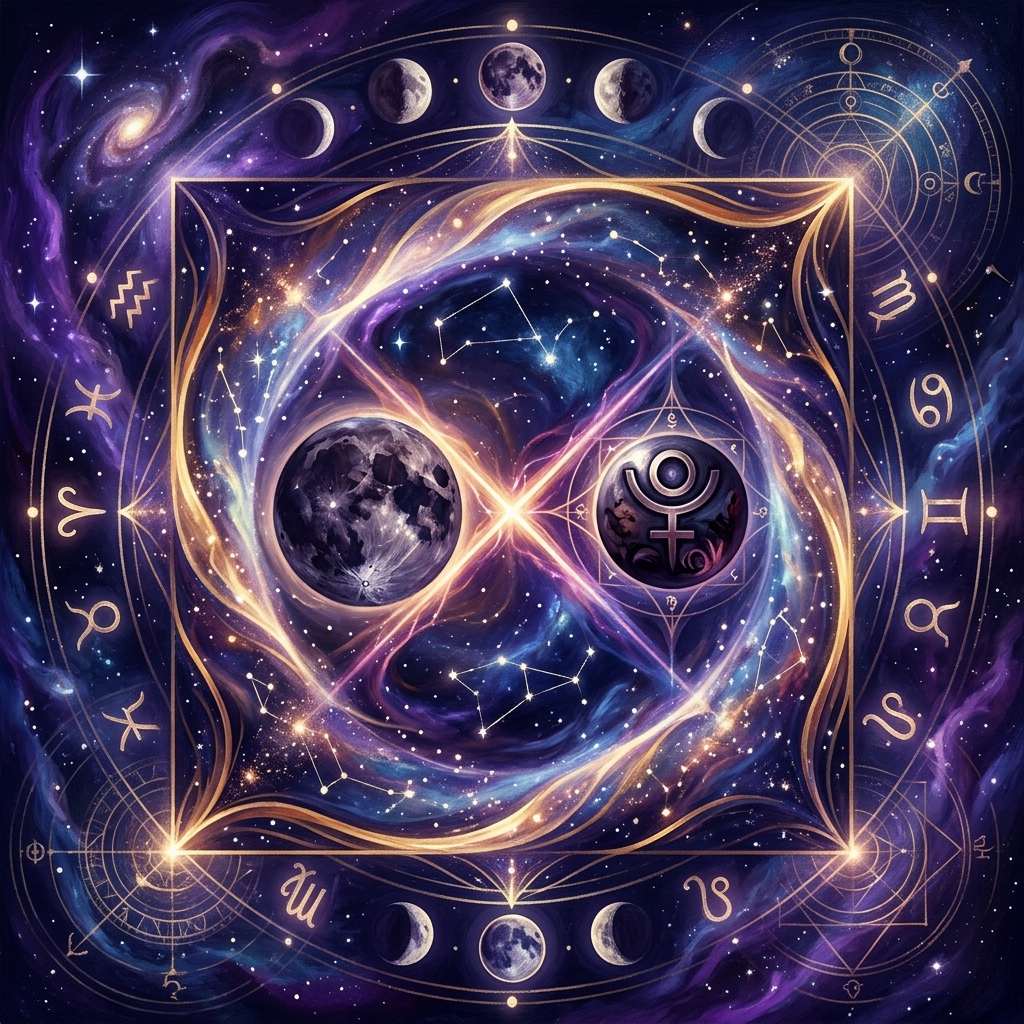
Mars square Pluto comes and goes with the decades. Moon square Pluto does not. Pick any ten years from 1950 to 2010, and close to one chart in eleven has it. That steady rate is the key to this aspect, and it explains a lot about how the square is read.
This guide covers the three things people search for. First, what Moon square Pluto means in a birth chart. Then, when the sky forms it again, with exact dates. Last, what it does between two people.
First, the words. An aspect is an angle between two planets, as seen from Earth. A square is an angle of 90 degrees, a quarter of the circle. The orb is the gap we allow on either side of the exact angle. With a 3 degree orb, a square counts anything from 87 to 93 degrees apart.
What Moon square Pluto means in a birth chart
Start with the two bodies. The Moon is read for feelings, needs, and the sense of home. It shows what makes you feel safe. Our guide to the Moon in astrology sets out that role in full.
Pluto is read for depth, control, and slow change below the surface. It was found in 1930, so every reading of it is less than a hundred years old. Our guide to the planet Pluto covers its dates and its limits.
Now the angle. Picture your chart as a house with twelve rooms. Each room is an area of life, and the planets are the furniture. A square puts two pieces at right angles. They face different ways, so they get in each other’s path. Our page on the square aspect explains the angle on its own.
In the second century, Ptolemy sorted the angles in his book, the Tetrabiblos. In Book I, chapter 13, he calls the trine and the sextile harmonious. He calls the square and the opposition discordant. That split between easy and hard angles still runs through Western astrology.
Ptolemy never saw Pluto, so the reading of this pair is modern. Reinhold Ebertin, in The Combination of Stellar Influences (1940), read Moon and Pluto contacts as strong, sometimes extreme, emotional states. Sue Tompkins, in Aspects in Astrology (2002), treats any square as friction that asks for action. In her reading, it is a task, not a verdict.
Put together, the tradition reads Moon square Pluto as feelings under pressure. The need to feel safe meets a force that wants to dig, test, and change things. Here is how that reading is usually laid out:
- Feelings that run deep and stay a long time.
- A strong need to trust, and a slow pace in giving trust.
- A wish to control the mood of a room, or to escape when you can’t.
- A lesson, per tradition, about letting feelings change without forcing them.
That is a reading, not a fact about any person. Astrology is not a science. No chart feature makes anyone cold, jealous or cruel, and none excuses harm.
Which way the square points
Astrologers add one more layer. The Moon lives in a sign, and Pluto lives in another sign. In a square, those two signs share a mode. The modes are cardinal, fixed and mutable. Cardinal signs start things. Fixed signs hold on. Mutable signs adapt.
So a Moon in Scorpio square Pluto in Leo is a fixed square. The tradition reads it as the most stubborn form. A Moon in Pisces square Pluto in Sagittarius is a mutable square. It is read as more restless and less locked in. The angle is the same, but the tone shifts with the signs.
Moon square Pluto natal: how common is it?
Most pages call this square intense. Few say how many people have it. So we counted.
We drew 200,000 moments at random between 1950 and 2010. Each moment had the same chance, so this counts time, not real births. For each one, we took the Moon and Pluto from the Swiss Ephemeris. That is the standard table of planet positions used by chart software. We used the tropical zodiac, the one tied to the seasons. Then we measured the gap between the two.
Here is the result. The Moon was square Pluto within 8 degrees in 8.91 percent of the moments. That is about one chart in eleven. With a tight 3 degree orb, the share falls to 3.3 percent, about one chart in thirty.
| Birth decade | Moon square Pluto, 8 degree orb |
|---|---|
| The 1950s | 8.83 percent of the time. |
| The 1960s | 8.97 percent of the time. |
| The 1970s | 8.87 percent of the time. |
| The 1980s | 8.85 percent of the time. |
| The 1990s | 9.18 percent of the time. |
| The 2000s | 8.79 percent of the time. |
Look at how flat that row is. Every decade lands near 9 percent. The small ups and downs are the noise of a random draw.
Why the decade does not matter here
Compare it with Mars square Pluto. On this site we measured that square at 11.35 percent of the time in the 1950s. In the 1980s it fell to 6.71 percent. The cause is speed. Mars and Pluto both move slowly, so the gap between them can stay wide or narrow for years.
The Moon is not slow. It goes all the way round the zodiac in about 27.3 days. On each lap it passes Pluto’s square twice, once on each side. Pluto barely moves in that time. So every month, in every decade, the Moon runs the same course.
That gives a simple rule you can check by hand. An 8 degree orb makes a window 16 degrees wide. There are two such windows on the circle. Two times 16, divided by 360, is 8.9 percent. With a 3 degree orb, it is two times 6, divided by 360, or 3.3 percent. The random draw lands right on both.
We checked it a second way. We stepped through the same sixty years every three hours, with no random draw at all. That gave 8.88 percent at 8 degrees and 3.32 percent at 3 degrees. Each decade sat between 8.85 and 8.92 percent.
Why a birth time matters
The Moon’s speed has a cost. It moves about 13 degrees a day. A whole 16 degree window passes in roughly a day and a quarter. If you don’t know your birth time, the Moon could sit inside the orb or just outside it.
So check your chart with an exact time of birth. A noon chart is a guess. For the slow planets a guess is fine. For the Moon it is not.
Moon square Pluto transit: two transits with one name
A transit is a planet in today’s sky making an angle to a planet in your birth chart. It is also used for two planets meeting each other in the sky. Here, the name covers two very different events.
- The Moon in the sky squares Pluto in the sky, or your natal Pluto. This happens twice a month and lasts hours.
- Pluto in the sky squares your natal Moon. This happens at most a few times in a life and lasts about two years.
Searches for the pluto square moon transit are almost always about the second kind. We give dates for both.
When the Moon squares Pluto in the sky
Pluto entered Aquarius in late 2024. So the Moon squares it each time it passes the early degrees of Taurus or Scorpio. Here are the exact moments through April 2027. Times are in UTC, with New York time beside them.
| Exact moment, UTC | New York time | Positions |
|---|---|---|
| 11 October 2026, 21:08 UTC. | 11 October, 5:08 pm. | Moon 3° Scorpio, Pluto 3° Aquarius. |
| 26 October 2026, 04:44 UTC. | 26 October, 12:44 am. | Moon 3° Taurus, Pluto 3° Aquarius. |
| 8 November 2026, 04:44 UTC. | 7 November, 11:44 pm. | Moon 3° Scorpio, Pluto 3° Aquarius. |
| 22 November 2026, 15:50 UTC. | 22 November, 10:50 am. | Moon 3° Taurus, Pluto 3° Aquarius. |
| 5 December 2026, 11:37 UTC. | 5 December, 6:37 am. | Moon 3° Scorpio, Pluto 3° Aquarius. |
| 20 December 2026, 03:23 UTC. | 19 December, 10:23 pm. | Moon 4° Taurus, Pluto 4° Aquarius. |
| 1 January 2027, 18:40 UTC. | 1 January, 1:40 pm. | Moon 4° Scorpio, Pluto 4° Aquarius. |
| 16 January 2027, 13:19 UTC. | 16 January, 8:19 am. | Moon 4° Taurus, Pluto 4° Aquarius. |
| 29 January 2027, 03:11 UTC. | 28 January, 10:11 pm. | Moon 5° Scorpio, Pluto 5° Aquarius. |
| 12 February 2027, 21:02 UTC. | 12 February, 4:02 pm. | Moon 5° Taurus, Pluto 5° Aquarius. |
| 25 February 2027, 13:30 UTC. | 25 February, 8:30 am. | Moon 6° Scorpio, Pluto 6° Aquarius. |
| 12 March 2027, 03:51 UTC. | 11 March, 10:51 pm. | Moon 6° Taurus, Pluto 6° Aquarius. |
| 25 March 2027, 00:25 UTC. | 24 March, 8:25 pm. | Moon 6° Scorpio, Pluto 6° Aquarius. |
| 8 April 2027, 11:26 UTC. | 8 April, 7:26 am. | Moon 6° Taurus, Pluto 6° Aquarius. |
Each of these lasts about a day inside an 8 degree orb. In the tradition, it is a mood, not an event. Astrologers read it as a day when feelings run deeper than the facts call for.
Note the first date. On 11 October 2026, Pluto sits at 3 degrees of Aquarius. Five days later, on 16 October at 02:40 UTC, it stops and turns direct. Planets sometimes seem to move backwards from where we stand on Earth. That is what retrograde means. The pause when the motion turns is called a station.
When Pluto squares your natal Moon
This is the slow one. Pluto takes about 248 years to go round the zodiac. So it squares a given natal Moon only a few times in a life, if at all. Each time, it moves forward, turns back, and moves forward again. That back and forth makes three or more exact hits.
Pluto’s path in Aquarius over the next few years runs like this. Each line shows where it turns retrograde and where it turns direct again.
| Year | Retrograde station, UTC | Direct station, UTC |
|---|---|---|
| In 2026. | 6 May, at 5°30′ Aquarius. | 16 October, at 3°04′ Aquarius. |
| In 2027. | 8 May, at 7°10′ Aquarius. | 18 October, at 4°44′ Aquarius. |
| In 2028. | 9 May, at 8°49′ Aquarius. | 19 October, at 6°24′ Aquarius. |
| In 2029. | 11 May, at 10°27′ Aquarius. | 21 October, at 8°02′ Aquarius. |
| In 2030. | 12 May, at 12°03′ Aquarius. | 23 October, at 9°39′ Aquarius. |
Now find your Moon. Pluto in Aquarius squares Moons in Taurus and Scorpio at the same degree. If your Moon sits at 3 to 12 degrees of Taurus or Scorpio, this transit falls between 2025 and 2030.
Take one worked case. Say your natal Moon sits at exactly 5 degrees of Taurus. Pluto makes the exact square five times:
- 20 March 2026, at 08:33 UTC, moving forward.
- 24 June 2026, at 17:27 UTC, moving back.
- 21 January 2027, at 22:57 UTC, moving forward.
- 14 September 2027, at 14:54 UTC, moving back.
- 19 November 2027, at 20:52 UTC, moving forward.
Within a 1 degree orb, Pluto stays square to that Moon for 403 days in all. Those days are spread from February 2026 to early January 2028. So the answer to “how long does it last?” is close to two years, with gaps.
Our page on Pluto in Aquarius gives the full dates of its stay in that sign.
What does the tradition say about this transit? It reads it as a slow rebuild of the inner life. Home, family and old habits come up for review. Some readers link it to a move, a loss, or a change in a close bond. That is a reading, not a forecast. Pluto does not cause events in anyone’s life.
Moon square Pluto synastry
Synastry is the comparison of two birth charts. It looks at the angles between one person’s planets and the other person’s planets. Our guide to synastry charts covers the method.
In synastry, Moon square Pluto means one person’s Moon is about 90 degrees from the other person’s Pluto. The tradition reads it as one person’s need for safety meeting the other person’s need for depth and control. Read well, it is a bond that refuses to stay on the surface. Read badly, it is a tug of war over feelings.
How common is it? We took two moments at random. The first fell between 1950 and 2010. The second fell within five years of the first, like two people of a similar age. We repeated this 40,000 times.
- The first person’s Moon was square the second person’s Pluto in 9.1 percent of pairs.
- Counting both directions, one or the other was there in 17.2 percent of pairs.
So about one couple in six of a similar age has this contact. It is a common link, not a rare mark of fate.
Why is it so common? People born a few years apart have Pluto in almost the same place. Pluto moves only a few degrees in five years. So the contact depends on the Moon alone, and the Moon is spread evenly round the circle. The odds come out close to the natal rate, once for each direction.
Some posts online call this “one of the worst aspects you can have with someone”. Our numbers say otherwise. A contact found in one pair in six cannot doom them all. In synastry, the tradition weighs every angle together, not one square in isolation.
Working with it, per the tradition
Astrologers who write on Pluto, such as Stephen Arroyo, stress awareness over fear. In that view, a hard aspect is a place where effort pays off. Here is how the tradition frames the work, as reflection rather than advice:
- Name the feeling before acting on it.
- Notice when the wish to feel safe turns into a wish to control.
- Let some feelings fade on their own time.
- Use the depth for work that needs it, such as research or care.
None of this is a health claim. If feelings become hard to manage, a doctor or a licensed therapist is the right person to see. A chart is not a diagnosis.
How we counted
All positions come from the Swiss Ephemeris, read through the pyswisseph library. We used the tropical zodiac and the center of the Earth as the point of view.
For the natal share, we drew 200,000 moments with a standard random number generator, between 1 January 1950 and 1 January 2010. We then checked the result with a fixed step of three hours over the same span. The two routes agree to within 0.03 points at 8 degrees.
For the dates, we stepped through time in short steps and found each moment the gap crossed 90 degrees. Then we halved the time window again and again until the minute was found. All times are in UTC, with New York time added for readers in the United States.
For synastry, we drew 40,000 pairs of moments, the second within five years of the first. These figures count time, not people. More babies are born in some years than in others, and we did not weight for that. They describe the sky, and nothing about the person who has the square.
For more on how angles are counted and named, see our guide to astrological aspects.
Frequently Asked Questions
What does it mean when the Moon squares Pluto?
It means the Moon sits about 90 degrees from Pluto. In a birth chart, the tradition reads it as deep feelings under pressure, and a need to trust that is slow to settle. In the sky, it is a one day mood that returns twice a month.
What is the significance of Moon square Pluto in synastry?
One person’s Moon sits about 90 degrees from the other’s Pluto. The tradition reads it as a need for safety meeting a need for depth and control. In our count, it links about one pair in six born within five years, counting both directions.
What does it mean when the Moon is squaring a planet?
A square is a 90 degree angle, read as friction that asks for action. With the Moon, the friction touches feelings and needs. The Moon is fast, so in the sky it squares each planet twice a month, for about a day each time.
How common is Moon square Pluto in a birth chart?
About 8.9 percent of the time from 1950 to 2010 within an 8 degree orb, and 3.3 percent within 3 degrees. The share stays near 9 percent in every decade, because the Moon laps the zodiac every 27.3 days.
How long does a Pluto square Moon transit last?
Close to two years. For a Moon at 5 degrees of Taurus, Pluto makes five exact squares from March 2026 to November 2027. It stays within 1 degree for 403 days in all, spread from February 2026 to early January 2028.
Go deeper with your personal Astrovision report
Reading about astrological concepts is a great start, but nothing compares to hearing how they apply directly to you. Our users love our audio-first approach, calling it “friendly, personal, and easy to understand.” While this article gives you the “what,” a personal report gives you the “so what.” Discover your unique path with an Astrovision report—your personal ‘user manual’ delivered in our celebrated podcast format.