

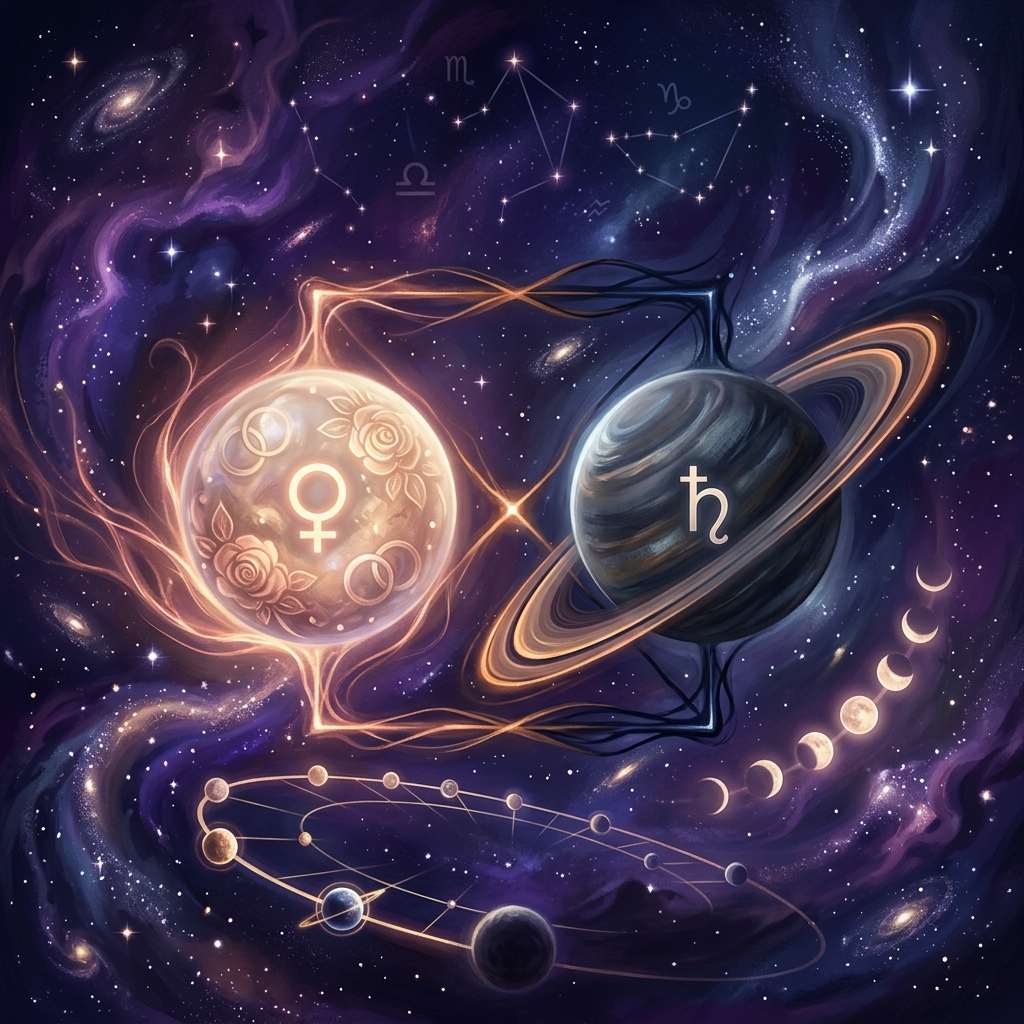
Venus is the planet of love, pleasure and the things we value. Saturn is the slow, cold planet of limits, time and duty. When the two stand at a right angle, astrologers call it Venus square Saturn. Online, it has a grim name. People call it the loneliness aspect, or the love-is-late aspect.
This guide checks that reputation against numbers. We counted how many birth charts hold this square. We counted how the sky repeats it. Two facts came out. First, about one chart in 11 has it, which is exactly what chance predicts. Second, if you were born with it, Saturn comes back to test it on a fixed clock. That clock runs about 29 years, with a checkpoint halfway.
What Venus square Saturn means in a birth chart
An aspect is an angle between two planets, measured along the circle of the zodiac. A conjunction is 0°: the two planets sit side by side. A square is 90°: a quarter of the circle apart, like clock hands at three o’clock. Saturn square Venus is the same aspect, named the other way round.
Your natal chart, or birth chart, is a map of the sky at the moment you were born. Think of it as a house with twelve rooms. Each room covers one part of life, and the planets are the furniture. A square is two pieces of furniture that block each other’s door. Every time you cross the room, you bump into the same corner.
No square is ever perfect. The orb is the gap astrologers allow around the exact angle. With an 8° orb, Venus at 10° Cancer and Saturn at 15° Aries still count as square. Most modern astrologers use 6° to 8° for Venus and Saturn. A tight orb, under 3°, is read as the loudest version.
The idea of good and hard angles is old. In the second century, Ptolemy sorted the angles in his Tetrabiblos (book I, chapter 13). He called the trine and the sextile harmonious. He called the square and the opposition disharmonious. In 1647, the English astrologer William Lilly wrote Christian Astrology. He gave each planet its own orb, wider for some and tighter for others.
The two planets matter as much as the angle. In the Hellenistic tradition, Venus is the lesser benefic. That tradition comes from the Greek-speaking astrologers of roughly 100 BC to 600 AD, where Western astrology begins. A benefic is a planet that brings ease and gifts. Saturn is the greater malefic, the planet that brings delay, weight and loss. A square between them is a meeting of the softest planet and the hardest one.
How common is natal Venus square Saturn?
We measured it. We drew 200,000 moments at random between 1950 and 2010. For each one, we computed where Venus and Saturn stood, using the Swiss Ephemeris. That is the standard planetary table used by astrology software. We used the tropical zodiac, the one Western astrologers use. Then we checked the angle between the two planets.
The result: 8.73% of those charts hold Venus square Saturn within 8°. With a tight 3° orb, the share drops to 3.31%. That is about one person in 11, or one in 30 for the tight version. Venus and Saturn move fast enough that the hour of birth does not matter here. The date is enough. The Sun and the Moon are different: they need a birth time to be placed with care.
We then checked the result a second way. Instead of random draws, we stepped through time at even intervals, every few hours. Over 1950 to 2010, that gave 8.68%, close to the random draw. Over a much longer window, 27 full turns of Saturn from 1613 to 2408, it gave 8.90%. Pure chance predicts 8.89%. A square has two sides, left and right, and each side is 16° wide with an 8° orb. That is 32° out of 360°.
So the long-run answer is simple. Venus square Saturn is not rare, and it is not common. It shows up at the rate you would expect from two planets that ignore each other. Its fame comes from its meaning, not from its numbers.
Your birth decade still moves the odds
Over a single decade, the share swings. Venus repeats its pattern with the Sun about every eight years. Saturn only covers about a third of the zodiac in ten years. So some decades line the two up more than others. Here is what the random draw gave, by decade of birth, with an 8° orb.
| Birth decade | Charts with Venus square Saturn. |
|---|---|
| 1950s | 7.2% of charts. |
| 1960s | 9.3% of charts. |
| 1970s | 7.82% of charts. |
| 1980s | 10.35% of charts. |
| 1990s | 10.25% of charts. |
| 2000s | 7.5% of charts. |
People born in the 1980s and 1990s got it about one time in ten. People born in the 1950s got it about one time in 14. Neither group is cursed or blessed. The sky simply spent more days in this shape in some years.
What the square says about love, money and worth
Venus rules what we love and what we find beautiful. She also rules what we value, which includes money and self-worth. Saturn rules rules themselves: limits, tests, time and the fear of not being enough. When Saturn squares Venus, the chart links pleasure to effort. Love does not arrive free. It has to be earned, or so the person feels.
Astrologers describe the same few patterns again and again. The person holds back affection until it feels safe. They test a partner before they trust them. They judge their own looks or worth with a hard eye. They take love seriously, sometimes too seriously to enjoy it. Commitment, once made, is solid.
In his 1940 book The Combination of Stellar Influences, the German astrologer Reinhold Ebertin gave short notes for each planet pair. For Venus and Saturn, his notes point two ways. On one side sit duty, sobriety and faithfulness. On the other sit inhibition, coolness and separation. The square, as a hard angle, leans on the second list first. Over time, the first list grows.
Liz Greene’s 1976 book Saturn: A New Look at an Old Devil changed how many astrologers read Saturn. She treated Saturn less as bad luck and more as a place of fear and defense. In her reading, the wall Saturn builds is also the place where real strength forms. Applied to Venus, that means the guarded heart can become a loyal and steady one. Stephen Arroyo, in his own books, also framed Saturn as a teacher of structure rather than a punisher.
Sue Tompkins, in Aspects in Astrology (2002), stresses that a square is not a fixed fate. It is friction that asks for action. A trine between the same two planets brings the themes with less effort. A square brings them with more effort, and more growth.
What changes the reading
One aspect never tells the whole story. Astrologers look at a few more things before they say anything about a real person.
- The signs. Venus in Cancer square Saturn in Aries feels different from Venus in Capricorn square Saturn in Aries.
- The houses, the twelve rooms. Saturn in the 7th room, the room of partners, puts the weight on relationships.
- The orb. A 1° square speaks louder than a 7° one.
- Other aspects. A trine from Jupiter to Venus softens the picture a great deal.
- Applying or separating. An applying aspect is still getting closer at birth. Some astrologers read it as stronger.
The 29-year echo: why Saturn keeps coming back to it
Here is the part most guides skip. If you were born with Venus square Saturn, the square is built into your Saturn clock.
Saturn takes about 29.5 years to go around the zodiac. When it gets back to the spot it held at your birth, astrologers call that your Saturn return. Our Saturn return guide covers the timing in full. Now think about the geometry. At birth, Saturn stood 90° from your Venus. When Saturn comes back to that same spot, it stands 90° from your Venus again. Your Saturn return is also a Saturn square to your natal Venus.
The same thing happens halfway round. When Saturn reaches the point opposite its birth place, it is still 90° from your Venus, just from the other side. That falls around the midpoint of each 29-year cycle. So people born with this square meet the same angle again in their teens, around 29, in their mid-forties and again near 59.
This is the echo in our title. For most people, the Saturn return is about career and adult life. For people with natal Venus square Saturn, it lands squarely on love and worth as well. Astrologers who work with this aspect say the second and third rounds are easier than the first. The person knows the corner by then.
Transit Saturn square natal Venus: one pass or three?
A transit is a planet’s current place in the sky, compared with your birth chart. Anyone can have Saturn square their natal Venus by transit, with or without the natal square. It happens twice in every Saturn cycle: once as Saturn climbs, once as it falls.
How long does it last? We tested 120 natal Venus positions, spread around the zodiac, against Saturn’s real path from 1900 to 2100. We counted every time Saturn came within 1° of an exact square. The answer splits in two.
- One pass, 46.1% of the time. Saturn moves straight through. It stays within 1° for about 17 days.
- Three passes, 53.9% of the time. Saturn crosses the exact angle, turns back, crosses again, then turns forward and crosses a third time.
That turning back is called retrograde. Planets sometimes appear to move backwards from where we stand on Earth. For a three-pass transit, the first and last exact hits sit about 284 days apart, a little over nine months. Saturn spends about 78 of those days within 1° of the exact square.
So “Saturn square Venus” can mean two very different things. For one person, it is a sharp two-week pinch. For another, it is a slow nine-month season. A chart reading should say which one you are in.
Venus square Saturn transit dates through 2028
The other kind of transit is fast. Venus in the sky squares Saturn in the sky, and the whole world gets the same date. Between 1950 and 2049, this happens about twice a year on average. The exact count per year runs from one to four. The gap between two hits ranges from 13 days to about nine months.
Saturn entered Aries for good in mid-February 2026 and stays there until April 2028. In tradition, Aries is the sign where Saturn is weakest, called its fall. Our page on Saturn in Aries explains why. While Saturn sits in Aries, Venus squares it from Cancer and from Capricorn. Here are the exact moments, in UTC and in New York time.
| Exact square (UTC) | New York time | Where the planets stand. |
|---|---|---|
| Aug 1, 2025, 13:34 UTC | Aug 1, 9:34 a.m. | Venus 1°37′ Cancer, Saturn 1°37′ Aries. |
| Dec 21, 2025, 05:08 UTC | Dec 21, 12:08 a.m. | Venus 25°37′ Sagittarius, Saturn 25°37′ Pisces. |
| May 29, 2026, 03:02 UTC | May 28, 11:02 p.m. | Venus 11°59′ Cancer, Saturn 11°59′ Aries. |
| Feb 13, 2027, 11:40 UTC | Feb 13, 6:40 a.m. | Venus 11°25′ Capricorn, Saturn 11°25′ Aries. |
| Jul 25, 2027, 15:19 UTC | Jul 25, 11:19 a.m. | Venus 27°40′ Cancer, Saturn 27°40′ Aries. |
| Dec 12, 2027, 14:12 UTC | Dec 12, 9:12 a.m. | Venus 21°08′ Capricorn, Saturn 21°08′ Aries. |
| Sep 15, 2028, 17:19 UTC | Sep 15, 1:19 p.m. | Venus 10°49′ Leo, Saturn 10°49′ Taurus. |
Note the third row. In UTC it falls on May 29, 2026, but in New York it was still the evening of May 28. The next one, on February 13, 2027, is the first square of the year. After that comes a long gap. Venus turns retrograde in 2028, and the sky goes nine months without a Venus square Saturn.
These sky squares are short. Venus moves about 1° to 1.25° a day, so it stays within 1° of exact for less than two days. Astrologers read them as small weather: a cool date night, a hard talk about money, a bill that comes due. They matter more when they also touch a point in your own chart.
Venus square Saturn in synastry
Synastry is the comparison of two birth charts, laid one over the other. You can read more in our guide to synastry charts. Venus square Saturn in synastry means one person’s Venus sits 90° from the other person’s Saturn.
The roles are not equal. The Venus person brings warmth and wants to be enjoyed. The Saturn person brings structure and wants things to last. In the hard version, the Venus person feels judged or held at arm’s length. The Saturn person feels pushed to give more than they are ready to give.
Astrologers do not read this as a no. They read it as a pace problem. Saturn contacts are counted among the bonds that keep couples together over time. The square adds a test to that bond. Couples who talk plainly about money, time and affection get the steady side of it.
The same contact can go both ways. If her Venus squares his Saturn and his Venus also squares her Saturn, the test runs in both directions. That is a double contact, and astrologers weigh it more heavily.
How to read your own Venus square Saturn
Start with the facts. Find the orb: under 3° is tight, over 6° is loose. Find the signs and the rooms. Look for a softer aspect to Venus from Jupiter or the Moon.
Then look at the clock. Note your Saturn return year and the year halfway between. Those are your echo years. Note when transit Saturn will next square your natal Venus, and whether it is a one-pass or three-pass season.
Finally, read the pair, not the label. Our page on the planet Venus explains what she rules in a chart. Our page on the planet Saturn explains why his lessons take time. For the angle itself, see our guide to the square aspect. The guide to all the aspects places it among the others.
Astrology is a tradition, not a science. It does not decide who loves you. It gives words to a pattern so you can look at it.
Frequently asked questions
What happens when Venus squares Saturn?
In the sky, Venus stands 90° from Saturn. In a birth chart, tradition reads it as love and worth meeting limits and tests. Affection comes with care, and commitment, once given, is solid.
How common is Venus square Saturn in a birth chart?
About one chart in 11 has it within an 8° orb: 8.73% in our draw of 200,000 moments from 1950 to 2010. Within 3°, it drops to 3.31%. Over 27 Saturn cycles, the share is 8.90%, the rate pure chance predicts.
How long does transit Saturn square Venus last?
It depends on Saturn’s path. In 46.1% of cases, Saturn passes once and stays within 1° for about 17 days. In 53.9%, it passes three times because of its retrograde turn, over about nine months.
What does Venus square Saturn mean in synastry?
One person’s Venus is 90° from the other person’s Saturn. The Venus person can feel judged, and the Saturn person can feel pushed. Astrologers read it as a test of pace inside a bond built to last.
What does a Venus square Saturn composite chart mean?
A composite chart is one chart made from the midpoints of two people’s planets. Venus square Saturn there describes the couple, not either person. Tradition reads it as a bond that has to work for its pleasure, and earns its stability.
Go deeper with your personal Astrovision report
Reading about astrological concepts is a great start, but nothing compares to hearing how they apply directly to you. Our users love our audio-first approach, calling it “friendly, personal, and easy to understand.” While this article gives you the “what,” a personal report gives you the “so what.” Discover your unique path with an Astrovision report—your personal ‘user manual’ delivered in our celebrated podcast format.