
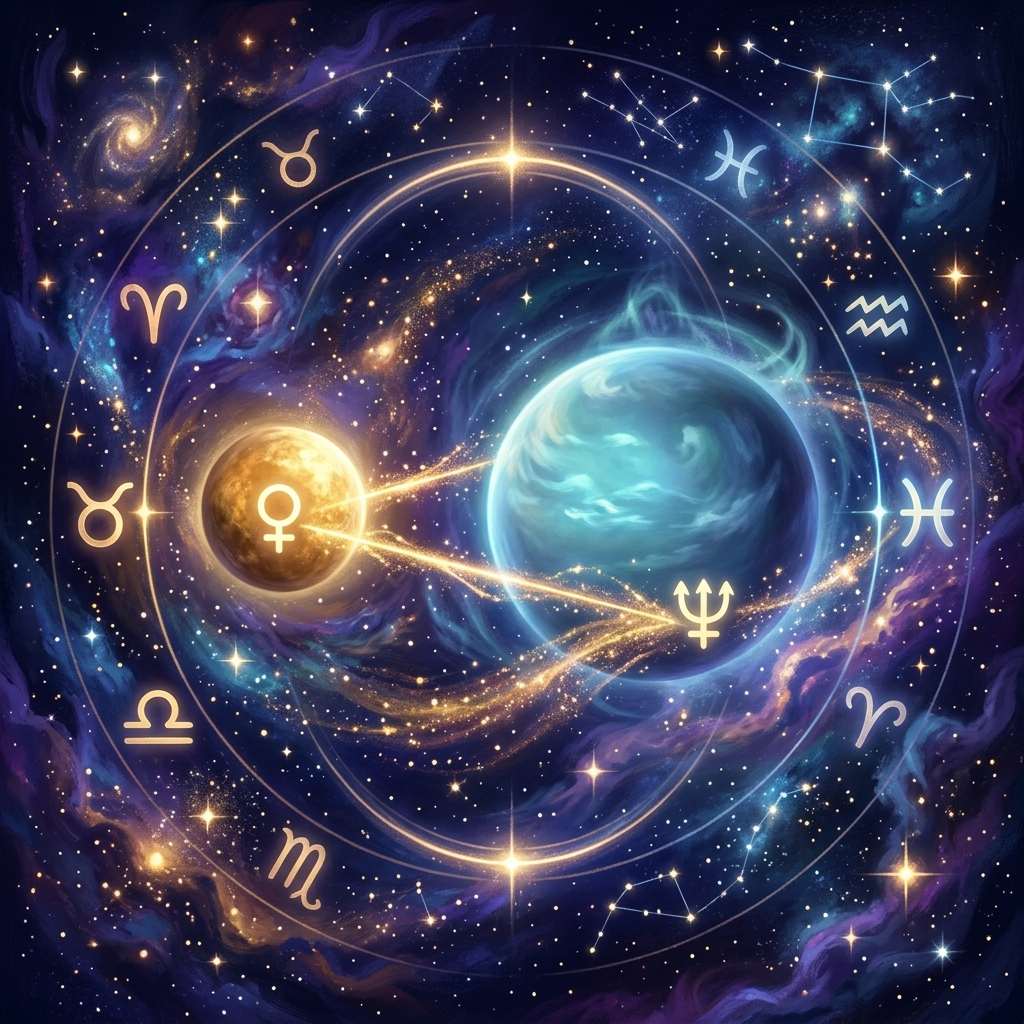
Venus trine Neptune is a soft link between the planet of love and the planet of dreams. Most guides call Neptune aspects a mark of a whole generation. This one is not. Neptune barely moves in a year, but Venus laps the whole sky. So whether you have this trine depends on the week you were born, not the decade. We measured it. The sky opens a window of about 13 days, roughly twice a year. About 1 birth chart in 11 falls inside one.
First, four words you will see again. An aspect is an angle between two planets, measured along the band of sky the Sun, Moon and planets move through. A trine is the aspect of 120°: one third of the circle. The orb is the gap an astrologer allows around the exact angle before the link stops counting. A transit is a planet’s position in the sky today, compared with your birth chart. Our guide to aspects in astrology and how planets argue covers every other angle.
What does Venus trine Neptune mean in a natal chart?
Think of a birth chart as a house with twelve rooms. Each room covers one part of life, and the planets are the furniture. Your natal chart is the map of that house at the moment you were born. With a trine, two pieces of furniture stand in rooms that share the same style. They match without any effort.
Venus is the rug that makes a room feel warm. In astrology it stands for love, taste, beauty, pleasure and the wish to draw people close. It asks, “What do I like, and who do I want near me?” Our page on what Venus means beyond the planet of love covers its full role.
Neptune is the soft light that fills the house at dusk. It stands for dreams, music, faith, longing and the urge to merge with something larger. It also stands for fog, where edges blur and things look better than they are. Our page on Neptune, the planet of dreams and fog explains the planet in depth.
Put the two in a trine and taste meets imagination. According to the tradition, the person sees beauty where others see nothing special. Love feels like art, and art feels like love. The ideal is gentle rather than wild. Compassion comes easily, and so does forgiveness.
The trine itself has old roots. Claudius Ptolemy wrote the Tetrabiblos, a Greek textbook of astrology, around 150 AD. In book I, chapter 13, he sorts the angles into two groups. The trine and the sextile are harmonious. The square and the opposition are not. Our page on the 120° trine and why it feels easy covers that idea in full.
Ptolemy never wrote about Neptune, though. No one saw the planet until 1846. Its meanings come from modern astrologers. In 1940 the German astrologer Reinhold Ebertin wrote The Combination of Stellar Influences, a handbook of planet pairs. He links Venus and Neptune to imagination and to a longing for an ideal love. Liz Greene gave Neptune a whole book in 1996, The Astrological Neptune and the Quest for Redemption. She reads the planet as the wish to return to a lost paradise.
The gift and the trap of an easy aspect
A trine is easy. That is its gift, and also its trap. Modern writers, Sue Tompkins among them in Aspects in Astrology (2002), stress that an easy aspect is not the same as a used one. Talent that costs nothing can sit in the corner unused.
Here is how the tradition reads the gift side:
- An eye and an ear for beauty, in music, film, photos, color or dance.
- Kindness that does not keep score.
- Romance that feels a little like a film, in a good way.
- Calm in the face of other people’s moods.
And here is the trap side:
- Seeing a partner as you wish they were, not as they are.
- Saying yes to keep the peace, then feeling drained.
- Waiting for inspiration instead of doing the work.
The square between the same two planets is the loud version of these traps. The trine is the quiet version. Nothing forces you to look at it. That is why some people with this trine never notice it at all.
When the two planets meet at the same degree, the blend is stronger still, as our page on Venus conjunct Neptune explains.
A simple test helps. Take one dream you hold about love or art. Then ask what it would look like on a normal Tuesday. If you can answer, the trine is working for you. If the dream goes blank, the fog is doing the talking.
How common is Venus trine Neptune? We counted
To find out, we drew 200,000 moments at random between 1950 and 2010. For each one we placed Venus and Neptune with the Swiss Ephemeris, the standard tables astrologers use for planet positions. We used the tropical zodiac, the one tied to the seasons that most Western astrologers use. Then we checked a second way. We stepped through the same 60 years every six hours and timed each window directly.
| Measure | Result. |
|---|---|
| Charts within 8° of the trine, 1950 to 2010 | 8.99% at random, 8.96% by steps. |
| Charts within 3° of the trine, 1950 to 2010 | 3.43% at random, 3.39% by steps. |
| Charts within 8°, over 800 years | 8.74% from 1600 to 2400. |
| Exact trines from 1950 to 2010 | 130 hits, about 2.2 a year. |
| Usual time inside 3° | About 5 days per pass. |
| Usual time inside 8° | About 13 days per pass. |
So an 8° orb catches about 1 chart in 11. A 3° orb catches about 1 in 30. These are close to what pure chance on a circle gives. A trine has two target points, one on each side, and each is 16° wide at an 8° orb. That is 32° out of 360°, or 8.9%.
One thing to know before you check your own chart: Venus and Neptune do not need a birth time. Both move slowly enough over a day that the date alone settles the question, unless the angle sits right at the edge of the orb. The Moon and the houses are the parts that need the hour.
Why the week of birth matters more than the year
Neptune takes about 165 years to go around the zodiac, the belt of twelve signs. It spends some 14 years in each sign and moves only about two degrees a year. For a year, it is nearly a fixed point.
Venus is the opposite. It goes around the zodiac about once a year, at roughly a degree a day. So twice a year, it sweeps across one of the two points 120° from Neptune. It crosses the 16° band in about two weeks. Then the window shuts for months. Across our 60 years, the median gap between windows was about six months. The shortest was nine days, and the longest about ten months.
This is why Venus trine Neptune is not a generation mark. Two siblings born a month apart can differ. One has the trine, the other does not. Two strangers born the same week of the same year almost always share it, or both lack it.
There is one twist. Every year and a half or so, Venus turns retrograde. Planets sometimes seem to move backwards from where we stand on Earth, and that is what retrograde means. When that backward loop lands on a trine point, Venus crosses it three times. The window then stretches from two weeks to about two months.
| Year | Time inside 8° when Venus looped back. |
|---|---|
| 1956 | About 60 days. |
| 1977 | About 69 days. |
| 1983 | About 54 days. |
| 2004 | About 60 days. |
Those long windows explain a pattern in the decade figures. The share of charts with the trine at 8° was 10.1% in the 1950s and 10.13% in the 1970s. It fell to 7.64% in the 1960s and 7.72% in the 1990s. The 1960s and the 1990s had no retrograde loop on a trine point. The other decades each had one. So it is still the week that decides, but some years have a much longer lucky week.
Which Venus signs make the trine for your birth years?
A trine almost always links two signs of the same element: fire, earth, air or water. Since Neptune sits in one sign for years, your birth years tell you which Venus signs can make the trine. Neptune moves back and forth across each border for a year or so, so the edge years can go either way.
| Born between | Neptune in | Venus signs that can form the trine. |
|---|---|---|
| Mid 1943 and late 1956 | Libra | Gemini or Aquarius. |
| Late 1956 and late 1970 | Scorpio | Cancer or Pisces. |
| Late 1970 and late 1984 | Sagittarius | Aries or Leo. |
| Late 1984 and late 1998 | Capricorn | Taurus or Virgo. |
| Late 1998 and early 2012 | Aquarius | Gemini or Libra. |
| Early 2012 and early 2026 | Pisces | Cancer or Scorpio. |
| Early 2026 and early 2039 | Aries | Leo or Sagittarius. |
The exact border dates, in UTC, came from the same tables. Neptune entered Scorpio for good on August 6, 1957, and Sagittarius on November 6, 1970. It entered Capricorn on November 21, 1984, and Aquarius on November 28, 1998. It settled in Pisces on February 3, 2012, and in Aries on January 26, 2026. Our page on Neptune in Aries and the babies born with it covers the newest stay.
A trine near the edge of a sign can cross into the wrong element. Astrologers call this an out-of-sign trine. Say Neptune sits at 29° Pisces and Venus at 1° Sagittarius. The angle is 122°, inside the orb. Yet Pisces and Sagittarius are not of the same element. Some astrologers count it. Others treat it as weaker.
When does the sky make Venus trine Neptune again?
When today’s Venus makes a trine to today’s Neptune, it is a sky event for everyone. Astrologers read it as a mild, short mood. According to the tradition, it suits art, music, a kind word or a gentle date. It is not a time to sign a contract or buy on a whim, since Neptune also brings fog.
Here are the exact moments, from the Swiss Ephemeris. Times are in UTC, with New York time beside them. Note that 2026 had only one. Venus turned retrograde from October 3 to November 14, 2026, and only reached Sagittarius on January 7, 2027.
| Exact moment (UTC) | New York time | Where the planets stand. |
|---|---|---|
| August 26, 2025, 22:18 | 6:18 pm on August 26 | Venus 1° Leo, Neptune 1° Aries. |
| November 30, 2025, 08:48 | 3:48 am on November 30 | Venus 29° Scorpio, Neptune 29° Pisces. |
| June 17, 2026, 03:40 | 11:40 pm on June 16 | Venus 4° Leo, Neptune 4° Aries. |
| January 9, 2027, 02:44 | 9:44 pm on January 8 | Venus 1° Sagittarius, Neptune 1° Aries. |
| August 1, 2027, 19:32 | 3:32 pm on August 1 | Venus 6° Leo, Neptune 6° Aries. |
| November 4, 2027, 18:37 | 2:37 pm on November 4 | Venus 4° Sagittarius, Neptune 4° Aries. |
| September 13, 2028, 03:41 | 11:41 pm on September 12 | Venus 7° Leo, Neptune 7° Aries. |
| December 20, 2028, 00:38 | 7:38 pm on December 19 | Venus 6° Sagittarius, Neptune 6° Aries. |
Each of these lasts about five days inside 3°, and about two weeks inside 8°. With Neptune in Aries until 2039, every pass now runs through the fire signs Leo and Sagittarius. The next one, in January 2027, has Venus at the start of Sagittarius.
A personal transit is different. That is when today’s Venus or today’s Neptune makes a trine to your own birth Venus or Neptune. Transiting Venus touches your birth Neptune twice a year for a few days. Transiting Neptune, which crawls, can sit in trine to your birth Venus for a year or more. Its slow loops back and forth cross the same degree up to three times. Astrologers read that long transit as a season of softer love, more art and more need for clear limits.
Venus trine Neptune in synastry
Synastry is the art of laying two birth charts side by side to read a couple. Here it means that one person’s Venus sits about 120° from the other person’s Neptune. Our page on how synastry charts compare two people explains the method.
According to the tradition, the Venus person feels seen in a gentle, almost magic light. The Neptune person finds in the Venus person a picture of the love they dreamed of. It is a link for art made together, music shared, and quiet kindness. The trap is the same as in a single chart. Each can love an image instead of the real person.
We checked how common it is. We paired 60,000 random birth moments from 1950 to 2010. One person’s Venus fell within 8° of the trine to the other’s Neptune in 8.7% of pairs. Counting both directions, about 1 couple in 6 has the link. Both directions at once came up in less than 1 pair in 100. Pairs born within five years of each other gave the same numbers.
So the link is common enough that it cannot carry a relationship alone. It is a mood, not a verdict. Read it with the rest of the two charts.
How to work with this trine
Astrology is a symbolic language, not a science. It does not predict who you will love. Still, a symbol can be a useful mirror. Here are a few ways people use this one:
- Give the dreamy side a form. Write, paint, sing, cook or take photos. A trine likes to be used.
- Check a new crush against facts. Ask a friend what they see.
- Keep one clear limit in every close bond, and say it out loud.
- Use the transit windows above for gentle plans, not big promises.
If you were born in one of the long retrograde years, the tradition says the theme runs a little louder. If you were born in a short window, it is a light touch. In both cases, the rest of the chart sets the tone.
Venus trine Neptune: questions and answers
Is Venus trine Neptune rare?
No. About 1 birth chart in 11 has it within an 8° orb, and about 1 in 30 within 3°. We measured this on 200,000 random moments from 1950 to 2010 with the Swiss Ephemeris. It is close to what chance on a circle predicts.
What do Venus and Neptune have in common?
Both deal with love and beauty. Venus wants what is lovely and near. Neptune wants what is ideal and far. In the tradition, Venus is exalted in Pisces, the sign modern astrologers give to Neptune. That shared sign is why the two are seen as close kin.
How long does the Venus trine Neptune transit last?
Transiting Venus stays within 3° of the trine for about five days, and within 8° for about two weeks. When Venus turns retrograde near the trine point, the window can stretch to one or two months. It ran about two months in 2004, and about a month in 2018.
Is Venus trine Neptune a soulmate aspect?
Some astrologers call it one, because it links love with a sense of the ideal. Yet about 1 couple in 6 has it in at least one direction. It shows a gentle, dreamy bond, not proof of fate. The rest of the two charts matters more.
Is Neptune trine Venus the same as Venus trine Neptune?
In a single birth chart, yes. The angle is the same whichever planet you name first. In synastry and transits, the order tells you whose planet is whose. Neptune trine Venus usually means transiting Neptune touching your birth Venus, a slow event that lasts many months.
Go deeper with your personal Astrovision report
Reading about astrological concepts is a great start, but nothing compares to hearing how they apply directly to you. Our users love our audio-first approach, calling it “friendly, personal, and easy to understand.” While this article gives you the “what,” a personal report gives you the “so what.” Discover your unique path with an Astrovision report—your personal ‘user manual’ delivered in our celebrated podcast format.