
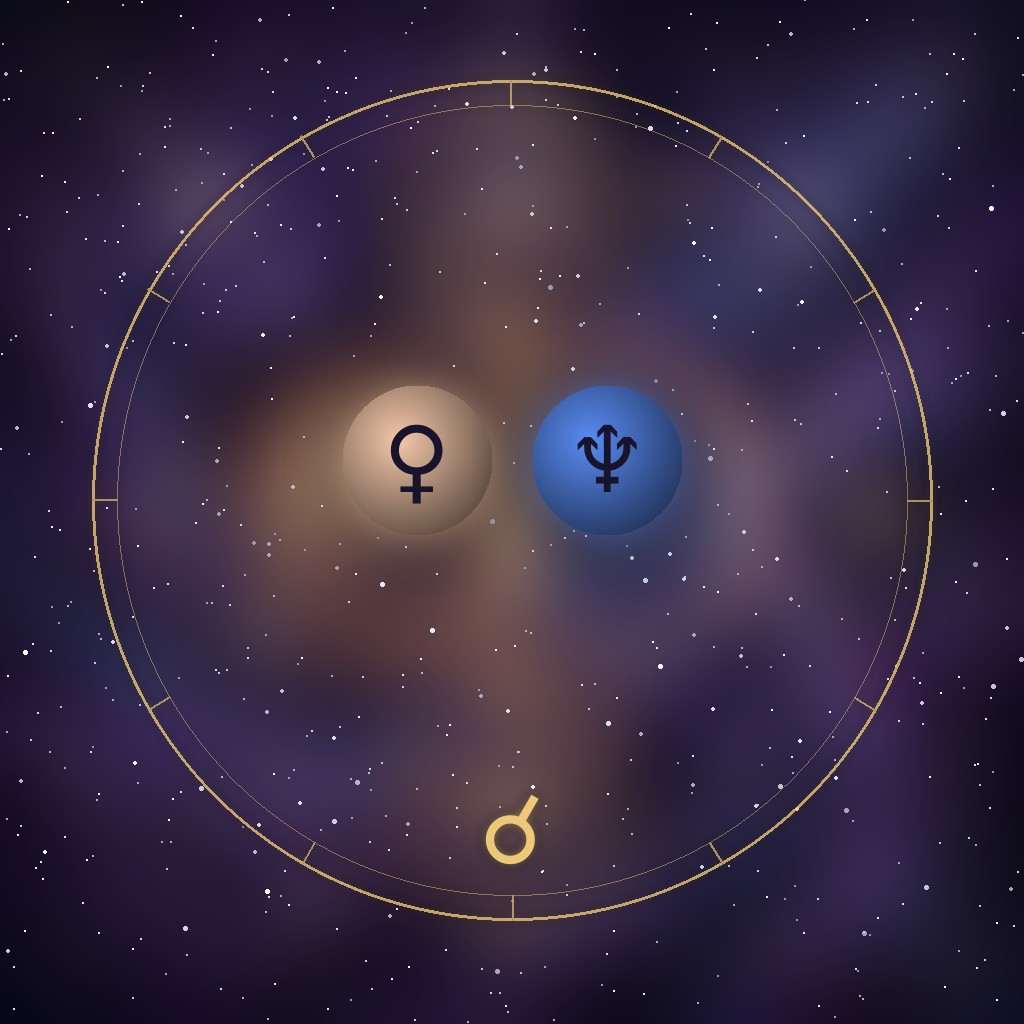
Venus conjunct Neptune is the meeting of the planet of love with the planet of dreams. Most years, the two meet in the sky once. In 2025 they met three times in a row, and the third meeting took place in a brand new sign. We timed every meeting from 1600 to 2400 to see how rare that is. This page explains what the conjunction means in a birth chart, how many people have it, why the Sun is always close by, and when the sky repeats it.
First, four words you will see again. An aspect is an angle between two planets, measured along the band of sky the Sun, Moon and planets move through. A conjunction is the aspect of 0°: the two planets stand at the same spot. The orb is the gap an astrologer allows around the exact angle before the link stops counting. A transit is a planet’s position in the sky today, compared with your birth chart. Our guide to aspects in astrology and how planets argue covers every other angle.
What does Venus conjunct Neptune mean in a natal chart?
Think of a birth chart as a house with twelve rooms. Each room covers one part of life, and the planets are the furniture. Your natal chart is the map of that house at the moment you were born. With a conjunction, two pieces of furniture stand in the same room, pushed so close that they look like one piece.
Venus is the rug that makes a room feel warm. In astrology it stands for love, taste, beauty, pleasure and the wish to draw people close. It asks, “What do I like, and who do I want near me?” Our page on what Venus means beyond the planet of love covers its full role.
Neptune is the soft light that fills the house at dusk. It stands for dreams, music, faith, longing and the urge to merge with something larger. It also stands for fog, where edges blur and things look better than they are. Our page on Neptune, the planet of dreams and fog explains the planet in depth.
Fuse the two and you get love seen through a soft lens. According to the tradition, the person falls for the ideal more than the face. Beauty, music and art move them deeply. They forgive fast and give a lot. The same lens can hide red flags, so the gift and the trap come in one package.
The idea of a conjunction is very old. Claudius Ptolemy wrote the Tetrabiblos, a Greek textbook of astrology, around 150 AD. In book I, chapter 13, he lists the angles between signs: the opposition, the trine, the square and the sextile. The conjunction is not on that list. For the Greek astrologers, two planets in one place did not look at each other. They were simply together, and their natures mixed. Our page on the 0° conjunction and how two planets blend covers that idea in full.
Ptolemy never wrote about Neptune, though. No one saw the planet until 1846. Its meanings come from modern astrologers. In 1940 the German astrologer Reinhold Ebertin wrote The Combination of Stellar Influences, a handbook of planet pairs. He links Venus and Neptune to a rich fantasy life and a longing for an ideal love. Liz Greene gave Neptune a whole book in 1996, The Astrological Neptune and the Quest for Redemption. She reads the planet as the wish to return to a lost paradise. With Venus fused to it, that paradise wears the face of a lover.
One piece of furniture, two natures
A conjunction is neither easy nor hard by itself. It is intense. The two planets act as one, and the mix depends on the rest of the chart. Modern writers, Sue Tompkins among them in Aspects in Astrology (2002), read a conjunction through the two planets in it, not as good or bad in itself.
The softer, 120-degree version of this pair has its own page: Venus trine Neptune.
Here is how the tradition reads the gift side:
- A fine eye and ear for color, sound, film, dance or verse.
- Warmth that reaches strangers, animals and lost causes.
- Romance with a touch of the sacred, as if love were a kind of prayer.
- A gift for sensing what another person feels before they say it.
And here is the trap side:
- Falling for potential, then waiting years for it to show up.
- Giving until there is nothing left, then feeling used.
- Choosing partners who need saving.
- Loose limits around money spent on beauty or on others.
A simple test helps. Pick one person you idealize, or once did. Write three facts about them and three hopes. If the two lists look the same, the fog is at work. If you can tell them apart, the lens is serving you.
How common is Venus conjunct Neptune? We counted
To find out, we drew 200,000 moments at random between 1950 and 2010. For each one we placed Venus and Neptune with the Swiss Ephemeris, the standard tables astrologers use for planet positions. We used the tropical zodiac, the one tied to the seasons that most Western astrologers use. Then we checked a second way. We stepped through the same 60 years every six hours and timed each window directly. Last, we ran the steps over 800 years, from 1600 to 2400, to see if our 60 years were typical.
| Measure | Result. |
|---|---|
| Charts within 8° of the conjunction, 1950 to 2010 | 4.55% at random, 4.46% by steps. |
| Charts within 3° of the conjunction, 1950 to 2010 | 1.68% at random, 1.67% by steps. |
| Charts within 8°, over 800 years | 4.57% from 1600 to 2400. |
| Exact meetings from 1950 to 2010 | 63 hits, about one a year. |
| Exact meetings from 1600 to 2400 | 841 hits, about 1.05 a year. |
| Usual time inside 8° | About 13 days per pass. |
So an 8° orb catches about 1 chart in 22. A tight 3° orb catches about 1 in 60. That is close to what pure chance on a circle gives. The target is one point, 16° wide at an 8° orb. That is 16° out of 360°, or 4.4%.
One thing to know before you check your own chart: you do not need a birth time. Venus moves about one degree a day, and Neptune barely moves at all. The date alone settles the question, unless the gap sits right at the edge of the orb. The Moon and the houses are the parts that need the hour.
Why the Sun is never far from this pair
Here is a fact most guides skip. Seen from Earth, Venus never strays more than about 47° from the Sun. It is the morning star or the evening star, never the midnight star. So when Venus sits on top of Neptune, the Sun has to be near Neptune too.
We checked this on 20,000 random charts with Venus within 8° of Neptune. The Sun was never more than 55° from Neptune. Half the time it was within 31°. In about one chart in four, the Sun and Neptune stood in the very same sign.
This has a neat result. The conjunction can only happen in the months when the Sun is near Neptune. Neptune moves so slowly that this season shifts by only about a month every 14 years. So your birth years tell you the sign of your conjunction, and your birth month tells you if you could have it at all.
| Born between | Conjunction falls in | Months it happened. |
|---|---|---|
| Mid 1943 and late 1956 | Libra | August to November. |
| Late 1956 and late 1970 | Scorpio | September to December. |
| Late 1970 and late 1984 | Sagittarius | October to January. |
| Late 1984 and late 1998 | Capricorn | November to February. |
| Late 1998 and early 2012 | Aquarius | December to March. |
| Early 2012 and early 2026 | Pisces | January to April. |
| Early 2026 and early 2039 | Aries | February to May. |
The table lists the months of every exact meeting from 1943 to 2039. In most years, only one of those months holds the meeting. Neptune moves back and forth across each sign border for a year or so, so the edge years can go either way.
So a person born in July 1990 cannot have Venus conjunct Neptune. Neptune stood in Capricorn, and the Sun was far away, on the other side of the sky. Someone born in mid November 1989 has it. The exact meeting came on November 15, 1989, at 10° Capricorn, with the Sun close by in Scorpio.
Three meetings in 2025: when Venus loops back
Most years, Venus passes Neptune once, in about two weeks, and moves on. Every year and a half or so, though, Venus turns retrograde. Planets sometimes seem to move backwards from where we stand on Earth, and that is what retrograde means. When that backward loop lands on Neptune, Venus crosses it three times. Astrologers call this a triple conjunction.
That is what happened in 2025. The exact moments, in UTC, from the Swiss Ephemeris:
| Exact moment (UTC) | New York time | Where the two planets stood. |
|---|---|---|
| February 1, 2025, 16:33 | 11:33 am on February 1 | Both at 27°59′ Pisces. |
| March 27, 2025, 13:13 | 9:13 am on March 27 | Both at 29°53′ Pisces, Venus moving backwards. |
| May 2, 2025, 17:06 | 1:06 pm on May 2 | Both at 1°08′ Aries. |
The second meeting came three days before Neptune first crossed into Aries, on March 30, 2025. The third took place in Aries itself. So 2025 gave the first Venus conjunct Neptune in Aries since April 1874. Our page on Neptune in Aries and the babies born with it tells that story.
The loop also stretched the window. In a normal year, Venus spends about 13 days inside 8° of Neptune. In 2025 it spent about 83 days there, split into two stretches. A baby born on almost any day from mid March to mid May 2025 has the conjunction. So does one born from late January to mid February 2025.
A retrograde loop of Venus always happens when Venus passes between the Earth and the Sun. So in a triple year, the Sun joins the pair. In late March 2025, the Sun, Venus and Neptune all stood within about seven degrees of the border between Pisces and Aries.
How rare is a triple Venus conjunct Neptune?
Over our 800 years, we counted 23 triple meetings. That is about one every 35 years on average. They come in runs spaced about 27 or 35 years apart. Then the run breaks for a long while.
| Triple year | Sign | Days inside 8°. |
|---|---|---|
| 1962 | Scorpio | About 69 days. |
| 1997 to 1998 | Capricorn into Aquarius | About 80 days. |
| 2025 | Pisces into Aries | About 83 days. |
| 2052 | Taurus | Next one, from early April. |
These long windows explain a pattern in the decade figures. The share of charts with the conjunction at 8° was 5.34% in the 1960s and 5.62% in the 1990s. It stayed between 3.81% and 4.59% in the other four decades. The two high decades are the two with a triple meeting.
When does the sky make Venus conjunct Neptune again?
When today’s Venus meets today’s Neptune, it is a sky event for everyone. Astrologers read it as a soft, short mood. According to the tradition, it suits music, art, prayer, a kind gesture or a quiet date. It is a poor time to sign a contract or to buy on a whim, since Neptune also brings fog.
Here are the exact moments, from the Swiss Ephemeris. Times are in UTC, with New York time beside them. With Neptune in Aries until 2039, every meeting now falls in Aries.
| Exact moment (UTC) | New York time | Where the two planets stand. |
|---|---|---|
| March 7, 2026, 11:27 | 6:27 am on March 7 | Both at 1°16′ Aries. |
| April 24, 2027, 10:55 | 6:55 am on April 24 | Both at 5°12′ Aries. |
| February 11, 2028, 12:15 | 7:15 am on February 11 | Both at 4°46′ Aries. |
| March 27, 2029, 21:30 | 5:30 pm on March 27 | Both at 8°31′ Aries. |
| May 12, 2030, 23:22 | 7:22 pm on May 12 | Both at 12°18′ Aries. |
Each one lasts about two weeks inside 8°, centered on the date above. The gap between them swings from about 9 to about 14 months. That is why 2028 has its meeting in February, but 2027 waits until April.
A personal transit is different. That is when today’s Venus or today’s Neptune meets your own birth Venus or Neptune. Transiting Venus crosses your birth Neptune about once a year, for a few days. Transiting Neptune, which crawls, can sit on your birth Venus for a year or more. Its slow loops back and forth cross the same degree up to three times. Astrologers read that long transit as a season of tender love, deep longing and blurry limits.
Venus conjunct Neptune in synastry
Synastry is the art of laying two birth charts side by side to read a couple. Here it means that one person’s Venus sits on the other person’s Neptune. Our page on how synastry charts compare two people explains the method.
According to the tradition, the Neptune person sees the Venus person as a dream come true. The Venus person feels adored, almost worshipped. It is a link for shared music, faith, art and tender care. The trap is the one from the single chart. The Neptune person can love a picture, and the Venus person can feel pressed to live up to it.
We checked how common it is. We paired 60,000 random birth moments from 1950 to 2010. One person’s Venus fell within 8° of the other’s Neptune in 4.4% of pairs. Counting both directions, about 1 couple in 11 has the link. Both directions at once came up in only 1 pair in 500. Pairs born within five years of each other gave the same numbers. So the link is a mood, not a verdict.
How to work with this conjunction
Astrology is a symbolic language, not a science. It does not predict who you will love. Still, a symbol can be a useful mirror. Stephen Arroyo framed the planets as energies we learn to use, not fates we suffer. Here are a few ways people use this one:
- Give the dream a form. Paint, sing, write, cook, dance or take photos.
- Let facts catch up with feelings. Wait three months before big promises.
- Ask a friend you trust what they see in a new crush.
- Set one firm limit on time or money given to others.
- Keep a place for the sacred, whether faith, nature or music.
FAQ
What does it mean when Venus conjuncts Neptune?
It means Venus and Neptune stand at the same spot in the sky, within a few degrees. In a birth chart, the tradition reads it as love, taste and dreams fused into one. The gift is warmth and a fine sense of beauty. The trap is loving an ideal instead of a real person.
How rare is Venus conjunct Neptune in a birth chart?
About 1 chart in 22 has it within 8°, and about 1 in 60 within 3°. We measured this on 200,000 random moments from 1950 to 2010 with the Swiss Ephemeris. Over 800 years, the 8° figure is 4.57%.
Do I need my birth time to know if I have it?
No. Venus moves about one degree a day, and Neptune barely moves. Your birth date settles it, except when the gap sits right at the edge of the orb. You need the time only for the house it falls in.
When is the next Venus conjunct Neptune?
The next exact meeting is on April 24, 2027, at 10:55 UTC, at 5° Aries. After that come February 11, 2028, and March 27, 2029. The next triple meeting, with Venus retrograde, comes in 2052, in Taurus.
What do Venus and Neptune have in common?
Both are linked to love, beauty and art in astrology. Venus covers personal love and taste, and Neptune covers ideal love and dreams. In traditional astrology, Venus is said to be exalted in Pisces, the sign modern astrologers give to Neptune. That shared sign is why many astrologers call Neptune the higher octave of Venus.
Go deeper with your personal Astrovision report
Reading about astrological concepts is a great start, but nothing compares to hearing how they apply directly to you. Our users love our audio-first approach, calling it “friendly, personal, and easy to understand.” While this article gives you the “what,” a personal report gives you the “so what.” Discover your unique path with an Astrovision report—your personal ‘user manual’ delivered in our celebrated podcast format.