
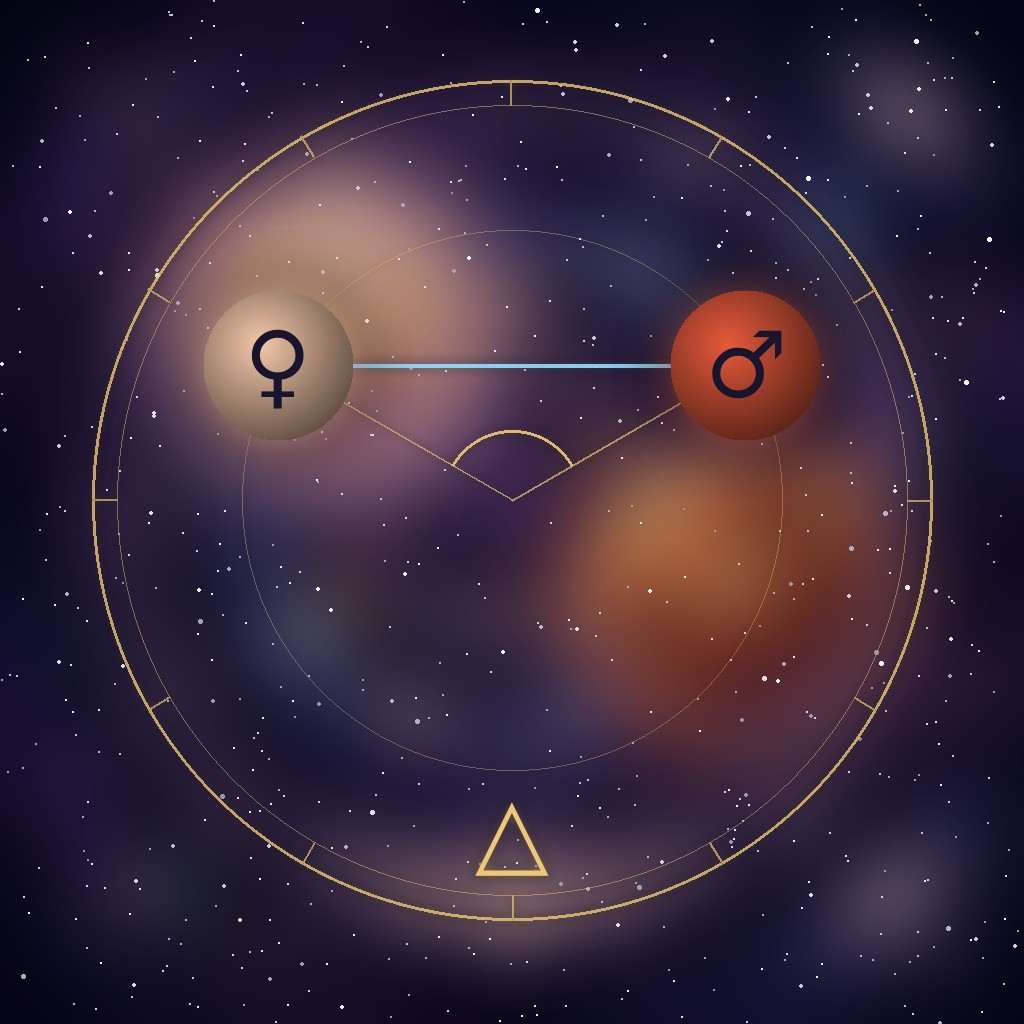
Venus trine Mars is the aspect of easy chemistry. Venus is the planet of love, taste and attraction. Mars is the planet of drive and desire. When they sit 120 degrees apart, astrologers say the two work as a team instead of a tug of war. That part you can read anywhere. What you will not read elsewhere is that the sky hands out this aspect on a strict two-year clock. In 2026, it did not hand it out at all.
We measured it. Across the whole of 2026, Venus and Mars never came closer than 19 degrees to a trine. Nobody born this year has Venus trine Mars in their birth chart. Below, you will see why, how common the aspect really is, what the tradition says it means, when the sky repeats it, and what it does between two people.
What does Venus trine Mars mean in a natal chart?
Your natal chart is a map of the sky at the minute you were born. Picture it as a house with twelve rooms. Each room covers one area of life, and the planets are the furniture. An aspect is the angle between two pieces of furniture, measured around the circle of the zodiac. It tells you how two planets talk to each other.
A trine is an angle of 120 degrees, one third of the circle. More in our guide to the trine. In the second century, the astronomer Ptolemy grouped the angles in his Tetrabiblos (book I, chapter 13). He called the trine and the sextile harmonious, and the square and the opposition hostile.
Now add the two planets. In the tradition, Venus stands for what you love, what you find beautiful, and how you invite others in. Mars stands for what you go after, how you fight, and how you act on desire. In his book The Combination of Stellar Influences (1940), the German astrologer Reinhold Ebertin read the Venus and Mars pair as the meeting of love and passion.
So the classic reading of Venus trine Mars is simple. What you want and how you go after it agree with each other. You do not have to argue yourself into a date, a project, or a hobby you love. Charm and courage come out of the same door. Astrologers describe people with this aspect as warm, at ease in their body, and natural at flirting.
There is a catch, and the British astrologer Sue Tompkins makes the general point in Aspects in Astrology (2002). Easy aspects do not push you. A square forces two planets to deal with each other. A trine lets them coast. With Venus trine Mars, the risk is not conflict. The risk is drifting toward whatever is pleasant, and walking away when love starts to take effort.
How rare is Venus trine Mars?
First, a word on the orb. Two planets are rarely at exactly 120 degrees. The orb is the margin of error astrologers accept around the exact angle. In 1647, the English astrologer William Lilly gave each planet its own orb in Christian Astrology. Today, most charts use a single margin. We tested two: a wide orb of 8 degrees, and a tight orb of 3 degrees.
Here is what we found for births between 1950 and 2010.
| Measure | Result. |
|---|---|
| Venus trine Mars, wide orb of 8 degrees | 7.5 percent of charts. |
| Venus trine Mars, tight orb of 3 degrees | 2.7 percent of charts. |
| Best decade, the 1980s | 9.8 percent of charts. |
| Worst decade, the 1990s | 5.7 percent of charts. |
| Long window, 1600 to 2400 | 6.4 percent of charts. |
So about one chart in 13 has it with a wide orb. With a tight orb, it is closer to one in 37. Your decade of birth changes the odds a lot. A baby born in the 1980s was about 1.7 times as likely to get it as a baby born in the 1990s.
The long window matters too. Sixty years is short next to the cycles of Venus and Mars. Over eight centuries, the share falls to 6.4 percent. That is below what you would expect by pure chance. If the gap between Venus and Mars were spread evenly, a 16-degree band around 120 degrees would catch 8.9 percent of the time. The trine gets less than its fair share. The sextile, an angle of 60 degrees, gets more, with about 12 percent. The next section explains why.
Why the sky skipped 2026: the two-year clock
The answer lies with the Sun. Seen from Earth, Venus never strays far from the Sun. Its orbit sits inside ours, so it always looks like it is close to the Sun. In our data, Venus never got more than 47.3 degrees away from it. Venus is a planet on a short leash.
Mars is different. Its orbit lies outside ours, so it can stand anywhere in the sky. But it does not move freely. Most of the time, Mars looks fairly close to the Sun in our sky. It only swings far away from the Sun for several months around its opposition. That is the moment when Earth passes between Mars and the Sun, and Mars shines all night. Oppositions come about every 26 months. Recent and coming ones fell or fall around December 8, 2022, January 16, 2025, and late February 2027.
Now do the sum. For Venus to reach 120 degrees from Mars, Mars has to be at least 73 degrees from the Sun. Venus can cover the other 47 degrees, but no more. We checked every exact trine from 1600 to 2400. Mars was never closer than 72.8 degrees to the Sun at any of them. Mars is that far from the Sun only 38 percent of the time, in one stretch around each opposition.
That is the clock. Every 26 months or so, Mars swings out, and Venus gets a chance to reach the trine. Between those windows, the door stays shut. From June 10, 2025 to February 2, 2027, the two planets stay outside even the wide orb. The whole of 2026 falls in that gap. It is not a fluke. Over eight centuries, 228 years out of 800 had no Venus trine Mars at all, even with the 8-degree orb. In 2017, the pair never came within 53 degrees of a trine.
This also explains the sextile. A sextile only needs 60 degrees. Venus can get there with Mars close to the Sun, which is where Mars spends most of its time. So the sextile shows up in many more months. The trine needs Mars out at the edge of its swing. In our 800 years, the sky made 893 exact trines between Venus and Mars, about 1.1 a year. It made 1,149 exact sextiles, about 1.4 a year.
How the numbers were measured
A number you cannot check is worth nothing, so here is the method. We used the Swiss Ephemeris, a standard table of planet positions, in the tropical zodiac. That is the zodiac tied to the seasons, used by most Western astrologers. First, we drew 200,000 moments at random between 1950 and 2010, and measured the angle between Venus and Mars at each one. Second, we checked that result with a regular grid, one sample every six hours over the same sixty years. Both routes gave 7.5 percent.
For the long window, we sampled every day from 1600 to 2400. For exact dates, we found each crossing of 120 degrees and narrowed it down by halving the time step. To check the empty years, we ran 2026 again with a second engine, the open-source Astronomy Engine library. It gave the same closest approach, 19.2 degrees from a trine.
One good piece of news for your own chart: you do not need a birth time for this aspect. Venus and Mars move slowly enough that the date of birth alone settles the question in almost every case. The Moon and the houses need the hour.
Which signs hold a Venus Mars trine?
A trine almost always links two signs of the same element. The twelve signs fall into four elements of three signs each. Signs of one element sit 120 degrees apart.
| Element | Signs | Flavor of the trine. |
|---|---|---|
| Fire | Aries, Leo, Sagittarius | Bold, quick, playful desire. |
| Earth | Taurus, Virgo, Capricorn | Steady, physical, loyal desire. |
| Air | Gemini, Libra, Aquarius | Desire that starts with talk and ideas. |
| Water | Cancer, Scorpio, Pisces | Deep, protective, emotional desire. |
The orb can break this rule. Take Venus at 28 degrees of Taurus and Mars at 2 degrees of Libra. The gap is 124 degrees, within orb, yet earth and air do not match. Astrologers call this an out-of-sign trine. It still counts, but the easy flavor of a shared element is missing.
The signs also tell you where the clock left its mark. The recent run of trines put Mars in Cancer, a water sign, with Venus in Scorpio and Pisces. The last pass of that run moved to fire, with Venus in Aries and Mars in Leo. The next run puts Mars in Virgo, an earth sign. If you want to know how Mars behaves there, read our page on Mars in Virgo.
Venus trine Mars transit: when the sky repeats it
A transit is the sky of today, read against your birth chart or on its own. Here are the exact Venus trine Mars dates in the current cycle. Times are in UTC, with New York time in the last column.
| Exact date (UTC) | Positions | New York time. |
|---|---|---|
| October 8, 2024, 10:21 | Venus in Scorpio, Mars in Cancer, both near 18 degrees | 6:21 am, October 8. |
| January 25, 2025, 23:53 | Venus in Pisces, Mars in Cancer, both near 22 degrees | 6:53 pm, January 25. |
| April 6, 2025, 12:13 | Venus in Pisces, Mars in Cancer, both near 25 degrees | 8:13 am, April 6. |
| May 22, 2025, 07:41 | Venus in Aries, Mars in Leo, both at 16 degrees | 3:41 am, May 22. |
| February 8, 2027, 02:29 | Venus in Capricorn, Mars in Virgo, both near 5 degrees | 9:29 pm, February 7. |
| May 14, 2027, 23:46 | Venus in Taurus, Mars in Virgo, both at 0 degrees | 7:46 pm, May 14. |
Look at the gap. After May 22, 2025, the next exact trine comes on February 8, 2027. That is close to 21 months of silence. The same rhythm runs through the decade. Exact trines came in January 2021, then not again until October 2022. They came in January 2023, then not again until October 2024.
The clusters are not all the same size. The 2024 to 2025 run had four exact passes. Mars turned retrograde in Cancer, and Venus turned retrograde in Pisces. Retrograde means a planet looks like it moves backward, as seen from Earth. Each turn brought the pair back to the same angle. From March 27 to June 10, 2025, the two planets stayed inside the wide orb for 75 days in a row. The 2027 run is much shorter, with about 30 days in orb in total.
There is a second kind of transit, and it is more personal. Transiting Venus can form a trine to the Mars in your birth chart. Venus goes around the zodiac in about a year, so it passes the two trine points to your natal Mars about twice a year. Transiting Mars can also trine your natal Venus. Mars takes about two years to go around, so expect that about once a year. Tradition links these short windows to dates and making up after a fight.
Venus trine Mars synastry: chemistry between two charts
Synastry is the art of laying two birth charts side by side. You can learn the basics in our guide to synastry charts. Here, the aspect links one person’s Venus to the other person’s Mars.
The tradition reads it as easy attraction. The Venus person feels wanted without feeling hunted. The Mars person feels welcome to make the first move. Desire and affection flow in the same direction.
Here the clock does not apply, and that changes the numbers. In one chart, Venus and Mars share the same sky, so the Sun ties them together. Between two people born at different times, there is no such link. We paired 100,000 random birth moments from 1950 to 2010. One person’s Venus fell in trine to the other’s Mars, within 8 degrees, in 8.9 percent of pairs. That is exactly its fair share. If you count both directions, about one couple in six has it. Fewer than one couple in a hundred has it both ways.
So in synastry, Venus trine Mars is a nice bonus, not a rare gift. It does not make a relationship last on its own. A couple also needs shared values, patience and repair. Astrologers look at the whole picture, with Saturn and the Moon in the mix.
Venus trine Mars versus the other Venus Mars aspects
The trine is one of several ways the two planets can meet. When they sit together in the same part of the sky, that is a conjunction, an angle of 0 degrees. We wrote about it in our article on Venus conjunct Mars. A square is 90 degrees and brings friction. An opposition is 180 degrees, and for this pair it is the rarest of all. In our long window, it appeared in less than 2 percent of charts with a wide orb. The reason is the same leash: Mars must stand almost opposite the Sun.
The 60-degree link has its own page, Venus sextile Mars, and so does the 90-degree clash, Venus square Mars.
For more on how all these angles work, see our guide to astrological aspects. The short version is that the trine is the easy road and the square is the hard one. Neither is good or bad on its own. What matters is what you do with it.
Living with an easy aspect
If you were born with Venus trine Mars, the tradition gives you a gift and a homework sheet. The gift is ease. You know what you like, and you are not shy about going for it.
The homework is effort. Because things come easy, you can skip the hard talks. Notice when you leave a bond the moment it stops being fun. The trine is a river that runs downhill. You still choose where to build the bridge.
Astrology is not a science, and no aspect decides your love life. Read this as one voice in your chart, not the whole song.
Venus trine Mars: FAQ
What happens when Mars and Venus are in trine?
According to the tradition, love and desire work together. Attraction turns into action without much inner conflict. People with this aspect are described as warm, flirtatious and at ease with their body. The main risk is laziness in love, since the aspect does not force growth.
How rare is Venus trine Mars in a birth chart?
With an 8-degree orb, about 7.5 percent of charts from 1950 to 2010 have it. With a 3-degree orb, about 2.7 percent do. Over the long window from 1600 to 2400, the share is 6.4 percent, below the 8.9 percent you would expect by chance.
Why does nobody born in 2026 have Venus trine Mars?
Venus never strays more than about 47 degrees from the Sun. A trine needs Mars at least 73 degrees from the Sun, which only happens around its opposition, every 26 months. In 2026, Mars stayed too close to the Sun. The pair never came within 19 degrees of a trine.
Can Venus and Mars be in the same house with a trine?
In whole sign houses, where each room of the chart is exactly one sign, never. A gap of at least 112 degrees cannot fit inside one 30-degree sign. The two planets sit four houses apart, or three or five for an out-of-sign trine. Other house systems can stretch some houses at far northern latitudes, but a shared house is still extremely rare.
When is the next Venus trine Mars transit?
The next exact trine falls on February 8, 2027, at 02:29 UTC. In New York, that is 9:29 pm on February 7. Another follows on May 14, 2027, at 23:46 UTC. After that, the next run starts in February 2029.
Go deeper with your personal Astrovision report
Reading about astrological concepts is a great start, but nothing compares to hearing how they apply directly to you. Our users love our audio-first approach, calling it “friendly, personal, and easy to understand.” While this article gives you the “what,” a personal report gives you the “so what.” Discover your unique path with an Astrovision report—your personal ‘user manual’ delivered in our celebrated podcast format.