
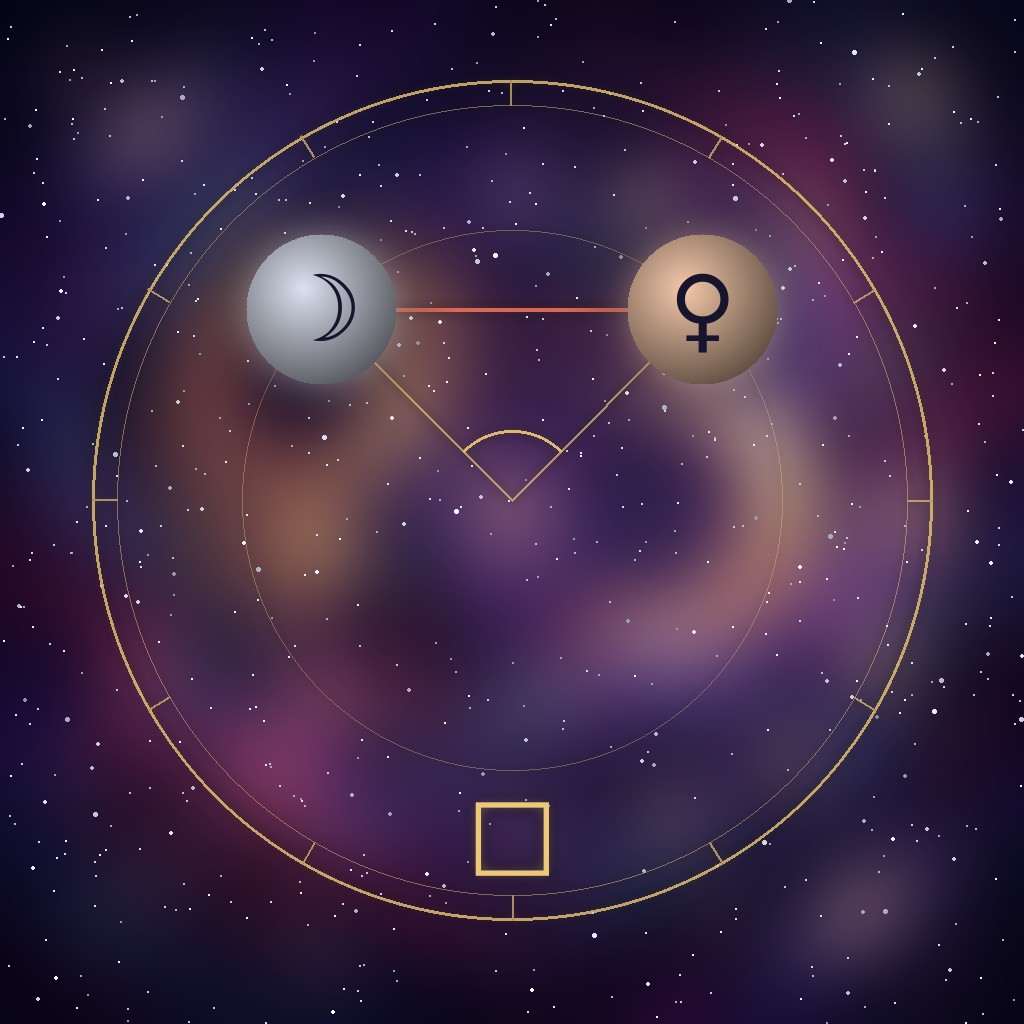
Here is a fact you can check on any night. If you were born under a full Moon, you do not have Moon square Venus. If you were born at a new Moon, you do not have it either. The aspect simply cannot form at those two moments. This guide shows why, how common the square is, what the tradition reads in it, and when the sky makes it again.
First, the words. An aspect is an angle between two planets, seen from Earth. A square is the aspect of 90°, a quarter of the circle. The orb is how far from exact we still count it. Here we use two orbs, 8° and 3°. With a 3° orb, any gap from 87° to 93° counts as a square. If aspects are new to you, our practical guide to astrological aspects walks through all of them.
What Moon square Venus means in a birth chart
Start with the two bodies. The Moon stands for your needs. It is how you feel safe, how you rest, and what you reach for when a day goes wrong. Our page on what the Moon means in your chart covers it in depth.
Venus stands for what you value and what you find lovely. It is taste, pleasure, charm and the way you draw people close. Our guide to Venus and its role in love goes further.
Now the angle. Picture your chart as a house with twelve rooms. Each room is one part of life, and the planets are the furniture. A square puts two pieces of furniture at right angles. They face different ways, so they get in each other’s way. Our page on the square in astrology explains the angle on its own.
Two kind planets at a hard angle
In the second century, the Greek astronomer Ptolemy wrote the Tetrabiblos, the book that shaped Western astrology for fifteen hundred years. He counts both the Moon and Venus as benefic, which means planets that bring good. Yet in Tetrabiblos I.13, he groups the square with the opposition as a clashing angle. The trine and the sextile are the friendly ones.
So Moon square Venus is two gentle planets that do not agree. Neither one is harsh. The clash is between two kinds of comfort. The Moon wants what feels safe and known. Venus wants what feels lovely and new. Ask one person to choose between a warm blanket and a night out, and you have the picture.
In The Combination of Stellar Influences (1940), the German astrologer Reinhold Ebertin ties the Moon and Venus to tenderness, affection and a feeling for art. In her book Aspects in Astrology (2002), Sue Tompkins reads every square as friction that asks for action. In her view, a square is a task, not a verdict. Put the two together, and the task is to make room for both kinds of comfort.
How the tradition describes it in a life
Here are the themes astrologers describe. They are readings, not facts. Astrology is not a science.
- Want and need pull apart. What you are drawn to is not always what makes you feel safe.
- Comfort can turn into excess. Good food, nice things and spending are read as quick ways to refill.
- Affection comes and goes with mood. Warmth is real, but it rises and falls with how safe you feel.
- Home and pleasure compete. Time for the people you love can clash with time for fun.
- Taste is strong and personal. The friction is read as a spur for art, style and craft.
Many readers search for “Moon square Venus woman” or “Moon square Venus cheating.” The tradition ties this square to no gender, and it marks no one as unfaithful. A chart shows themes, not choices.
Why the Moon is never new or full in this aspect
This is the part most pages leave out. Venus never strays far from the Sun. Seen from Earth, it swings out to about 47° on one side, then back, then out to about 47° on the other. Astronomers call that farthest point its greatest elongation. So Venus can never stand at a right angle to the Sun.
Now add the Moon. The gap between the Moon and the Sun tells you the phase. At 0°, the Moon is new and dark. At 180°, it is full. For the Moon to square Venus, it must sit about 90° from Venus. Venus is never more than about 47° from the Sun. So the Moon must sit between about 35° and 145° from the Sun, counting the 8° orb. That is simple sums: 90 minus 47 minus 8, and 90 plus 47 plus 8.
We checked it. In our sample, the smallest Moon to Sun gap in any Moon square Venus moment was 35.1°. The largest was 145.0°. Over a long window from 1600 to 2400, the range was 35.0° to 145.1°. Not one case went past it.
What does that look like in the sky? A Moon 35° from the Sun is about 9 percent lit. A Moon 145° from the Sun is about 91 percent lit. So everyone with Moon square Venus was born under a Moon between 9 and 91 percent lit. The new Moon, the thinnest crescents, the full Moon and the nights just around it are all ruled out.
| Gap between Moon and Sun | Share of Moon square Venus births. |
|---|---|
| 35° to 60°, a crescent Moon | About 25 percent. |
| 60° to 90°, a Moon close to half lit | About 24 percent. |
| 90° to 120°, just past half lit | About 25 percent. |
| 120° to 145°, a fat gibbous Moon | About 26 percent. |
The four bands are close to equal. The split between a growing Moon and a shrinking one is even too: 49.8 percent of these births had a waxing Moon, and the rest a waning one.
Which phase you get depends on Venus
When Venus sits close to the Sun, both squares fall near the half Moons. That is the first quarter and the last quarter. When Venus swings far from the Sun, the squares move away from the half Moons. One falls at a crescent, and the other at a gibbous Moon.
You can see this in the dates below. In late 2026, Venus passes between the Earth and the Sun. Its squares to the Moon fall near half lit. By early 2027, Venus is far out as the morning star. Its squares fall at Moons about 15 percent lit or about 85 percent lit.
Our page on Moon conjunct Venus shows the mirror image. That aspect can only form within a few days of a new Moon. The square sits on the other side of the rule. It can never form at a new Moon at all.
Moon square Venus natal: how common is it?
We drew 200,000 moments at random between 1950 and 2010. This counts time, not real births. For each moment, we took the Moon and Venus from the Swiss Ephemeris, the standard table of planet positions used by chart software. We used the tropical zodiac, the one tied to the seasons.
Here is the result. The Moon was square Venus within 8° in 9.08 percent of the moments. That is about one chart in eleven. Within a tight 3° orb, the share drops to 3.44 percent, or about one chart in twenty-nine.
| Decade | Moon square Venus, 8° orb. |
|---|---|
| The 1950s | 9.0 percent of the time. |
| The 1960s | 9.04 percent of the time. |
| The 1970s | 9.17 percent of the time. |
| The 1980s | 9.35 percent of the time. |
| The 1990s | 8.82 percent of the time. |
| The 2000s | 9.11 percent of the time. |
See how flat that column is. Every decade lands near 9 percent. The small ups and downs are the noise of a random draw.
There is a simple rule behind it. An 8° orb makes a window 16° wide. A circle holds two such windows, one on each side. Two times 16, divided by 360, gives 8.9 percent. With a 3° orb, two times 6, divided by 360, gives 3.3 percent. The Moon laps the whole zodiac every 27.3 days, so it fills those windows at a steady pace.
We checked these numbers two more ways. A fresh draw of 200,000 moments gave 8.98 and 3.39 percent. A fixed step through 1600 to 2400, about 790,000 steps, gave 8.96 and 3.36 percent. The three routes agree.
Why a birth time matters
The Moon moves about 13° a day, so a whole 16° window goes by in about a day and a quarter. Without a birth time, the Moon can sit inside the orb or just outside it. A chart cast for noon is only a guess.
Moon square Venus transit: two transits with one name
A transit is a planet in today’s sky making an angle to a point in your birth chart. Two events share this name.
- The Moon in the sky squares Venus in the sky, or squares your natal Venus. This comes twice a month and lasts about a day.
- Venus in the sky squares your natal Moon. This is the slower one, the “Venus square Moon transit.”
When the Moon squares Venus in the sky
The Moon squares Venus about 25 times a year. Here are the exact moments through April 2027, in UTC with New York time (ET). Both bodies sit at the same degree. The last column shows how much of the Moon is lit.
| Exact square | Where they stand | Moon lit. |
|---|---|---|
| Oct 19, 2026, 08:52 UTC (4:52 a.m. ET) | Moon 3°35′ Aquarius, Venus Scorpio | 57 percent. |
| Oct 31, 2026, 21:59 UTC (5:59 p.m. ET) | Moon 26°17′ Cancer, Venus Libra | 61 percent. |
| Nov 14, 2026, 18:55 UTC (1:55 p.m. ET) | Moon 22°52′ Capricorn, Venus Libra | 25 percent. |
| Nov 28, 2026, 05:40 UTC (12:40 a.m. ET) | Moon 26°33′ Cancer, Venus Libra | 82 percent. |
| Dec 13, 2026, 05:05 UTC (12:05 a.m. ET) | Moon 6°23′ Aquarius, Venus Scorpio | 15 percent. |
| Dec 27, 2026, 03:28 UTC (Dec 26, 10:28 p.m. ET) | Moon 18°43′ Leo, Venus Scorpio | 86 percent. |
| Jan 11, 2027, 19:56 UTC (2:56 p.m. ET) | Moon 4°42′ Pisces, Venus Sagittarius | 14 percent. |
| Jan 25, 2027, 17:56 UTC (12:56 p.m. ET) | Moon 19°57′ Virgo, Venus Sagittarius | 86 percent. |
| Feb 10, 2027, 18:28 UTC (1:28 p.m. ET) | Moon 8°15′ Aries, Venus Capricorn | 16 percent. |
| Feb 24, 2027, 16:36 UTC (11:36 a.m. ET) | Moon 24°34′ Libra, Venus Capricorn | 83 percent. |
| Mar 12, 2027, 16:38 UTC (11:38 a.m. ET) | Moon 13°36′ Taurus, Venus Aquarius | 19 percent. |
| Mar 26, 2027, 20:55 UTC (4:55 p.m. ET) | Moon 0°38′ Sagittarius, Venus Pisces | 79 percent. |
| Apr 11, 2027, 12:45 UTC (8:45 a.m. ET) | Moon 19°32′ Gemini, Venus Pisces | 24 percent. |
| Apr 26, 2027, 05:33 UTC (1:33 a.m. ET) | Moon 7°21′ Capricorn, Venus Aries | 74 percent. |
Each pass stays within an 8° orb for about a day. For the tradition, that is a mood, not an event: a day when you want to stay in and go out at once.
Look at the third date. On November 14, 2026, Venus is barely moving. It turned direct just hours before, at 00:28 UTC (7:28 p.m. on November 13 in New York). Planets sometimes seem to move backward from where we stand on Earth. That is what retrograde means. The pause where the motion turns is called a station.
When Venus squares your natal Moon
Most of the time, Venus moves about a degree a day. In 2027, for example, it stays within 1° of 15° Aries for about a day and a half.
Fall 2026 is different. Venus turns retrograde on October 3, 2026, at 07:16 UTC (3:16 a.m. in New York), at 8°29′ Scorpio. It turns direct on November 14 at 00:28 UTC, at 22°52′ Libra. Between those two points, Venus crosses the same degrees three times: forward, backward, then forward again.
Take a natal Moon at 25° Cancer or 25° Capricorn. Venus squares it from 25° Libra on three dates. The first is September 3, 2026, at 08:03 UTC. The second, in retrograde, is November 3 at 17:59 UTC. The third is November 24 at 16:27 UTC. In total, Venus stays within 1° of that square for about 13 days, spread from early September to late November. A normal pass gives you less than two.
Who gets the triple pass? Anyone whose natal Moon sits in the last seven degrees of Cancer or Capricorn, or in the first eight degrees of Leo or Aquarius. For them, the “Venus square Moon transit” is not a day. It is a season.
Moon square Venus synastry
Synastry is the comparison of two birth charts. It looks at the angles between one person’s planets and the other’s. Our guide to synastry charts and relationship dynamics explains the method.
In synastry, Moon square Venus means one person’s Moon sits about 90° from the other person’s Venus. The tradition reads it as one person’s need for safety meeting the other’s way of showing love. The Moon person wants comfort and care. The Venus person shows love through charm, gifts or fun. Done well, each learns the other’s language. Done badly, each feels missed.
How common is it? We drew 40,000 pairs of moments, the second within five years of the first. In 8.8 percent of pairs, the first person’s Moon was square the second person’s Venus within 8°. Counting both ways, the share was 16.9 percent. That is about one pair in six.
A link found in one couple in six cannot doom a bond on its own. The tradition weighs all the angles together.
Working with it, per the tradition
Modern astrologers such as Stephen Arroyo treat a hard aspect as a source of drive more than a flaw. Here is how the tradition frames the work, as reflection, not advice.
- Name the need before you chase the treat.
- Tell people how you like to be cared for, in plain words.
- Give the friction a craft, such as cooking, design or music.
- Plan both kinds of comfort into a week: time at home and time out.
None of this is a health claim. If moods or habits get hard to manage, the right person to see is a doctor or a licensed therapist. A birth chart is not a diagnosis.
How we counted
All positions come from the Swiss Ephemeris, read with the pyswisseph library, in the tropical zodiac, seen from the center of the Earth. For the dates, we stepped through time and found each moment the gap crossed 90°, then halved the window again and again down to the minute. These numbers count time, not people. More babies are born in some years than others, and we did not weight for that. They describe the sky, and nothing about the person who has the square.
Frequently Asked Questions
What does it mean when someone has a Moon square Venus in synastry?
One person’s Moon sits about 90° from the other’s Venus. The tradition reads it as a need for comfort meeting a different way of showing love. In our count, it links about one pair in six, counting both directions.
What does Moon square Venus mean in a natal chart?
The Moon, your needs, sits at a right angle to Venus, your taste and affection. The tradition reads it as two kinds of comfort that pull apart: what feels safe and what feels lovely. Both planets are benefic, so the friction is soft.
How common is Moon square Venus?
We found it in 9.08 percent of moments from 1950 to 2010 within an 8° orb, about one chart in eleven. Within 3°, the share is 3.44 percent. Every decade lands near 9 percent.
Can you be born with Moon square Venus at a full Moon?
No. Venus stays within about 47° of the Sun, so the Moon must be 35° to 145° from the Sun to square it. That means a Moon between 9 and 91 percent lit, never new and never full.
How long does a Venus square Moon transit last?
Usually about a day and a half within 1°. During a Venus retrograde, it stretches. In fall 2026, a natal Moon at 25° Cancer or Capricorn gets three exact squares and about 13 days within 1°.
Go deeper with your personal Astrovision report
Reading about astrological concepts is a great start, but nothing compares to hearing how they apply directly to you. Our users love our audio-first approach, calling it “friendly, personal, and easy to understand.” While this article gives you the “what,” a personal report gives you the “so what.” Discover your unique path with an Astrovision report—your personal ‘user manual’ delivered in our celebrated podcast format.