
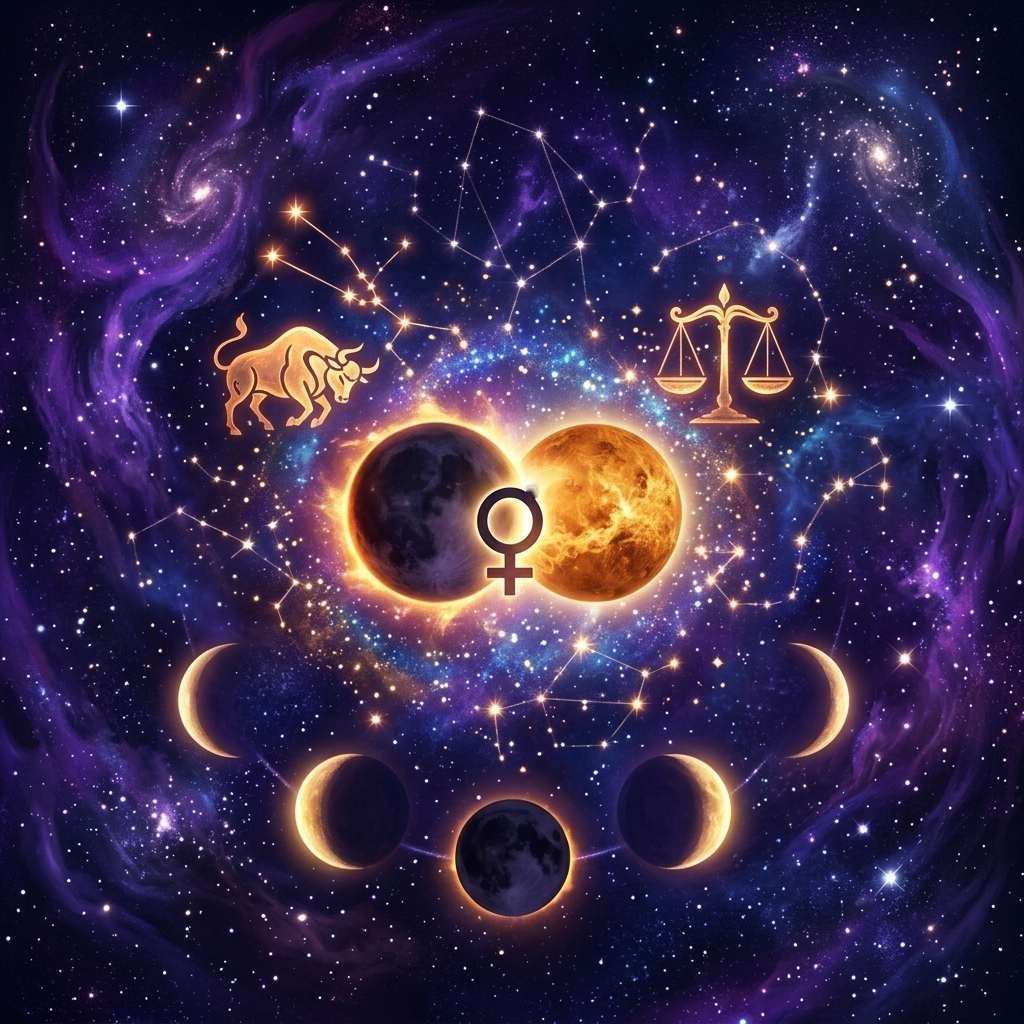
Moon conjunct Venus is one of the softest signatures a birth chart can hold. It is also one of the most tied to the sky. You cannot be born with it on just any night. You can only be born with it in the few days around a new Moon, when the Moon is a thin sliver or not visible at all. This article shows why, how rare the pattern is, what the tradition says it means, and when the sky repeats it.
First, the words. An aspect is an angle between two planets, measured along the path the Sun, Moon and planets follow across the sky. A conjunction is the aspect of 0°: the two sit at the same spot, or close to it. The orb is how far from exact we still count the aspect. Here we use two orbs, 8° and 3°. With an 8° orb, a Moon at 10° Leo and a Venus at 17° Leo still count as conjunct. With a 3° orb, they do not. If aspects are new to you, our practical guide to astrological aspects walks through all of them.
Two planets of the night, fused into one
In the chart, the Moon stands for your needs. It is how you feel safe, how you rest, what you reach for when a day goes wrong. Our page on what the Moon represents in astrology covers it in depth. Venus stands for what you value and what you find lovely. It is taste, pleasure, charm and the way you draw people close. Our guide to Venus in astrology goes further.
The two share a lot in the old texts. In the second century, the Greek astronomer Ptolemy wrote the Tetrabiblos, the book that shaped Western astrology for fifteen hundred years. In its first book, he counts both the Moon and Venus as benefic, which means planets that bring good. He also calls both of them feminine and places both among the planets of the night. So when they meet, you are not mixing oil and water. You are pouring two warm, gentle things into one cup.
A conjunction does not work like the other aspects. Ptolemy lists four angles in Tetrabiblos I.13: the opposition, the trine, the square and the sextile. The conjunction is not on that list. It is not an angle at all. It is a meeting. In her book Aspects in Astrology (2002), Sue Tompkins reads a conjunction as a fusion: the two planets act as one, and you cannot see one without the other. With Moon conjunct Venus, the need for comfort and the wish for beauty and affection come as a pair.
Reinhold Ebertin, a German astrologer, wrote a short entry for each pair of planets in The Combination of Stellar Influences (1940). For the Moon and Venus, he links the pair with tenderness, affection and a feeling for art. In the classic reading, a person with this contact feels loved when things are pleasant, and a cold word hits them hard.
What the tradition says it looks like in a life
Astrologers who read this aspect in the classic way describe a few themes. They are readings, not facts. Astrology is not a science, and no chart can prove how a person will act.
- Comfort as a need. Beauty, good food, soft light and kind company are not extras. According to the tradition, they are how this person refills.
- Warmth that others feel fast. The Moon is the face you show at home, and Venus adds charm to it. People with this contact are read as easy to be near.
- Love tied to mood. Feelings and affection come as one package. When the mood drops, the wish to connect can drop with it.
- A pull toward peace. Venus likes harmony and the Moon likes safety. Together they can avoid a needed fight to keep the calm.
- A strong link between mother and love. The Moon is the mother in the old texts, and Venus is love. Many readings tie the aspect to a warm bond with the mother, or to a strong wish for one.
The shadow side comes from the same place. A person who needs peace to feel loved can say yes too fast. They can please others and forget to ask what they want. The tradition does not call this a flaw of the aspect. It calls it the cost of a gift used without care.
How rare is Moon conjunct Venus?
We measured it. We took 200,000 moments picked at random between 1950 and 2010. For each one, we used Swiss Ephemeris, the standard software for planet positions, to find where the Moon and Venus stood. We used the tropical zodiac, the one tied to the seasons that most Western astrologers use. Then we counted the moments when the two were close.
- Within 8°: 4.46 % of all moments, or about one birth in 22.
- Within 3°: 1.68 % of all moments, or about one birth in 60.
We checked these numbers a second way. Instead of random picks, we stepped through time at a fixed pace, every few hours, from 1600 to 2400. That long window gave 4.41 % within 8° and 1.65 % within 3°. The two routes agree. The share also holds steady by decade: every decade from 1950 to 2009 landed between 4.3 % and 4.7 %.
One note on method. We counted moments, not real births. Births are not spread evenly over the day and year, but they come close enough for a rough answer. And the Moon moves about 13° a day. So you need a birth time to know if you have this aspect. A date alone leaves the Moon anywhere in a wide band.
Why every Moon–Venus birth falls near a new Moon
This is the part no other page tells you. Venus never strays far from the Sun. Seen from Earth, it swings out to about 47° on one side, then back, then out to about 47° on the other. Astronomers call that farthest point its greatest elongation. Venus can never be opposite the Sun, and never even at a right angle to it.
Now add the Moon. If the Moon is within 8° of Venus, and Venus is within 47° of the Sun, the Moon must be within about 55° of the Sun. That is simple sums. In our sample, the largest gap we found between the Moon and the Sun, in any Moon-Venus birth, was 55.0°. Over the long window from 1600 to 2400, it was 55.2°. Not one case went past it.
What does 55° mean in the sky? The Moon gains about 12° a day on the Sun. So 55° is about four and a half days. Every person born with Moon conjunct Venus was born within about four and a half days of a new Moon, before or after it. The new Moon is the moment when the Moon passes the Sun and turns dark to us.
| Gap between Moon and Sun | Share of Moon–Venus births. |
|---|---|
| Up to 30°, about two and a half days from new Moon | About 49 %. |
| Up to 45°, about three and a half days from new Moon | About 86 %. |
| Up to 55°, about four and a half days from new Moon | All of them. |
So there are only three kinds of Moon conjunct Venus birth. The first is a birth near the new Moon itself, when the Moon is lost in the Sun’s glare. The second is a waxing crescent. That is the thin, growing Moon you see in the west after sunset, with Venus as the evening star beside it. The third is a waning crescent, or balsamic Moon. That is the last thin sliver in the east before dawn, with Venus as the morning star.
The split is even. Over 1600 to 2400, 49.95 % of these births had a waxing Moon and the rest a waning one. Between 1950 and 2010, the split was 49.5 % to 50.5 %.
Does the phase change the meaning?
Many astrologers read the phase of the Moon as a layer of its own. A waxing Moon is growing toward the full, so the energy faces out and builds. A waning Moon is shrinking toward the dark, so the energy faces in and lets go. Set Venus beside a young crescent at dusk, and the classic reading is warmth that reaches out: charm, a wish to start things, love as something you make. Set Venus beside an old crescent before dawn, and the reading turns quieter: love as a place to rest, beauty found in endings, a softer and more private kind of care.
Venus conjunct Moon by sign: is any sign favored?
In our 1950-2010 sample, the aspect landed most in Aries and least in Sagittarius. Aries held about 10 % of cases and Sagittarius about 7 %. That looks like a pattern, but it is not one that lasts.
Venus runs on an eight-year cycle, so a 60-year window over-counts some signs. When we stepped through the full 800 years from 1600 to 2400, every sign landed between 8.1 % and 8.6 %. That is close to one twelfth each. Over the long run, Moon conjunct Venus shows up in every sign at about the same rate.
The sign still matters for the meaning. It sets the style. A Moon conjunct Venus in Taurus or Libra puts Venus in a sign she rules, which the tradition calls her home, or domicile. In Pisces, Venus is exalted, a place of honor. In Aries and Scorpio, she is in detriment, the sign across from her home. In Virgo she is in her fall, the sign across from her exaltation. The same aspect in Scorpio reads more intense and private than in Libra. Our page on Venus in Scorpio shows how much the sign can change her tone.
Orb matters too. In 1647, the English astrologer William Lilly set out in Christian Astrology that each planet has an orb of its own, and he gave the Moon one of the widest. Most modern astrologers use a single orb for all planets instead. Either way, the rule is simple. The tighter the orb, the louder the aspect. A 1° conjunction speaks in every part of the chart. A 7° one is a softer note.
When the sky repeats it: Moon conjunct Venus transits
A transit is what the planets are doing in the sky right now, set against your birth chart. The Moon passes Venus about once a month. In 2026, the Moon meets Venus twelve times. It stays within 8° for about a day and a third each time. So each transit is short.
We found each exact meeting with Swiss Ephemeris, then checked each one with a second program, Astronomy Engine. The two agree to the minute. Times are given in UTC, the world clock, and in New York time, since a late meeting in UTC can fall on the day before in the United States.
| Exact meeting (UTC) | New York time | Where it falls. |
|---|---|---|
| January 19, 02:02 | January 18, 9:02 p.m. | Aquarius, 1°57′. |
| February 18, 08:01 | February 18, 3:01 a.m. | Pisces, 9°53′. |
| March 20, 09:23 | March 20, 5:23 a.m. | Aries, 17°18′. |
| April 19, 06:43 | April 19, 2:43 a.m. | Taurus, 24°02′. |
| May 19, 01:49 | May 18, 9:49 p.m. | Cancer, 0°02′. |
| June 17, 20:28 | June 17, 4:28 p.m. | Leo, 5°06′. |
| July 17, 15:05 | July 17, 11:05 a.m. | Virgo, 8°43′. |
| August 16, 07:10 | August 16, 3:10 a.m. | Libra, 9°19′. |
| September 14, 11:32 | September 14, 7:32 a.m. | Scorpio, 2°33′. |
| October 12, 04:26 | October 12, 12:26 a.m. | Scorpio, 6°56′. |
| November 7, 10:49 | November 7, 5:49 a.m. | Libra, 23°44′. |
| December 5, 05:41 | December 5, 12:41 a.m. | Scorpio, 0°34′. |
Look at the last four rows. The Moon meets Venus in Scorpio, then Scorpio, then Libra, then Scorpio again. That back-and-forth comes from Venus turning retrograde. Seen from Earth, a planet sometimes looks as if it is moving backward. That is what retrograde means. In 2026, Venus stations retrograde, or seems to stop and turn, on October 3 (UTC) at 8°29′ Scorpio. She backs into Libra on October 25. She stations direct on November 14 (UTC) at 22°52′ Libra, which is the evening of November 13 in New York. She returns to Scorpio on December 4.
How do you use these dates? Find your natal Venus, the spot Venus held when you were born. When the transiting Moon crosses it, the tradition reads a day with a softer mood, a wish for comfort, and an easy hand with people. Find your natal Moon, too. When Venus crosses that point, it is a slower visit, lasting days, not hours. A Moon transit is a mood for a day, not a turning point.
Moon conjunct Venus in synastry
Synastry is the art of laying two birth charts side by side to see how two people fit. For more on the method, see our guide to synastry charts and relationship dynamics. Here, the aspect means that one person’s Moon sits on the other person’s Venus.
We measured this too. We drew 100,000 pairs of random moments between 1950 and 2010 and checked each pair. Person A’s Moon fell within 8° of person B’s Venus in 4.4 % of pairs. When you count both ways, A’s Moon on B’s Venus or B’s Moon on A’s Venus, the share rises to 8.6 %, about one pair in twelve. Both ways at once came up in only 0.18 % of pairs.
In the classic reading, this is one of the kindest contacts two charts can share. The Moon person feels liked and at ease. The Venus person feels that their warmth lands. Tastes match in small ways: food, music, the feel of a room. The risk is the same as in the natal chart. Two people who value peace can skip the hard talks that keep a bond honest. A good synastry reading looks at this contact along with the rest of both charts, never alone.
Frequently asked questions
How rare is the Moon and Venus conjunction?
With an 8° orb, it appears in about 4.4 % of moments, or roughly one birth in 22 to 23. With a tight 3° orb, it drops to about 1.7 %, or one in 60. We measured it over 200,000 random moments from 1950 to 2010 and checked it by stepping through 1600 to 2400.
What does it mean when the Moon is conjunct Venus?
It means the Moon and Venus sat at nearly the same spot when you were born. According to the tradition, your need for comfort and your sense of love and beauty act as one. It also means you were born within about four and a half days of a new Moon.
What does it mean when the Moon is conjunct Venus in synastry?
It means one person’s Moon lies on the other person’s Venus. The classic reading is ease and affection: the Moon person feels liked, and the Venus person feels their warmth received. It shows up one way or the other in about one pair in twelve.
Which celebrities have Moon–Venus conjunctions?
We do not list names, and here is why. The Moon moves about 13° a day, while the aspect only spans 16° from edge to edge. Without a checked birth time, you cannot always tell if a person has it. Many birth times online are guesses. Listing names from those would give you a list we cannot stand behind.
What is considered a strong Venus placement?
In the tradition from Ptolemy onward, Venus is strongest in the signs she rules, Taurus and Libra, and in Pisces, where she is exalted. She is weaker in Aries and Scorpio and in Virgo. A tight conjunction with the Moon, the other benefic of the night, is read as a further boost to her warmth.
Go deeper with your personal Astrovision report
Reading about astrological concepts is a great start, but nothing compares to hearing how they apply directly to you. Our users love our audio-first approach, calling it “friendly, personal, and easy to understand.” While this article gives you the “what,” a personal report gives you the “so what.” Discover your unique path with an Astrovision report—your personal ‘user manual’ delivered in our celebrated podcast format.