


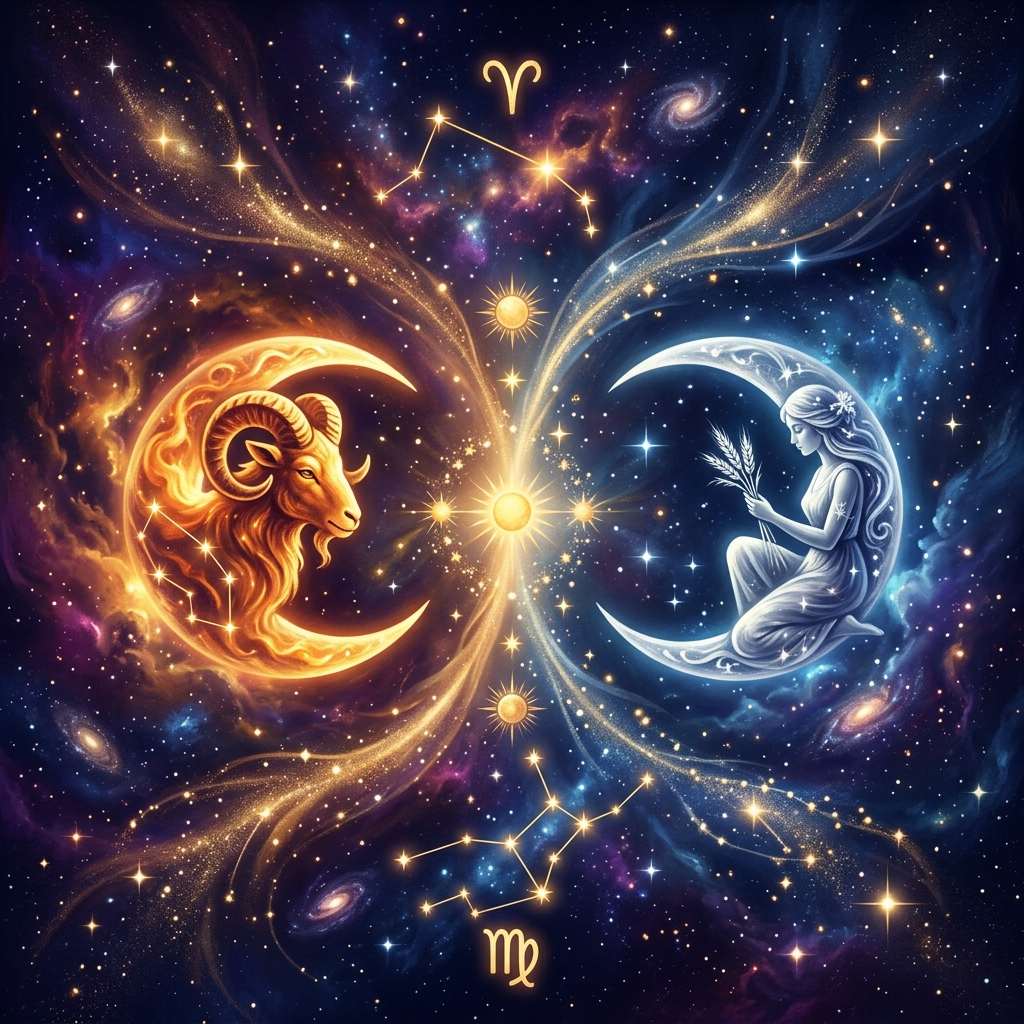
Aries Moon and Virgo Moon compatibility gets a poor score in most guides. The two signs sit five signs apart. That gap makes no classic aspect at all. Ptolemy called such signs disjunct, which means turned away from each other.
Yet the same author gives a second rule that pulls the other way. Signs where the Sun makes days of the same length are said to behold each other. By that daylight rule, Aries and Virgo are a mirror pair. Each degree of Aries has a twin degree in Virgo.
This page sets out both readings and counts the couples who sit on those mirror degrees. Read it as a lens, not a forecast. Astrology is not a science, and no study has shown that a Moon sign predicts how a couple will do.
The pair at a glance
| Question | What we found. |
|---|---|
| How common is the pair? | About 1 random couple in 72, the rate for any pair of two different Moon signs. |
| What link do the signs form? | No classic aspect, five signs apart, fire with earth. |
| Do the Moons mirror each other? | Within 1 degree for 6.6 percent of couples, within 3 degrees for 19 percent. |
| Do some couples form a real aspect anyway? | Yes, 7.1 percent form a trine or an opposition in degrees. |
| Where is the Moon strong? | In neither sign, since it holds no rank there. |
| Is it unique? | Yes, it is the only five-sign gap between a fire season sign and a mutable earth sign. |
Turned away by sign
Ptolemy wrote the Tetrabiblos in Alexandria around 150 AD. In Book I, chapter 13, he names four aspects. They are the opposition, the trine, the square and the sextile. Two signs that are one or five signs apart make none of them.
Later writers call the five-sign gap a quincunx, or inconjunct. The name is modern. Ptolemy had no place for it in his list.
In chapter 16, he gives such signs a harsh label. They are disjunct and alien, with no tie at all. Five signs apart, he says, cut the circle into unequal parts, while the true aspects divide it evenly.
That label has one condition. A disjunct pair must also lack the two other ties he describes, command and beholding. So the question is whether Aries and Virgo share either one.
Command does not apply. In chapter 14, Ptolemy pairs signs that rise in equal time, on each side of the spring point. Frank Robbins, who made the standard English version, notes that Aries and Libra are left out of that scheme. So Aries commands no sign and obeys none.
Mirrored by daylight
Beholding is where the two readings split. Chapter 15 says that signs at equal distance from the same solstice sign behold each other. The reason he gives is daylight. When the Sun is in either sign, the days are the same length. The two signs also rise and set at the same part of the horizon.
Now test Aries and Virgo against that reason. The Sun at 10 degrees Aries gives about the same day length as the Sun at 20 degrees Virgo. Both sit 80 degrees from the first point of Cancer, the longest day. The same is true for every degree of Aries and its twin in Virgo. By the daylight rule, the two signs behold each other.
Robbins reads the chapter another way. In his note, he lists the pairs by whole sign, counted around the sign of Cancer. Aries pairs with Libra, and Virgo with Taurus. Under that list, Aries and Virgo do not behold each other. They are then fully disjunct.
| Reading | What it counts | Aries and Virgo. |
|---|---|---|
| Robbins’ list by whole sign | Signs on each side of the sign of Cancer | Not linked, so fully disjunct. |
| The daylight rule in degrees | Degrees with the same day length | Mirror signs, so they behold each other. |
We present both, since both claim Ptolemy. The daylight rule matches the reason he states. The whole-sign list matches how Robbins, and some old writers, applied it.
How many couples sit on mirror degrees?
William Lilly, in Christian Astrology in 1647, used the daylight rule by degree. He called the mirror point of a planet its antiscion. For Aries and Virgo, the rule is easy. Add the two degrees. If they make 30, the two points mirror each other. So 5 degrees of Aries mirrors 25 degrees of Virgo.
Lilly read a planet on another’s mirror point as a hidden link, close to a friendly aspect in effect. So we asked how many Aries and Virgo couples have their Moons on mirror degrees.
| Allowed gap from the mirror point | Share of Aries and Virgo couples | Put simply. |
|---|---|---|
| 1 degree | 6.6 percent | About 1 couple in 15. |
| 3 degrees | 19 percent | About 1 couple in 5. |
The math is the same as for any orb. With 1 degree allowed, the share is one minus 29/30 squared, or 6.56 percent. We checked it against the real spread of Moon positions over eight centuries.
So the mirror link is real, but thin. Most couples in this pair do not have it. Only a small group, about 1 in 15, sits on a near exact mirror. Six of the 78 Moon pairs are mirror signs, and only four of those make no classic aspect by sign.
A real aspect across the sign line
There is one more twist at the edges. Some couples form a true aspect in degrees even though their signs make none.
Say the Aries Moon sits at 28 degrees and the Virgo Moon at 1 degree. The gap is 123 degrees, which is a trine. Now say the Aries Moon sits at 1 degree and the Virgo Moon at 28 degrees. The gap is 177 degrees, which is an opposition.
At an 8 degree orb, 7.1 percent of Aries and Virgo couples form one of those links. For them, the pair Ptolemy called turned away is linked in the sky. So look up both degrees before you read this pair as a blank.
Two guests with different hosts
The Moon holds no rank in either sign. It rules Cancer and is exalted in Taurus. Lilly calls a planet with no rank peregrine, which means a wanderer or a guest.
So each Moon takes its tone from its host. Aries belongs to Mars, the planet of heat and speed. Virgo belongs to Mercury, the planet of thought and detail. In chapter 19, Ptolemy also gives Mercury its exaltation in Virgo, so Mercury is doubly at ease there.
The modes differ too. Aries is cardinal, which means it opens a season, spring. Virgo is mutable, which means it closes one, summer. In the old reading, one Moon starts and the other refines. Our pages on the Moon in Aries and the Moon in Virgo cover each sign on its own.
Born near a new Moon or a full Moon
The Moon’s sign also hints at its phase. A phase is the Moon’s angle to the Sun. If the Moon is in the same sign as the Sun, the birth came near a new Moon. If it is in the opposite sign, the birth came near a full Moon.
Of all people with a Virgo Moon, 8.32 percent also have the Sun in Virgo. Only 8.06 percent have the Sun in Pisces, across the wheel. The gap is real but small. It comes from the Sun’s speed, which is slowest in early July and still below average in Virgo. For an Aries Moon, the two shares are 8.21 and 8.18 percent.
For the couple, we asked what share has at least one partner born with the Moon in the Sun’s sign. The answer is 15.85 percent. For at least one partner with the Moon opposite the Sun, it is 15.58 percent. Our guide to moon phase compatibility shows how to find each phase by hand.
The birth-time trap
The Moon moves fast. It stays in a sign for 54.6 hours on average, and each stay runs from about 47 to 61 hours. So it changes sign on 43.92 percent of all days.
Most free tools ask only for a date and place the birth at noon. On a day when the Moon changes sign, noon can give the wrong one. Across all birth moments, a noon chart names the wrong Moon sign 10.98 percent of the time.
A couple has two charts, so the risk adds up. With noon charts for both, 20.75 percent of couples get the wrong Moon pair. That is about 1 couple in 5. Only 31.45 percent of couples can skip the clock, because both were born on a day with no Moon change.
For this pair, the clock matters twice. A wrong sign changes the pair. A wrong hour changes the degree, and the mirror test needs the degree. Our pivot page on moon sign compatibility gives the full count, with a second method and a US time zone.
Reading the pair the traditional way
In a chart, the Moon stands for the private self. It is the part that reacts before it thinks. Stephen Arroyo reads fire as a need for action and earth as a need for form. Liz Greene treats the Moon as an old emotional pattern, one you did not choose. Here is how the old grid reads this pair. None of it has been tested.
Where the two Moons meet
- Work. Both Moons feel better when something gets done. A shared task calms both.
- Plain speech. Aries says it straight, and Virgo says it exactly. Neither likes hints.
- Repair. The Aries Moon starts the fix, and the Virgo Moon finishes it.
- Growth. Each partner has a skill the other lacks, speed on one side and care on the other.
Where they rub
- Rush and check. The Aries Moon wants to act now. The Virgo Moon wants to check first.
- Heat and critique. A blunt flare meets a precise note. Both can land as an attack.
- Comfort. Aries soothes by moving on. Virgo soothes by sorting the facts. Each can feel the other skipped a step.
- No common ground by default. With no aspect to lean on, the link has to be built on purpose.
Modern writers read the quincunx as a gap that calls for steady change on both sides. In this pair, that means the Aries Moon learns to wait for the check, and the Virgo Moon learns to let a small flaw go.
What the evidence says
No study has tested Moon signs in couples at scale. The data does not exist. A census gives dates, not birth times, and a Moon sign needs the clock on more than 4 days in 10.
The best test of love signs used the Sun. In 2007 the sociologist David Voas looked at the 2001 census of England and Wales. He studied 10.3 million married couples. He found no link between Sun signs and who marries whom. A small excess of same-sign couples came from form errors, not from the stars.
So treat the Aries and Virgo reading as a prompt for a talk about pace and detail. It is not a verdict on the couple.
How we measured it
We used two separate routes over the years 1600 to 2400. Every moment counts the same.
Route one used the Astronomy Engine library. It found each Moon sign change to within a tenth of a second, 128,335 of them. It then summed the time in each sign, with no random draws. The mirror shares come from an hourly scan of Moon degrees, in steps of a tenth of a degree.
Route two used the Swiss Ephemeris. It placed the Moon once an hour, on a grid shifted by 30 minutes from the first. That gave 7,012,656 moments. The two routes agree to within 0.04 points on every Moon figure on this page.
The degree shares assume two people born at unrelated moments. The Ptolemy quotes come from the Loeb edition by Frank Robbins, Book I, chapters 13 to 16 and 19.
Other Aries Moon pairs
Aries has one other five-sign partner. The Aries Moon and Scorpio Moon pair shares a ruler but no line of sight. For a Virgo Moon in an easy match, see Taurus Moon and Virgo Moon.
Next door in the zodiac, the Aries Moon and Leo Moon pair forms a fire trine held by the Sun.
Questions about Aries and Virgo Moons
Are an Aries Moon and a Virgo Moon compatible?
By sign, they form no classic aspect, and Ptolemy’s list calls such signs disjunct. By his daylight rule, they are mirror signs. No study has shown that Moon signs predict how a couple does. Read the pair as speed meeting care.
What is a quincunx?
It is a gap of five signs, or 150 degrees. Ptolemy did not count it as an aspect. Modern astrologers read it as a link that needs steady effort on both sides.
Do Aries and Virgo behold each other?
By degree, yes. A degree of Aries and its twin in Virgo give the same day length, so they mirror. By the whole-sign list in Robbins’ note, no. Both readings trace back to Ptolemy.
How many Aries and Virgo couples have mirror Moons?
About 6.6 percent within 1 degree, and 19 percent within 3 degrees. To check, add the two Moon degrees. A total near 30 means a mirror.
Can I check this pair with a birth date alone?
Only in part. The Moon changes sign on 43.92 percent of days. With noon charts for both partners, about 1 couple in 5 gets the wrong pair. The mirror test also needs exact degrees, so a birth time matters here.
Go deeper with your personal Astrovision report
Reading about astrological concepts is a great start, but nothing compares to hearing how they apply directly to you. Our users love our audio-first approach, calling it “friendly, personal, and easy to understand.” While this article gives you the “what,” a personal report gives you the “so what.” Discover your unique path with an Astrovision report—your personal ‘user manual’ delivered in our celebrated podcast format.