
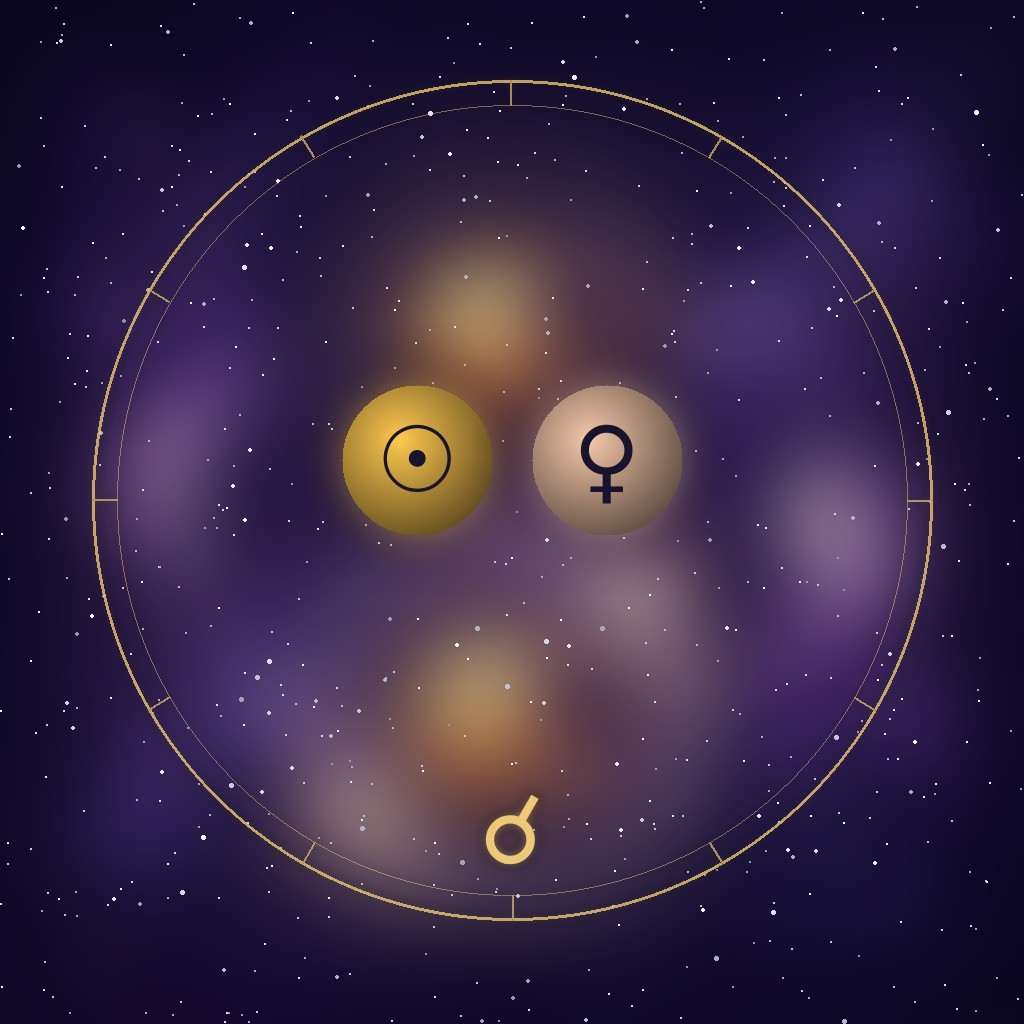
Late on October 23, 2026, New York time, Venus will pass between the Earth and the Sun. The exact meeting falls at 03:44 UTC on October 24, at 0°45′ Scorpio. This is Sun conjunct Venus. Few guides say that it comes in two very different kinds.
In one kind, Venus passes in front of the Sun while moving backward. It is over in about ten days. In the other kind, Venus slips behind the Sun while moving forward. That one lasts about two months. We measured both over eight centuries. Out of every seven people born with this pair, six got the slow kind.
First, a few words you will see again. An aspect is an angle between two planets, measured along the band of sky where the Sun, Moon and planets travel. A conjunction is the 0° aspect: the two bodies sit at the same point on that band. A sextile is the 60° aspect, a square is 90°, a trine is 120° and an opposition is 180°. The orb is the gap an astrologer allows around the exact angle before the link stops counting. We use two orbs here: 8°, a wide one, and 3°, a tight one. Our guide to how astrological aspects work sets them all out in one place.
The only major aspect the Sun and Venus can make
Venus orbits the Sun inside the orbit of the Earth. Seen from here, it swings out to one side of the Sun, then back, then out to the other side. Its widest swing is a little over 47°.
Think of a dog on a 47° leash, with the Sun as its owner. The dog can run ahead or fall behind, but never further than the leash allows.
That leash decides which aspects the pair can form. A sextile needs 60°. A square needs 90°. None of them fits on a leash of 47°. Here is what our count found for the five major aspects.
| Aspect | Angle | Share of time, 8° orb, 1600 to 2400 |
|---|---|---|
| Conjunction | 0° | 12.3 percent of the time. |
| Sextile | 60° | Never possible. |
| Square | 90° | Never possible. |
| Trine | 120° | Never possible. |
| Opposition | 180° | Never possible. |
The widest gap we found from 1600 to 2400 was 47.3°. Even a sextile with a full 8° orb would need 52°. So the conjunction is the one major aspect these two can share in a single chart.
Two minor angles remain. The semi-sextile is 30°, and the semi-square is 45°. Most astrologers give them much less weight than the major ones. So if a reading lists “Sun square Venus” or “Sun trine Venus” for one birth chart, something has gone wrong. That pairing can only exist between two charts.
How common is Sun conjunct Venus in a birth chart?
About one birth chart in eight has the Sun within 8° of Venus. Within the tight 3° orb, the share drops to about one in twenty-two.
| Window | Within 8° | Within 3° |
|---|---|---|
| Births from 1600 to 2400 | 12.3 percent | 4.6 percent of births. |
| Births from 1950 to 2010 | 12.3 percent | 4.6 percent of births. |
Here is how we got these numbers, so anyone can check them. We used the Swiss Ephemeris, the planet tables most astrology software relies on, with the tropical zodiac. For the long window, we read the Sun and Venus every six hours from 1600 to 2400. For the modern window, we read them every 2.4 hours from 1950 to 2010. Then we counted the share of moments when the gap fell within the orb. A separate draw of 200,000 random moments between 1950 and 2010 gave the same answer: 12.3 percent within 8° and 4.6 percent within 3°.
We also checked by a second route. A different set of planet formulas, the open astronomy-engine library, read the sky every twelve hours from 1950 to 2010. It found 12.29 percent within 8°, and the same widest gap of 47.15° over that window.
The share barely moves from one decade to the next. The 1970s were the highest, at 13.4 percent. Every other decade from 1950 to 2010 sat close to 12 percent.
Do you need a birth time to know if you have it? Not most of the time. The Sun moves about 1° a day, and Venus never moves much faster than 1.25° a day. So your birth date settles the question, except on a day when the gap sits right at the edge of the orb. On that one day, the hour of birth decides. The Moon is a different story: it moves so fast that its aspects need a birth time.
Two kinds of meeting: in front of the Sun or behind it
The Sun and Venus meet about every 292 days. The meetings come in two kinds, and they take turns.
In the first kind, Venus passes between the Earth and the Sun. Astronomers call it the inferior conjunction. Venus is close to us at that point, and it seems to move backward against the stars. Planets sometimes appear to move backward from where we stand on Earth, and that is what retrograde means. It is a trick of our viewpoint, like a car that seems to roll back as you pass it on the highway.
In the second kind, Venus passes behind the Sun, on the far side of its orbit. Astronomers call it the superior conjunction. Venus is far from us and moves forward, a little faster than the Sun. It catches up slowly, and it pulls away slowly.
That difference in speed is the whole story. Moving in opposite directions, they race past each other. Moving the same way at close to the same pace, they walk side by side for weeks.
| Kind of meeting | Venus moves | Days within 8° | Days within 3° | Share of all births |
|---|---|---|---|---|
| In front of the Sun | Backward | About 10 days | About 4 days | 1.7 percent of births. |
| Behind the Sun | Forward | About 61 days | About 23 days | 10.6 percent of births. |
The day counts are medians, the middle values, over one meeting in seven from 1600 to 2400. The forward kind ranged from 58 to 67 days within 8°, the backward kind from 9.9 to 10.3 days. Both kinds came up exactly 500 times in those eight centuries.
So equal numbers of meetings do not mean equal numbers of people. Of everyone born with the Sun within 8° of Venus, 86 percent have the slow kind, with Venus behind the Sun. Only 14 percent have the fast kind, with Venus retrograde. That is our six in seven.
After the meeting behind the Sun, Venus shines after sunset as the evening star. After the meeting in front, it rises before dawn as the morning star.
What Sun conjunct Venus means in a natal chart
Think of your chart as a house with twelve rooms. Each room covers one area of life, and the planets are the furniture. Your natal chart, cast for the moment of your birth, is the floor plan. With this conjunction, two pieces of furniture stand side by side in the same room.
The Sun is the lamp in the middle of the house. In astrology it stands for the self, the will and what you want to be known for. Our page on the role of the Sun in your chart covers it in full. Venus is the vase of flowers on the table. It stands for love, taste, pleasure, beauty and what you value. Our page on what Venus means in love and beyond explains its whole role.
Put them together, and who you are and what you love become hard to pull apart. Sue Tompkins, in Aspects in Astrology (2002), describes the conjunction as a blend: the two planets act as one, and you cannot call on one without the other. Our page on how the conjunction works goes deeper into that blend. In The Combination of Stellar Influences (1940), the German astrologer Reinhold Ebertin links the Sun with Venus to love, affection and a sense of beauty.
The gifts, as the tradition tells it
The tradition says people with this pair come across as warm and pleasant. They care how things look and sound. Art, design, music, fashion and any work that pleases other people all suit the pair.
Love sits close to the center of the self here. Being liked feels like being seen.
The other side
The same blend has a weak spot. When taste and self are one thing, a remark about what you love can feel like a remark about you.
The wish to be liked can also turn into a habit of pleasing. Saying yes to keep the peace is easy for this pair. So is putting off a needed argument. The tradition adds vanity to the list: the urge to look good can grow stronger than the urge to be honest.
Burned or in the heart: the old rules about the Sun
The old astrologers called any planet close to the Sun combust, which means burned. Its light is lost in the Sun’s glare, and so, they said, is its power to act alone. William Lilly set out this rule in Christian Astrology in 1647.
Lilly also gave the exception. A planet almost exactly on the Sun’s center is cazimi, from the Arabic for “in the heart”. The usual limit is 17 arcminutes, a little over a quarter of one degree. A cazimi planet is said to be made stronger, not weaker. We found Venus cazimi in 0.43 percent of moments from 1600 to 2400, about one birth in 230.
Some modern astrologers read the retrograde kind as love turned inward, and the forward kind as love lived in plain view. These are readings, not rules.
The sign sets the tone
Since the Sun and Venus share a sign most of the time, that sign colors both at once. The October 2026 meeting falls at 0°45′ Scorpio, a sign the tradition links with depth and strong bonds. In Gemini or Libra, the tone turns lighter and more social. In Taurus, it turns slow and sensual.
In Leo, Venus sits in the Sun’s own sign, and the pair is at its most visible. Our page on Venus in Leo and the Sun beside it looks at that case in detail. By the old rules used by Ptolemy and by Lilly, Venus is strongest in Taurus and Libra, its home signs, and in Pisces, where it is exalted. It is weakest in Aries and Scorpio, its signs of exile, and in Virgo, its fall.
Venus conjunct Sun transit: every meeting to 2030
A transit is where a planet is now in the sky, read against your birth chart or against the sky itself. There are two ways to read “Venus conjunct Sun” as a transit.
The first is the meeting in the sky itself, which happens to everyone at once. From 1600 to 2400, it came 1.25 times a year on average. Three years in four had one meeting, and one year in four had two. No year went without one. Here is each exact meeting from 2024 to 2030. We found each one by stepping through Swiss Ephemeris positions twice a day, then narrowing each crossing to the minute.
| Date and time, UTC | Degree and sign | Kind of meeting |
|---|---|---|
| June 4, 2024, 15:33 | 14°30′ Gemini | Behind, Venus direct. |
| March 23, 2025, 01:07 | 2°39′ Aries | In front, Venus retrograde. |
| January 6, 2026, 16:36 | 16°22′ Capricorn | Behind, Venus direct. |
| October 24, 2026, 03:44 | 0°45′ Scorpio | In front, Venus retrograde. |
| August 12, 2027, 00:21 | 19°07′ Leo | Behind, Venus direct. |
| June 1, 2028, 10:00 | 11°26′ Gemini | In front, Venus retrograde. |
| March 23, 2029, 20:12 | 3°29′ Aries | Behind, Venus direct. |
| January 6, 2030, 13:18 | 16°16′ Capricorn | In front, Venus retrograde. |
| October 20, 2030, 11:12 | 27°06′ Libra | Behind, Venus direct. |
In New York time, the October 2026 meeting falls on October 23 at 11:44 pm. Around the January 2026 meeting, the pair stayed within 8° from December 4, 2025 to February 9, 2026. Around the October 2026 meeting, it stays within 8° only from October 19 to October 29.
Look at the meetings in front of the Sun from June 2020 on: Gemini in 2020, Capricorn in 2022, Leo in 2023, Aries in 2025, Scorpio in 2026. Five points, spread around the zodiac. Connect them in order and they trace a five-pointed star. Then the pattern comes back. The June 2028 meeting lands in Gemini again, 2°10′ behind the June 2020 one. Venus repeats its dance with the Sun almost exactly every eight years. Some modern astrologers call each exact meeting a Venus Star Point.
The second way to read the transit is personal. Each year, the moving Sun passes over the spot where Venus sat at your birth. That is transiting Sun conjunct natal Venus. It comes on about the same date every year, since the Sun keeps a steady yearly pace. With a 3° orb, it lasts about six days. The tradition reads those days as good ones for warmth, a date, a gift or a creative project. That is a reading, not a promise.
Sun conjunct Venus in synastry
Synastry is the art of laying one person’s chart over another’s to read how they get along. Our guide to how synastry charts work explains the method step by step. In synastry, the leash rule no longer holds. Your Sun and your partner’s Venus belong to two different moments, so they can sit at any angle at all.
How common is the contact? We drew 100,000 pairs of random birth moments between 1950 and 2010 and compared them. The Sun of the first person sat within 8° of the Venus of the second in 4.4 percent of pairs, about one pair in twenty-three. Within 3°, it was 1.6 percent. The contact can also run the other way, from the second person’s Sun to the first person’s Venus, so the odds of having one of the two are higher.
What does the tradition say it means? The Venus person admires the Sun person. The Sun person feels liked for their real self. Affection shows in public, and shared taste comes easily.
It is a warm contact, not a binding one. It does not by itself say a bond will last. Its weak spot is flattery in place of honest talk.
A composite chart is a third chart, built from the halfway points between two people’s planets. A composite Sun on the composite Venus reads the same way: a couple that enjoys being seen together.
FAQ
Is the Sun and Venus conjunction good?
The tradition counts it among the friendly contacts. It ties the self to love, taste and charm. Its weak side is a habit of pleasing others, and a touchiness when someone criticizes what you love. The rest of the chart decides how it plays out.
How common is Sun conjunct Venus in a birth chart?
About 12.3 percent of births have it within 8°, close to one in eight. Within 3°, it is about 4.6 percent, or one in twenty-two. Six in seven of these births have Venus behind the Sun, moving forward.
Can the Sun square or trine Venus in a birth chart?
No. Venus never gets more than about 47° from the Sun. A square needs 90° and a trine needs 120°, so neither can happen in one chart. Even the 60° sextile is out of reach. Only in synastry, between two charts, can the Sun and Venus form those angles.
How many times a year does the Sun conjunct Venus?
About 1.25 times a year on average, or once every 292 days. The meetings take turns: Venus passes in front of the Sun, then behind it. The next one falls on October 24, 2026, at 0°45′ Scorpio, with Venus retrograde.
Which Venus signs are the luckiest?
By the old rules used by Ptolemy and by William Lilly, Venus is strongest in Taurus and Libra, its home signs, and in Pisces, where it is exalted. It is weakest in Aries, Scorpio and Virgo. These rules describe strength, not luck, and the rest of the chart still counts.
Go deeper with your personal Astrovision report
Reading about astrological concepts is a great start, but nothing compares to hearing how they apply directly to you. Our users love our audio-first approach, calling it “friendly, personal, and easy to understand.” While this article gives you the “what,” a personal report gives you the “so what.” Discover your unique path with an Astrovision report—your personal ‘user manual’ delivered in our celebrated podcast format.