
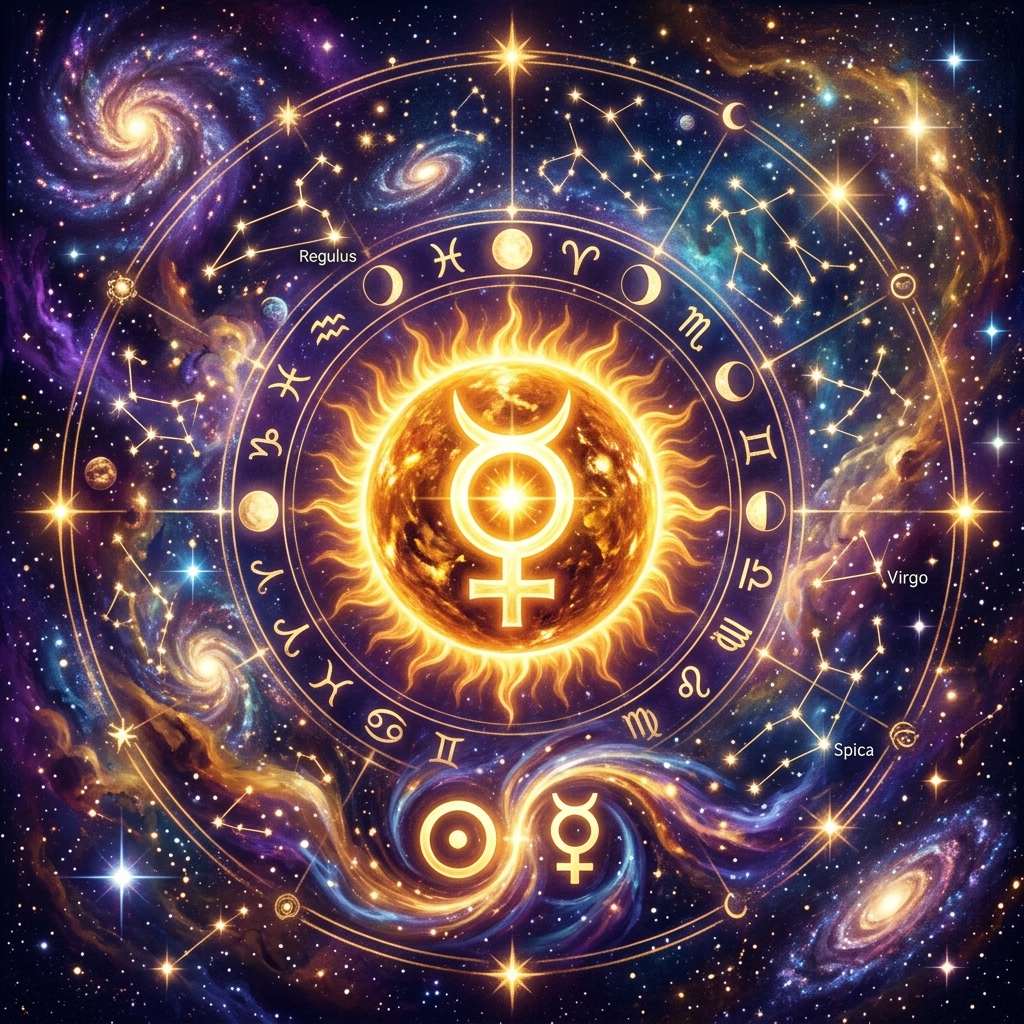
Sun conjunct Mercury is the most common close contact in astrology. About one birth chart in four has it. That is not luck. It is a rule of the sky. Mercury can never stray far from the Sun, so the two meet again and again. The rare thing is not the conjunction. The rare thing is the exact hit at the heart of the Sun, which the old books call cazimi. It shows up in about one chart in 120. Below we count both, give the old readings, and list each meeting date for 2026 and 2027.
First, the words. An aspect is an angle between two planets, measured along the band of sky that the Sun, Moon and planets follow. A conjunction is the aspect of 0°: the two sit at the same spot, or close to it. The orb is how far from exact we still count the aspect. Here we use 8° and 3°. With an 8° orb, a Sun at 10° Gemini and a Mercury at 17° Gemini still count as conjunct. With a 3° orb, they do not. Our practical guide to astrological aspects covers the other angles.
Mercury lives on a short leash
Mercury is the planet closest to the Sun. Its orbit is small, and we watch it from outside. So from Earth, it never seems to wander far from the Sun. It swings ahead, then behind, like a dog on a lead.
We measured the longest stretch of that lead. Over eight hundred years, from 1600 to 2400, the widest gap between the Sun and Mercury was 27.79°. It never reached 28°. That one fact shapes all the rest.
Look at what it rules out. A sextile is an angle of 60°, a square 90°, a trine 120°, an opposition 180°. None of them can form between these two in one chart. Even the small 30° angle, the semi-sextile, is out of reach. The conjunction is the only aspect these two can ever make with each other.
So the question is never whether the two are close. It is how close, and in which way.
How common is Sun conjunct Mercury?
We counted. We took 200,000 moments at random between 1950 and 2010 and placed the Sun and Mercury for each one. The positions come from the Swiss Ephemeris, the planet tables most astrology software uses, in the tropical zodiac. Then we checked the result two other ways. We stepped through 1950 to 2010 every 72 minutes, and through 1600 to 2400 every six hours. We also ran a second, free-standing planet code. All routes agree to within a tenth of a point.
| How close are the Sun and Mercury? | Share of moments | Rough odds. |
|---|---|---|
| Within 8°, a wide conjunction. | 23.5 percent. | One in 4. |
| Within 3°, a tight conjunction. | 8.6 percent. | One in 12. |
| Within 1°, a near-exact meeting. | 2.9 percent. | One in 35. |
| Within 17 arcminutes, cazimi. | 0.8 percent. | One in 120. |
| Same sign, at any distance. | 51.2 percent. | One in 2. |
The share barely moves. With the 8° orb it stays between 22.9 and 24.1 percent in each decade from the 1950s to the 2000s, and it is 23.5 percent over 800 years. Your birth year does not change the odds.
Note the last row. Mercury shares the Sun’s sign in about half of all charts, but only half of those are a true conjunction. Two planets can share a sign and still be 25° apart. A Sun at 1° Leo and a Mercury at 27° Leo are in the same sign, yet they are not conjunct. The aspect counts degrees, not sign names.
One caution. The Sun moves about one degree a day, so your birth date places it well. Mercury changes pace. To know if yours is within 3° or 1°, you need the exact date, and for the tightest cases the birth time too.
Combust, cazimi, under the beams: one aspect, three verdicts
Here the old tradition parts ways with modern books. Modern astrology treats this as one aspect. The older schools split it into zones and read each one in its own way.
Start with the widest zone. In the Hellenistic tradition, the Greek-speaking astrologers whose work, from roughly 100 BC to 600 AD, is where Western astrology begins, a planet within about 15° of the Sun is under the beams. That means it is lost in the Sun’s glare, out of sight. The old reading is that its themes are hidden too.
Closer in, a planet is combust, which means burned. The later tradition, which our page on the conjunction and its special Sun cases follows, draws that line at about 8°30′. In the old reading, a combust Mercury is weakened. Its voice is drowned out by the Sun.
Then, at the very centre, the verdict flips. A planet within 17 arcminutes of the Sun’s centre is cazimi, a word taken from Arabic that means in the heart. Seventeen arcminutes is about half the width of the full Moon. A cazimi planet is not burned. It sits inside the king’s tent, and the old books read it as the strongest place a planet can hold. William Lilly, the English astrologer, set out both states in his book Christian Astrology in 1647. He warned readers not to confuse them, since a hair of distance turns ruin into honour.
Our counts match the shape of that scheme. Within 8°30′ but outside the heart, Mercury is combust in 24.2 percent of moments. It is cazimi in 0.8 percent. Out of all charts with Sun conjunct Mercury at an 8° orb, only about one in 29 is cazimi. Most people with this aspect have a combust Mercury, not a cazimi one.
In the last twenty years, Chris Brennan and Demetra George, both working from Hellenistic sources, have brought cazimi back into common use. Many modern writers still skip it. When you read about this aspect, check which school the writer follows. The same chart can be called bright or burned by two books.
Two kinds of meeting: Mercury retrograde or direct
The Sun and Mercury meet in two ways, and you can see the gap in the sky.
At times Mercury passes behind the Sun, on the far side of its orbit. This is called a superior conjunction, and the planet is moving forward through the signs. At other times it passes between the Earth and the Sun. That is an inferior conjunction. At that moment Mercury is retrograde, which means it seems to move backwards against the stars from where we stand on Earth.
The two kinds take turns. Each year brings about three of each, and they do not last the same time. A forward meeting keeps the pair within 8° for 13 to 28 days. A retrograde meeting rushes past in 7 to 11 days, because the two then move in opposite directions.
This shows up in birth charts. Across all moments, Mercury is retrograde 19.2 percent of the time. Among charts with Sun conjunct Mercury at 8°, the share is 31.3 percent. So close to one in three people with this aspect was born with Mercury retrograde. A common modern reading is that a backward-moving Mercury turns thought inward: more review, more second drafts, more talk with oneself.
What the tradition reads in Sun conjunct Mercury
In the chart, the Sun stands for the core of who you are. It is your sense of self and what you want to shine at. Our page on the Sun’s role in your chart goes deeper. Mercury stands for the mind in motion. It is how you think, speak, learn, trade and connect ideas. Our guide to Mercury in astrology covers it in full.
Ptolemy, the Greek astronomer who wrote the Tetrabiblos in the second century, gave Mercury rule over reason, speech and learning. He also noted that it takes on the colour of the planets it joins. Next to the Sun, it borrows the Sun’s colour.
Sue Tompkins, in her book Aspects in Astrology (2002), reads every conjunction as a fusion. The two planets act as one, and you cannot see one without the other. With the Sun and Mercury, that means who you are and how you think come as a single package. Reinhold Ebertin, a German astrologer, wrote short notes for each planet pair in The Combination of Stellar Influences (1940). He links this pair with the mind at work and with the drive to put one’s aims into words.
Put plainly, the classic natal reading runs like this. You think with your whole self. Your ideas feel like part of you, not tools you pick up and put down. You speak with conviction, and you are drawn to work built on words, ideas or trade.
The other side of the coin follows from the same fusion. If your ideas are you, then a critique of your idea feels like a critique of you. Modern psychological astrology describes a related blind spot. The Sun is so close that Mercury cannot see it from outside. It can be hard to stand back from your own view.
The combust and cazimi zones add shading. In the old reading, a burned Mercury speaks under the Sun’s orders. The mind serves the ego rather than checking it. A planet in the heart is read as a mind in tune with the self, clear and given power. Treat these as the tradition’s images, not as forecasts about you.
Sign and house: where the meeting happens
Because the two are fused, they share the colour of the sign they stand in. Think of your chart as a house with twelve rooms. Each room covers one part of life, and the planets are the furniture. With this aspect, the Sun and Mercury nearly always sit in the same room. The theme of that room becomes the place where you think and speak with the most force.
The sign works the same way. A Sun–Mercury meeting in Gemini or Virgo puts Mercury in its own signs, which the tradition reads as a strong mind. In Pisces, its sign of fall, the old texts see a mind that works by image and feeling rather than by list.
The link with your Sun sign clears up a fact many people find odd. Not all those with Mercury in a sign have the Sun there too. Our article on Mercury in Aquarius shows that about half of those people are Aquarius Suns, and the rest have their Sun in Pisces or Capricorn. With this aspect, that doubt goes away. Your Mercury sign is nearly always your Sun sign.
Sun conjunct Mercury transit: when the sky does it again
A transit is the moving sky of today touching the fixed points of your birth chart. Sun conjunct Mercury is also a daily-sky event. The two meet in the current sky six or seven times a year. Here is each exact meeting in 2026 and 2027, worked out with the Swiss Ephemeris and checked with a second planet code. Times are in UTC. For New York, subtract four hours in summer and five in winter, so a meeting soon after midnight UTC falls on the evening before in the US.
| Exact meeting (UTC) | Where in the zodiac | Kind of meeting. |
|---|---|---|
| January 21, 2026, 15:48. | 1°36′ Aquarius. | Forward, within 8° for 24 days. |
| March 7, 2026, 11:01. | 16°52′ Pisces. | Retrograde, within 8° for 8 days. |
| May 14, 2026, 14:24. | 23°48′ Taurus. | Forward, within 8° for 13 days. |
| July 13, 2026, 01:25. | 20°42′ Cancer. | Retrograde, within 8° for 10 days. |
| August 27, 2026, 17:03. | 4°26′ Virgo. | Forward, within 8° for 16 days. |
| November 4, 2026, 14:24. | 12°10′ Scorpio. | Retrograde, within 8° for 7 days. |
| January 1, 2027, 17:07. | 11°02′ Capricorn. | Forward, within 8° for 27 days. |
| February 18, 2027, 16:39. | 29°47′ Aquarius. | Retrograde, within 8° for 8 days. |
| April 28, 2027, 21:21. | 8°21′ Taurus. | Forward, within 8° for 14 days. |
| June 23, 2027, 07:59. | 1°39′ Cancer. | Retrograde, within 8° for 11 days. |
| August 11, 2027, 11:02. | 18°34′ Leo. | Forward, within 8° for 15 days. |
| October 19, 2027, 15:30. | 26°01′ Libra. | Retrograde, within 8° for 8 days. |
| December 11, 2027, 22:16. | 19°34′ Sagittarius. | Forward, within 8° for 28 days. |
Each of these moments is a sky-wide cazimi. The window is short. It lasts about 6 hours for a backward meeting and up to 24 hours for the slowest forward one. Astrologers who pick good moments to begin things, a practice called electional astrology, treat it as a good time to start writing or send a key message.
How does a transit touch you? Find the degree of each meeting above. If it lands within a few degrees of one of your own planets, that planet gets a brief spotlight. When the meeting falls on your natal Sun, the tradition reads a few days of clear thinking about your own aims. When it falls on your natal Mercury, the reading is busy talk, news and choices. Each one passes in days, not months.
Sun conjunct Mercury in synastry
Synastry is the comparison of two birth charts, laid one on top of the other. Here the 28° rule does not apply. Your Sun and my Mercury come from two different birth dates, so they can sit anywhere. Our guide to synastry charts and relationship dynamics explains the method.
If two birthdays are unrelated, the odds follow simple geometry. With an 8° orb, one person’s Sun falls within 8° of the other’s Mercury in about 4.4 percent of pairs. Count both ways, your Sun on my Mercury or mine on yours, and it rises to about one pair in eleven or twelve.
The tradition reads this contact as a meeting of minds. The Sun person feels understood. The Mercury person finds words for the Sun person’s aims. Mercury rules talk and exchange, so this contact is read as one of easy companionship. The risk is the same blind spot as in the natal aspect. The Mercury person can end up as the Sun person’s voice rather than their own. A good test is whether both people still argue freely.
Frequently asked questions
Is Sun conjunct Mercury rare?
No. It is the most common close contact in astrology. With an 8° orb, about 23.5 percent of all moments have it, or about one chart in four. With a 3° orb it is about one chart in twelve. The rare form is cazimi, with Mercury in the heart of the Sun: about one chart in 120.
Is the Sun and Mercury conjunction good?
According to the tradition, it depends on the distance. Modern astrology reads it as a bright, self-driven mind. The older schools call Mercury weakened, or combust, when it is close to the Sun but not exact. They call it strong, or cazimi, when it is within 17 arcminutes. Astrology is a symbolic language, not a science, so take these as readings, not verdicts.
What is the difference between combust and cazimi?
Both describe a planet next to the Sun. Combust means burned: Mercury is within about 8°30′ of the Sun and its voice is lost in the glare. Cazimi means in the heart: Mercury is within 17 arcminutes of the Sun’s centre and is read as honoured and strong. About 24.2 percent of moments are combust and 0.8 percent are cazimi.
Why can’t the Sun and Mercury form a square or trine?
Mercury orbits inside the Earth’s orbit, so from Earth it never strays more than 27.79° from the Sun. That was the widest gap we found from 1600 to 2400. A sextile needs 60°, a square 90° and a trine 120°. The conjunction is the only aspect the two can make in one chart.
How often does the Sun conjunct Mercury transit happen?
Six or seven times a year. In 2026 the exact meetings fall on January 21, March 7, May 14, July 13, August 27 and November 4, all in UTC. They alternate between forward meetings, which last two to four weeks within 8°, and retrograde meetings, which pass in about a week.
Go deeper with your personal Astrovision report
Reading about astrological concepts is a great start, but nothing compares to hearing how they apply directly to you. Our users love our audio-first approach, calling it “friendly, personal, and easy to understand.” While this article gives you the “what,” a personal report gives you the “so what.” Discover your unique path with an Astrovision report—your personal ‘user manual’ delivered in our celebrated podcast format.