
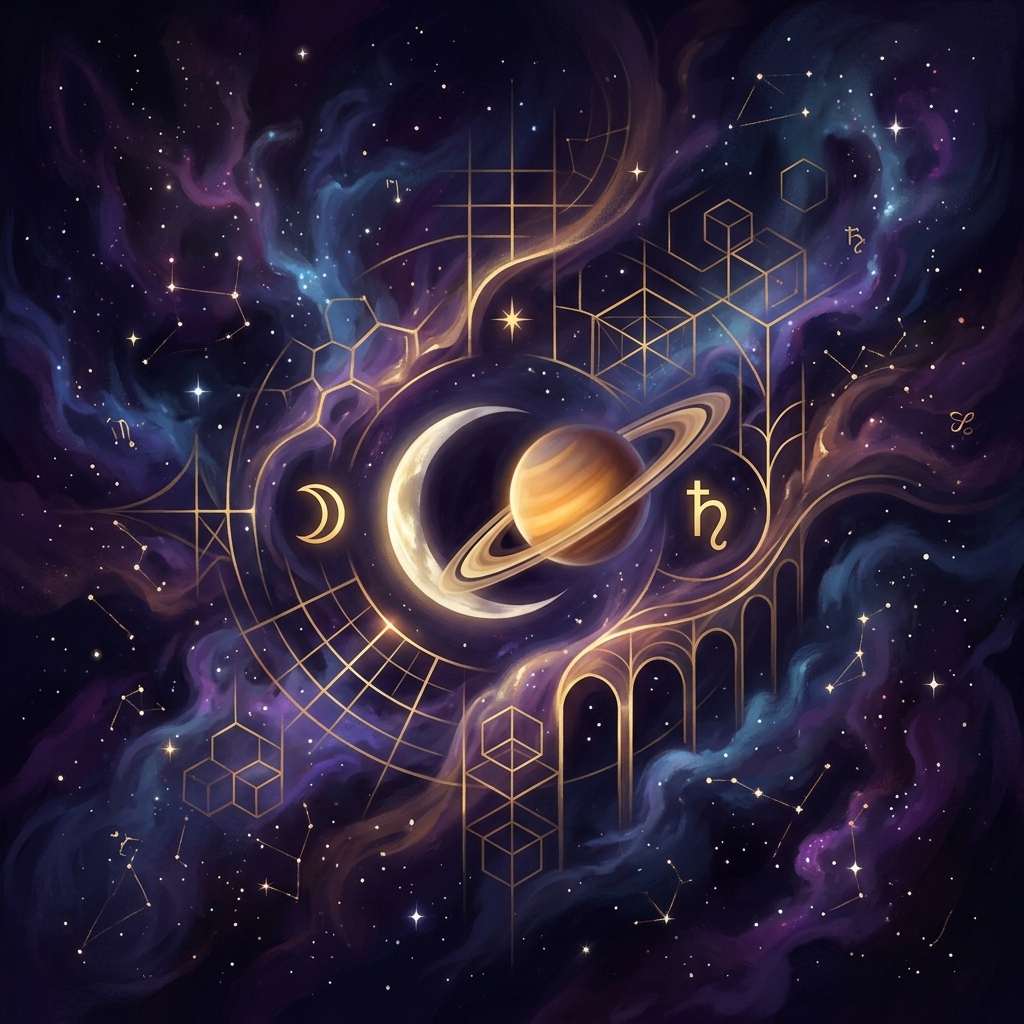
Moon conjunct Saturn has a bad name. Read ten short guides and you will meet words like cold, lonely and heavy. This article takes a slower route. It counts how common the aspect is, gives every date the sky repeats it in 2026, and sets the old verdicts next to a newer reading. That newer reading comes from Liz Greene. In her 1976 book on Saturn, she treats the planet less as a curse and more as a need for structure.
First, three words you will see again. An aspect is an angle between two planets, measured along the band of sky the Sun, Moon and planets move through. A conjunction is the aspect of 0°: the two bodies sit at the same place in that band. The orb is the gap an astrologer allows around the exact angle before the link stops counting. Here we use two orbs: 8°, which is wide, and 3°, which is tight. Our guide to aspects in astrology and how planets argue covers every other angle.
What does it mean when the Moon and Saturn are conjunct?
Think of a birth chart as a house with twelve rooms. Each room covers one part of life, and the planets are the furniture. With this aspect, two very different pieces sit side by side in the same room, and they cannot be moved apart.
The Moon is the soft chair. In astrology it stands for feelings, needs, comfort, habits and the sense of home. It is the part of you that asks, “Am I safe? Am I fed? Am I held?” Our guide to what the Moon represents in astrology goes through its full role.
Saturn is the solid oak shelf. It stands for time, rules, limits, duty and the work that only pays off late. It is the part of you that asks, “Is this built to last?” Our page on Saturn and its 29-year clock covers the planet in depth.
Put the two together and the question changes. It is no longer “What do I feel?” but “Is it all right to feel this, and is it safe to show it?” Sue Tompkins, in Aspects in Astrology (2002), explains the conjunction as a blend: the two planets act as one, and you cannot use one without calling up the other. So each time the Moon’s needs rise, Saturn’s caution comes with them.
The old tradition put it more bluntly. Claudius Ptolemy, the Greek writer of the Tetrabiblos around 150 AD, called Saturn cold and dry and the Moon moist. In that system, Saturn chills what the Moon warms. In 1940 the German astrologer Reinhold Ebertin wrote The Combination of Stellar Influences, a handbook of planet pairs. He files Moon and Saturn under self-control, a strong sense of duty and feelings held in check.
Liz Greene read the same facts in another light. In Saturn: A New Look at an Old Devil (1976), she treats Saturn as the place where a person feels a lack, and then slowly builds the skill that fills it. Apply that idea to the Moon, and the lack is a sense of ease and care. The skill is the ability to give yourself steady care, on purpose. Read this way, the aspect is not a sentence. It is a job that takes time.
In daily life, the tradition links this pairing with a few clear themes:
- Feelings that are real but slow to show, like water under ice.
- A strong pull toward routine, lists and plans as a way to feel calm.
- An early sense of duty: being “the grown-up” in a room from a young age.
- Loyalty that is earned slowly and then kept for years.
- A dry, quiet humor that others notice late.
None of these is a fate. They are what the tradition says the two symbols share. Your sign, your house and the rest of your chart change how they play out.
Moon conjunct Saturn or Saturn conjunct Moon: is there a difference?
In a birth chart, no. “Moon conjunct Saturn” and “Saturn conjunct Moon” name the same aspect. The order of the words is only habit.
In transits, the order matters a lot. A transit is what happens when a planet moving in today’s sky reaches a point in your birth chart. There are two kinds here, and they feel nothing alike.
- The moving Moon reaches your birth Saturn. This happens once a month and lasts about a day.
- Moving Saturn reaches your birth Moon. This happens about once every 29 years and lasts for months.
The first is a short mood. The second is a whole season.
How common is a Moon Saturn conjunction at birth?
We measured it ourselves. Here is how, so you can check it. We drew 200,000 moments at random between 1950 and 2010. For each one, we took the exact places of the Moon and Saturn from the Swiss Ephemeris. That is the star table most astrology software runs on. We used the tropical zodiac, the one tied to the seasons that Western astrologers use. Then we measured the gap between the two bodies along their path.
| Orb allowed | Share of birth moments | Roughly one chart in. |
|---|---|---|
| Within 8° of exact | 4.45 percent of moments | About one chart in 22. |
| Within 3° of exact | 1.70 percent of moments | About one chart in 59. |
We then checked the result a second way. Instead of random moments, we stepped through the same sixty years every 2.4 hours and measured each step. That second count gave 4.46 percent at 8° and 1.68 percent at 3°. The two routes agree.
What do these numbers tell us? First, the aspect is not rare. An orb of 8° on each side makes a window of 16° out of 360°. That is 4.44 percent, which is almost exactly what we found. The Moon laps the whole zodiac once a month, so it meets Saturn exactly as frequently as pure chance would say.
Second, the rate does not drift. By decade, the 8° share stays between 4.30 and 4.54 percent from the 1950s to the 2000s. No generation has much more of it than another.
Third, you need a birth time. The Moon moves about 13° a day, faster than anything else in the chart. In one pass, it spends about 28 hours within 8° of Saturn. Born in the morning, you might have the aspect. Born that night, you might not.
The Moon’s phase is free here
Some Moon aspects come with a built-in phase. Venus never strays more than about 47° from the Sun. So when the Moon meets Venus, it is always a thin crescent or near a new Moon. Saturn has no such leash. It can sit at any distance from the Sun.
Our sample shows it. Among the moments with the Moon within 8° of Saturn, only 36 percent had the Moon within 60° of the Sun. The gap between Moon and Sun ran all the way to 180°, which is a full Moon. So a Moon on Saturn can come with a new Moon, a half Moon or a full Moon.
Moon conjunct Saturn transit: the 2026 dates
The Moon catches Saturn about every 27.4 days. That is a little longer than the Moon’s 27.3-day trip around the zodiac, because Saturn moves on a bit each month. We found each exact meeting in 2026 with the Swiss Ephemeris, by narrowing the time until the two places matched. Times are in UTC. For New York, subtract four hours until 1 November and five hours after.
| Exact meeting (UTC) | Place in the zodiac | Moon phase at the time. |
|---|---|---|
| 23 January, 09:32 | 27°49′ Pisces | Waxing crescent. |
| 19 February, 20:48 | 0°39′ Aries | Waxing crescent. |
| 19 March, 10:51 | 3°58′ Aries | Close to the new Moon. |
| 16 April, 02:37 | 7°24′ Aries | Dark Moon, just before new. |
| 13 May, 18:10 | 10°31′ Aries | Waning crescent. |
| 10 June, 07:29 | 12°58′ Aries | Waning crescent. |
| 7 July, 17:14 | 14°26′ Aries | Last quarter. |
| 3 August, 23:21 | 14°41′ Aries | Waning gibbous. |
| 31 August, 03:18 | 13°43′ Aries | Waning gibbous. |
| 27 September, 07:19 | 11°51′ Aries | Just past the full Moon. |
| 24 October, 13:05 | 9°47′ Aries | Waxing gibbous. |
| 20 November, 20:44 | 8°17′ Aries | Waxing gibbous. |
| 18 December, 05:20 | 7°58′ Aries | Waxing gibbous. |
Across one year, the same meeting slides through every phase of the Moon.
Look at the degrees too. They climb from 0° to 14° of Aries, then turn back. That is Saturn’s retrograde. From Earth, a planet sometimes seems to move backward for a few months. That is all retrograde means: the planet does not really reverse. Saturn turned retrograde on 26 July 2026 at 14°44′ Aries, and it turns direct again in December. So the monthly meetings step back down the sign in the autumn.
Eleven of the thirteen 2026 meetings happen with Saturn in Aries. Saturn left Pisces for Aries on 14 February 2026, and it stays there until April 2028. In New York time, that entry fell on the evening of 13 February. The January meeting was the last one in Pisces for decades.
Why Saturn in Aries colors these meetings
Classical astrology gives each planet a best sign and a worst sign. Ptolemy set Saturn’s best sign, its exaltation, in Libra. The sign opposite is its fall, where it works against the grain. For Saturn, that is Aries. Our article on why Saturn in Aries is its weakest sign tells the full story.
What does that mean for a monthly Moon transit? In the tradition, the Moon over Saturn is a day for plain work, not grand plans. With Saturn in the sign of speed and start-ups, the classic pull is between “go now” and “wait until it is ready.” That tension is the tone of these dates, read through the old rules.
When Saturn reaches your birth Moon
The slow version matters far more to most readers. Saturn takes about 29 years to go once around the zodiac. So it comes back to your birth Moon about every 29 years. With retrograde, it can cross the same point three times in a single year.
The 2026 motion shows how. Saturn crosses the stretch from about 8° to 14° of Aries three times: once going forward, once going back, and once forward again. If your birth Moon sits in that stretch, Saturn stays with it for months. The tradition reads such a season as a time to build a firmer base at home and in private life. Liz Greene’s reading adds that the weight is a signal to build, not a penalty.
Is there a Moon-Saturn conjunction today?
On 30 September 2026, no. The last exact meeting was on 27 September at 07:19 UTC. The next is on 24 October at 13:05 UTC, which is 9:05 a.m. in New York. The table above lists every meeting left in the year.
Moon conjunct Saturn synastry: when two charts touch
Synastry is the art of laying two birth charts over each other to see how two people fit. In this case, one person’s Moon sits on the other person’s Saturn. Our guide to how synastry charts work sets out the method in full.
The roles are not the same. The Saturn person brings shape: plans, rules, patience, a sense of “we are in this for the long run.” The Moon person brings feeling, need and the daily texture of home. In a good year, the Moon person feels held and safe. In a hard year, the same person feels judged, or kept on a short rein.
Modern writers on relationships class Saturn links as binding. They add weight and staying power, which is why astrologers look for them in long bonds. The Saturn side holds real power here. Saturn can steady the other person, or it can chill them. The difference is in how the Saturn person speaks.
A few habits help, in the spirit of the tradition:
- The Saturn person names care in plain words, not only in deeds.
- The Moon person says what they need before it turns into a hurt.
- Both treat routines as shared, not as rules one side sets.
How to work with a Moon Saturn conjunction
People ask how to “overcome” this aspect. The tradition does not frame it as a thing to beat. Greene’s view is closer to training. Saturn marks a place where the skill was not handed to you, so you build it by hand.
In the language of the chart, that means giving the Moon a structure it can trust. Here are a few ways astrologers put it:
- Set a small daily ritual that is only for comfort: a walk, a meal, a call.
- Write down what you feel, then what you need. Saturn likes a list.
- Choose one or two people to show feelings to, and let trust grow slowly.
- Judge progress over years, not weeks. Saturn is the planet of time.
These are the symbols speaking, not a cure or a promise. Astrology is a symbolic language, not a science. It can frame a question. It cannot measure your life.
Work and calling in the old rulership lists
Astrologers who assign trades to planets link Saturn with land, buildings, old things, rules and long projects. They link the Moon with care, food, homes, water and the public. So the tradition connects this pair with work that gives care a firm shape. Examples from those lists include property, home building, caring work with clear rules, history and record keeping.
Treat this as a map of symbols, not job advice. The rest of the chart, and your own life, weigh far more.
Moon conjunct Saturn: FAQ
What does it mean when the Moon and Saturn are conjunct?
It means the Moon and Saturn sit at the same place in the zodiac, within the orb an astrologer allows. The tradition reads it as feelings held with care and control. Read through Liz Greene’s 1976 view of Saturn, it is a need for structure, not a curse.
Is there a Moon-Saturn conjunction today?
The Moon meets Saturn about every 27.4 days. In late 2026, the exact meetings fall on 24 October at 13:05 UTC, 20 November at 20:44 UTC and 18 December at 05:20 UTC. The Moon stays within 8° of Saturn for about 28 hours around each one.
What is the rarest conjunction in a birth chart?
Not this one. In our sample, 4.45 percent of moments had the Moon within 8° of Saturn. Conjunctions between slow planets are the rare ones. Uranus and Neptune met in 1821 and then not again until 1993, a gap of 172 years.
How can you overcome a Moon Saturn conjunction?
The tradition does not treat it as a flaw to beat. Liz Greene reads Saturn as a skill built slowly. Steady routines, plain words for needs and patience are the usual advice. This is symbolic advice, not a promise.
What profession is associated with a Moon-Saturn conjunction?
In the old lists, Saturn rules land, rules and long work, and the Moon rules care, food and home. The tradition pairs them with work that gives care a firm shape. A single aspect does not decide a career.
Go deeper with your personal Astrovision report
Reading about astrological concepts is a great start, but nothing compares to hearing how they apply directly to you. Our users love our audio-first approach, calling it “friendly, personal, and easy to understand.” While this article gives you the “what,” a personal report gives you the “so what.” Discover your unique path with an Astrovision report—your personal ‘user manual’ delivered in our celebrated podcast format.