
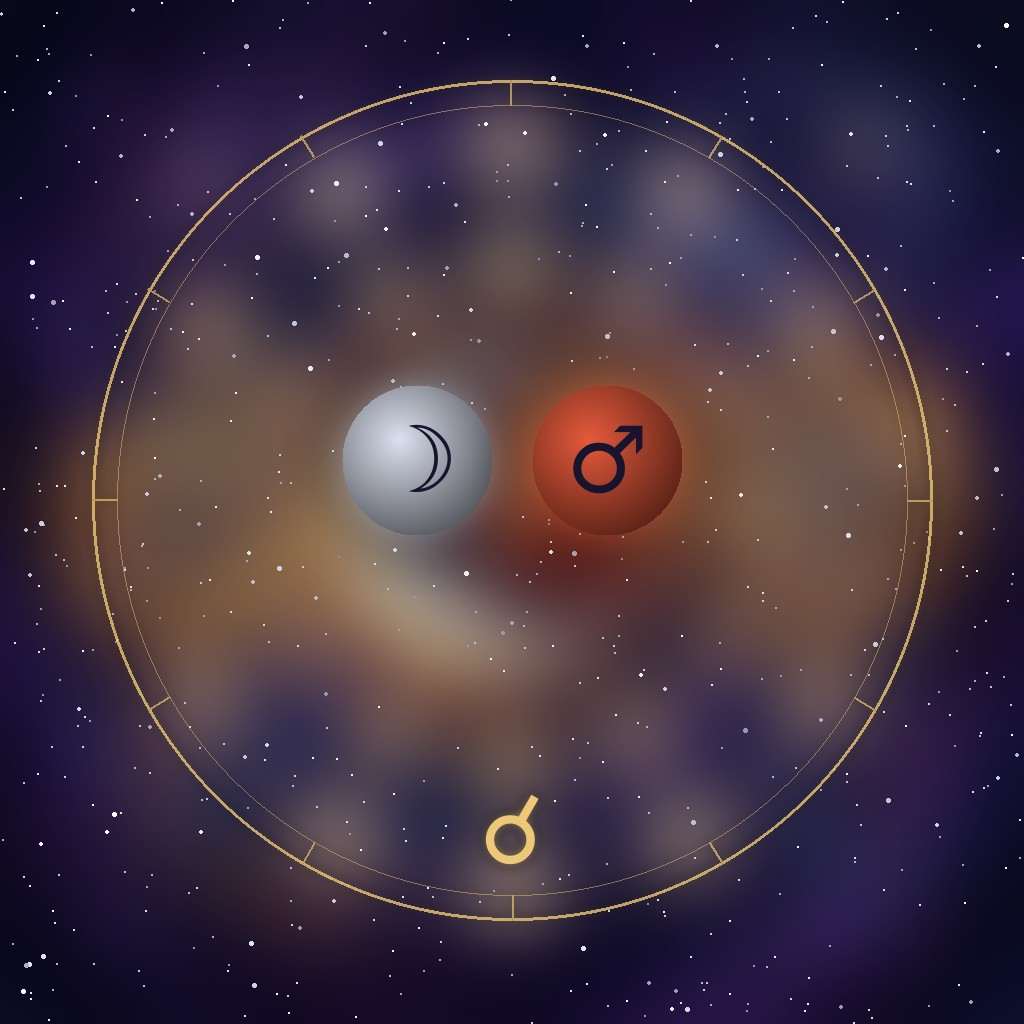
The Moon meets Mars about once a month. Most years, that makes 13 meetings. But from October 2026 to July 2027, something odd happens. Eleven meetings in a row land in just two signs, Leo and Virgo. The Moon is not the reason. Mars is. This guide explains why, and what it means for a birth chart, for the sky, and for two people.
First, the words. An aspect is an angle between two planets, seen from Earth. A conjunction is the angle of zero degrees: the two planets stand at the same place in the zodiac. The orb is the gap we allow around the exact angle. With an orb of 8 degrees, the Moon counts as conjunct Mars when it sits anywhere within 8 degrees of it, on either side.
The phrase has three uses: a birth chart, a transit, and synastry. Each gets its own section, with numbers we measured ourselves.
What Moon conjunct Mars means in a birth chart
Start with the two planets. The Moon is read for feelings, needs, and the sense of being safe at home. It shows what calms you down. Our guide to the Moon in astrology covers it in full.
Mars is read for drive, anger, courage, and the urge to act. It shows how you go after what you want. Our page on Mars in your chart goes further.
Now picture your chart as a house with twelve rooms. Each room is one part of life, and the planets are the furniture. A conjunction puts two pieces of furniture side by side in the same room. You cannot use one without bumping the other. Our page on the conjunction aspect explains that angle on its own.
So what does the tradition see when feelings and drive share a room? A feeling turns into an action fast, with little delay in between. Sue Tompkins, in Aspects in Astrology (2002), reads every conjunction as a fusion. The two planets act as one, and the person cannot easily tell them apart. Reinhold Ebertin, in The Combination of Stellar Influences (1940), reads Moon and Mars contacts as strong feelings that spill into action. He links them with an excitable, lively temper.
Here is how that reading is usually laid out:
- Feelings arrive with heat. Hurt becomes anger quickly, and joy becomes action.
- The person protects what they love with real force.
- Courage in a crisis is a classic theme. So is a short fuse at home.
In Indian astrology, this pairing has its own name: Chandra-Mangala yoga. Chandra is the Moon and Mangala is Mars. That school reads it with its own rules, and it uses a different zodiac, so its signs sit about 24 degrees away from ours. This guide stays with Western, tropical astrology.
Keep one point clear. This is a reading, not a fact about a person. Astrology is not a science. No chart point makes anyone angry or brave, and none excuses harm done to others.
Two planets that fall in each other’s homes
The old astrologers gave each planet signs where it is strong and signs where it is weak. Ptolemy’s Tetrabiblos, from the second century, sets these out. A planet’s home sign is the one it rules. Its exaltation is a sign where it is honored. Its fall is the sign opposite that honor, where it is weak.
Moon and Mars have a strange link here. Each one falls in the other’s home. The Moon falls in Scorpio, a sign ruled by Mars. Mars falls in Cancer, the Moon’s own sign. So the sign of your conjunction changes the story:
| Sign of the conjunction | What the tradition notes. |
|---|---|
| Aries | Mars is at home, and the Moon is its guest. |
| Taurus | The Moon is exalted, and Mars is out of place. |
| Cancer | The Moon is at home, and Mars is in its fall. |
| Scorpio | Mars is at home, and the Moon is in its fall. |
| Capricorn | Mars is exalted, and the Moon is out of place. |
| Any other sign | Neither planet holds a special rank. |
In the tradition, the stronger planet leads. In Scorpio, drive steers feelings. In Cancer, feelings steer drive.
Moon conjunct Mars natal: how common is it?
We drew 200,000 random moments between 1950 and 2010. For each one, we took the true positions of the Moon and Mars. Then we counted how many had the Moon within 8 degrees of Mars.
The answer is 4.53 percent. That is about one chart in 22. With a tight orb of 3 degrees, the share drops to 1.7 percent, or about one chart in 59. So this is not a rare mark. In a class of thirty, one child has it, give or take.
| Birth decade | Share of charts within 8 degrees. |
|---|---|
| The 1950s | 4.73 percent of charts. |
| The 1960s | 4.58 percent of charts. |
| The 1970s | 4.32 percent of charts. |
| The 1980s | 4.60 percent of charts. |
| The 1990s | 4.43 percent of charts. |
| The 2000s | 4.53 percent of charts. |
The column is flat. Each decade sits near 4.5 percent, and the small gaps are noise from random drawing. The Moon laps the zodiac every 27.3 days, so no decade is favored.
You can check it by hand: a window 16 degrees wide, divided by 360, gives 4.4 percent. A second count, with one moment every three hours across the same 60 years, gave 4.45 percent. Both routes agree.
Why your birth time matters so much here
The Moon moves about 13 degrees a day. Mars moves well under one degree. So the gap between them closes at roughly 12 degrees a day, and the full 16 degree window passes in about a day and a third.
That means a few hours can switch the aspect on or off. If you were born near the edge, a chart cast for noon can show a conjunction you do not have. Use your exact birth time. For slow planets, a guess is fine. For the Moon, it is not.
Mars picks the sign, not the Moon
The Moon spends the same time in every sign, month after month. Mars does not. It moves at uneven speed, and it sometimes seems to stop and go backward. So when the Moon meets Mars, the sign of that meeting depends on where Mars happens to be.
We found every exact meeting from 1600 to 2400. That is 10,270 meetings in 800 years. Here is where they fell:
| Sign | Share of all meetings. |
|---|---|
| Leo | 10.2 percent of meetings. |
| Virgo | 10.1 percent of meetings. |
| Libra | 9.7 percent of meetings. |
| Cancer | 9.4 percent of meetings. |
| Scorpio | 8.7 percent of meetings. |
| Gemini | 8.5 percent of meetings. |
| Sagittarius | 7.9 percent of meetings. |
| Taurus | 7.7 percent of meetings. |
| Aries | 7.2 percent of meetings. |
| Capricorn | 7.1 percent of meetings. |
| Aquarius | 6.8 percent of meetings. |
| Pisces | 6.7 percent of meetings. |
About one meeting in ten falls in Leo. Only one in fifteen falls in Pisces. This order follows the time Mars spends in each sign. Mars lingers in Leo and Virgo because its orbit takes it farthest from the Sun near those signs, where it moves most slowly. It rushes through Aquarius and Pisces.
So if you have this aspect, it is more likely to sit in Leo or Virgo than in Pisces. Our guide to Mars in Virgo covers one of the two busiest signs.
Moon conjunct Mars transit: the monthly meeting
A transit is a planet’s position in the sky today, read against a chart. The phrase “Moon conjunct Mars transit” covers two different events. In the first, the Moon meets Mars in the sky. In the second, Mars in the sky crosses the Moon in your birth chart. They run on very different clocks.
When the Moon meets Mars in the sky
This happens every 28.5 days on average. Over 800 years, the gap ran from 26.4 to 29.2 days. Most years hold 13 meetings. Some hold 12. In our count, only one year in 800 held 14.
Here are the exact moments through late 2027. Times are in UTC, with New York time beside them.
| Exact meeting | Where it falls. |
|---|---|
| Oct 5, 2026, 06:01 UTC (2:01 AM in New York) | At 4 degrees Leo. |
| Nov 2, 2026, 13:48 UTC (8:48 AM in New York) | At 19 degrees Leo. |
| Nov 30, 2026, 17:24 UTC (12:24 PM in New York) | At 1 degree Virgo. |
| Dec 28, 2026, 14:13 UTC (9:13 AM in New York) | At 9 degrees Virgo. |
| Jan 24, 2027, 23:39 UTC (6:39 PM in New York) | At 9 degrees Virgo. |
| Feb 20, 2027, 20:27 UTC (3:27 PM in New York) | At 0 degrees Virgo. |
| Mar 19, 2027, 16:16 UTC (12:16 PM in New York) | At 21 degrees Leo. |
| Apr 15, 2027, 23:10 UTC (7:10 PM in New York) | At 22 degrees Leo. |
| May 13, 2027, 17:31 UTC (1:31 PM in New York) | At 29 degrees Leo. |
| Jun 10, 2027, 20:04 UTC (4:04 PM in New York) | At 11 degrees Virgo. |
| Jul 9, 2027, 04:30 UTC (12:30 AM in New York) | At 26 degrees Virgo. |
| Aug 6, 2027, 17:32 UTC (1:32 PM in New York) | At 13 degrees Libra. |
| Sep 4, 2027, 10:25 UTC (6:25 AM in New York) | At 1 degree Scorpio. |
| Oct 3, 2027, 06:42 UTC (2:42 AM in New York) | At 21 degrees Scorpio. |
| Nov 1, 2027, 06:01 UTC (2:01 AM in New York) | At 11 degrees Sagittarius. |
Look at the first eleven rows. They all sit in Leo or Virgo. Mars entered Leo on September 28, 2026, and it will not leave Virgo for Libra until July 15, 2027 (both dates in UTC). That is close to ten months in two signs.
The reason is a retrograde. Seen from Earth, planets sometimes seem to move backward. That is what retrograde means. Mars stops and turns back on January 10, 2027, at 10 degrees Virgo. It stops again and turns forward on April 1, 2027, at 21 degrees Leo. Each of these pauses is called a station. While Mars backs up, the Moon catches it sooner. The gap from January 24 to February 20 is under 27 days.
One meeting stands out. On February 20, 2027, the Moon is nearly full when it meets Mars. In the tradition, a full Moon brings feelings into the open. Here, it does so next to the planet of drive.
A note for skywatchers. In astrology, a conjunction counts only the position along the zodiac. In the real sky, the two can still look far apart, one above the other. On February 20, 2027, the Moon passes about 5 degrees south of Mars. That is about ten Moon widths.
For the tradition, each meeting is a mood, not an event. It lasts about a day within an 8 degree orb.
When Mars crosses your natal Moon
This is the slower transit. Mars takes about two years to go around the zodiac. So it crosses your natal Moon about once every two years, for a few days each time.
Retrograde changes that. If your natal Moon sits in the stretch Mars walks three times, you get three crossings. In this cycle, that stretch runs from 21 degrees Leo to 10 degrees Virgo.
Take a natal Moon at 1 degree Virgo. Mars crosses it exactly on November 28, 2026, then again on February 19, 2027, going backward, then a third time on May 17, 2027. In total, Mars stays within one degree of that Moon for about 15 days. Compare a natal Moon at 15 degrees Leo, outside the stretch. Mars crosses it once, on October 24, 2026, and stays within one degree for under 4 days.
Moon conjunct Mars synastry
Synastry is the comparison of two birth charts. It looks at the angles between one person’s planets and the other’s. Our guide to synastry charts walks through the method.
In synastry, Moon conjunct Mars means one person’s Moon sits within a few degrees of the other’s Mars. The tradition reads it as strong pull. The Mars person stirs the Moon person’s feelings. The Moon person makes the Mars person want to act, to protect, or to pursue.
Handled well, this is warmth with energy in it. Handled badly, every small hurt turns into a fight. That part depends on the two people.
How common is it? We drew 40,000 pairs of birth moments, born up to five years apart. In 4.3 percent of pairs, the first person’s Moon was within 8 degrees of the second’s Mars. Counting both directions, the share was 8.7 percent. So about one couple in twelve has it one way or the other.
Some posts online call this a purely physical bond with no love in it. The numbers do not support so strong a claim. A contact found in one couple in twelve cannot define them all. In synastry, the tradition weighs all the angles together, never one alone.
Working with this aspect, per the tradition
Stephen Arroyo treats Mars as the way a person spends physical energy. In his view, Mars works best when it has a clear job. Here is how the tradition frames the work, as reflection rather than advice:
- Notice the gap between a feeling and an act, and stretch it a little.
- Give the drive a target that helps, such as sport, building, or defending someone.
- Name the hurt before the anger takes its place.
None of this is a health claim. If anger or strong moods feel hard to handle, the right person to see is a doctor or a licensed therapist. A birth chart is not a diagnosis.
How we counted
All positions come from the Swiss Ephemeris, read with the pyswisseph library. We used the tropical zodiac and the center of the Earth as the point of view.
For the birth chart shares, we drew 200,000 random moments between 1950 and 2010. Then we checked the result with a regular grid of one moment every three hours. These shares count time, not people. More babies are born in some years than others, and we did not weight for that.
For the dates, we stepped through time and marked each moment the Moon passed Mars. Then we cut the time window in half, again and again, down to the minute. For the share of meetings by sign, we repeated this from 1600 to 2400. A long window matters for Mars, whose pattern by sign repeats only slowly.
For synastry, we drew 40,000 pairs of moments, the second within five years of the first. These numbers describe the sky. They say nothing about the person who has this aspect. To learn more about how angles are counted and named, see our guide to astrological aspects.
Frequently Asked Questions
Is the Moon-Mars conjunction good?
The tradition calls it neither good nor bad. It reads it as feelings that turn quickly into action. That brings courage and warmth, and a quick temper. Mars is strong in Aries and Capricorn, and weak in Cancer.
Is there a Moon and Mars conjunction in 2026?
Yes, about once a month. The last three of 2026 fall on November 2 in Leo, then November 30 and December 28 in Virgo. The times are 13:48, 17:24 and 14:13 UTC.
What does Moon conjunct Mars mean in synastry?
One person’s Moon sits within a few degrees of the other’s Mars. The tradition reads it as a strong pull: one stirs feelings, the other wants to act. In our count, about one couple in twelve born within five years of each other has it in one direction or the other.
How common is Moon conjunct Mars in a birth chart?
About 4.5 percent of the time from 1950 to 2010 with an 8 degree orb, or one chart in 22. With a 3 degree orb, it is 1.7 percent. The share stays flat from decade to decade.
How long does a Mars conjunct Moon transit last?
Usually a few days within one degree, about once every two years. When Mars turns retrograde over your Moon, it can cross three times. For a natal Moon at 1 degree Virgo, the three crossings run from November 2026 to May 2027.
Go deeper with your personal Astrovision report
Reading about astrological concepts is a great start, but nothing compares to hearing how they apply directly to you. Our users love our audio-first approach, calling it “friendly, personal, and easy to understand.” While this article gives you the “what,” a personal report gives you the “so what.” Discover your unique path with an Astrovision report—your personal ‘user manual’ delivered in our celebrated podcast format.