
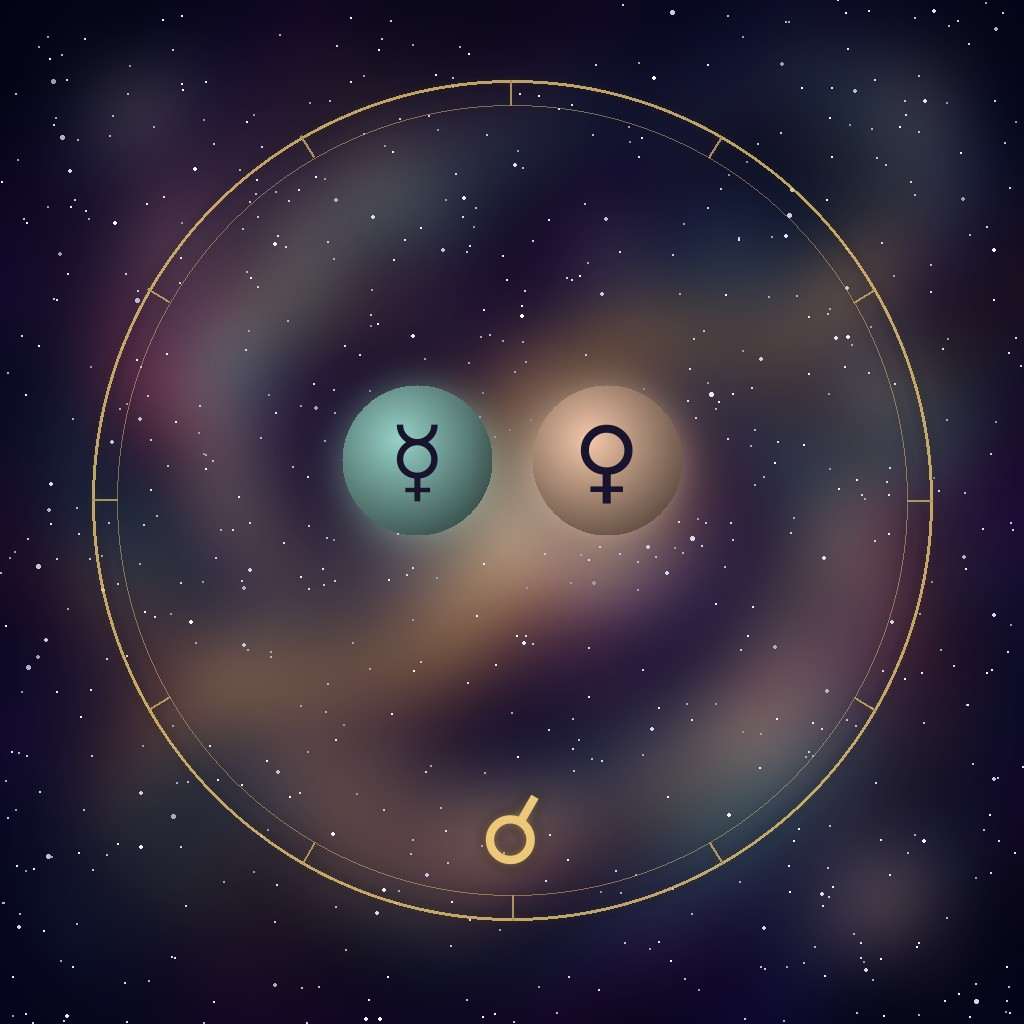
On the evening of October 6, 2026, New York time, Mercury caught up with Venus. The exact meeting fell at 8°13′ Scorpio, at 00:10 UTC on October 7. Astrologers call this Mercury conjunct Venus. It is one of the friendliest pairings in a birth chart, and there is a plain, physical reason for that.
Mercury and Venus can never square off. Seen from Earth, both planets stay close to the Sun. They can never drift far enough apart to form the hard angles that astrologers read as conflict. We measured it over eight centuries. The widest gap we found between them was 73.8°. A square needs 90°.
Below: the natal meaning, how common the pair is, every exact meeting through 2030, and what happens when one person’s Mercury touches another’s Venus.
First, a few words you will see again. An aspect is an angle between two planets, measured along the band of sky where the Sun, Moon and planets travel. A conjunction is the 0° aspect: both planets sit at the same point of that band. A sextile is the 60° aspect, and a square is the 90° aspect. The orb is the gap an astrologer allows around the exact angle before the link stops counting. Here we use two orbs: 8°, a wide one, and 3°, a tight one. Our guide to how astrological aspects work covers all of them in one place.
Why Mercury and Venus can never clash
Mercury and Venus are the two inner planets. They circle the Sun inside the orbit of the Earth. From where we stand, that means they never stray far from the Sun in the sky.
Mercury is on a short leash. It never gets more than about 28° from the Sun. Venus has a longer leash. It never gets more than about 47° away. Picture two dogs tied to one post, one on a short rope and one on a long rope. The gap between them can never be longer than the two ropes put together.
For Mercury and Venus, the two ropes add up to about 75°. Here is what our count found for each major aspect.
| Aspect | Angle | Share of time, 8° orb, 1600 to 2400 |
|---|---|---|
| Conjunction | 0° | 13.0 percent of the time. |
| Sextile | 60° | 14.9 percent of the time. |
| Square | 90° | Never possible. |
| Trine | 120° | Never possible. |
| Opposition | 180° | Never possible. |
So among the five major aspects, these two planets can form only the two gentle ones. A trine, the 120° angle, is out of reach too. That matters for how astrologers read the pair. The ancient rules say a square and an opposition bring friction. In the Tetrabiblos, written in the second century, the Greek astronomer Ptolemy sorted the angles into harmonious and clashing ones. Mercury and Venus only ever get the harmonious kind, at least among the major angles. The one tense contact left to them is a minor angle, the semi-square of 45°, which most astrologers give far less weight.
The sextile is even a little more common than the conjunction. If you do not have these two joined, there is a fair chance you have them at 60° instead.
How common is Mercury conjunct Venus in a birth chart?
About one birth chart in eight has Mercury within 8° of Venus. Within the tight 3° orb, the share drops to about one in twenty.
| Window | Within 8° | Within 3° |
|---|---|---|
| Births 1600 to 2400 | 13.0 percent | 4.9 percent of births. |
| Births 1950 to 2010 | 13.3 percent | 5.3 percent of births. |
Here is how we got these numbers, so anyone can check them. We used the Swiss Ephemeris, the planet tables most astrology software relies on, with the tropical zodiac. For the long window, we read the positions of Mercury and Venus every six hours from 1600 to 2400. For the modern window, we read them every 2.4 hours from 1950 to 2010. We then counted the share of moments when the gap was within the orb. A separate draw of 200,000 random moments between 1950 and 2010 gave the same answer: 13.35 percent within 8° and 5.23 percent within 3°.
We also checked the result by a second route. A different set of planet formulas, the open astronomy-engine library, read the sky every twelve hours from 1950 to 2010. It found 13.33 percent within 8°, and the same widest gap of 73.6° for that window.
The share moves a little from one decade to the next. Among births in the 1980s, it was 11.8 percent. Among births in the 1970s, it was 14.4 percent. The reason is the rhythm of Venus. Its dance with the Sun repeats almost exactly every eight years, so some stretches of time line the two planets up more than others.
One more practical point. You do not need an exact birth time to know if you have this pair. Mercury and Venus move slowly enough that your birth date settles it, except on a day when the gap sits right at the edge of the orb. The Moon is different: it moves so fast that its aspects need a birth time.
What Mercury conjunct Venus means in a natal chart
Think of your birth chart as a house with twelve rooms. Each room covers one area of life, and the planets are the furniture. Your natal chart, the chart cast for the moment you were born, is the floor plan of that house. With this conjunction, two pieces of furniture stand side by side in the same room. Most of the time, they even share the same sign.
Mercury is the writing desk. In astrology it stands for the mind, speech, letters, learning, trade and the daily back and forth of ideas. It asks, “What do I think, and how do I say it?” See the role of Mercury in your chart for the full picture.
Venus is the vase of flowers on that desk. It stands for love, taste, pleasure, beauty and the things you value. It asks, “What do I like, and who do I want near me?” Our page on what Venus means in love and beyond explains its whole role.
Put them together and thought takes on charm. Sue Tompkins, in Aspects in Astrology (2002), describes a conjunction as a blend: the two planets act as one, and you cannot call on one without the other. Our page on the conjunction and how it works goes deeper on that blending.
Older writers saw the same pair in the same light. Ptolemy, in the part of the Tetrabiblos that deals with the quality of the soul, links Venus working with Mercury to a love of the arts, of music and of poetry. In The Combination of Stellar Influences (1940), the German astrologer Reinhold Ebertin ties the Mercury and Venus pairing to a sense of beauty and form, and to thoughts about love.
The gifts, as the tradition describes them
According to the tradition, people with this pair speak with warmth. They choose kind words without trying. They notice how a sentence sounds, not only what it means. Writing, design, music, teaching and sales all fit this pair.
The pair also links thinking and liking. You enjoy ideas the way other people enjoy food. A clever book or a good talk can feel like a treat. In love, the tradition says you fall for minds first. A partner who can talk with you, and who laughs at the same jokes, wins more ground than one who only looks good.
Money is part of the picture too. Venus rules what you value, and Mercury rules trade and deals. Many astrologers read the pair as a knack for deals and for earning from a craft.
The catch
The same tact that smooths a room can dodge a hard truth. With this pair, it is easy to say what people want to hear. Some people with it put off a needed fight because a calm talk feels nicer.
The pair can also turn feelings into ideas. Some people with this conjunction think about love more than they feel it. They want to name a feeling before they let it in. In forums where people share their charts, both sides come up: some call it a cool, careful heart, and others call it a wise one.
The sign changes the tone
Since Mercury and Venus share a sign most of the time, the sign colors both at once. Our October 2026 meeting fell in Scorpio, a sign the tradition links with depth, secrets and strong bonds. Our page on Venus in Scorpio and how rare it is covers that placement. In Gemini or Libra, the tone turns lighter and more social. In Taurus, it turns slow, sensual and practical.
There is a neat mirror in the old rules. Mercury is said to be exalted, or at its best, in Virgo, and that is where Venus is said to be in its fall, at its weakest. Venus is exalted in Pisces, and that is where Mercury falls. So when the two meet in Virgo or in Pisces, one planet is strong and the other is weak in the same sign.
When one of them is retrograde
Here is a fact few guides mention. Most Mercury and Venus meetings happen while one of the two is retrograde. From Earth, planets sometimes seem to move backwards for a while. That is what retrograde means. It is an effect of our point of view, like a car that seems to slide back as you pass it on the road.
We counted every exact meeting from 1600 to 2400. There were 1,961 of them. Here is how they split.
| State at the exact meeting | Share of all meetings |
|---|---|
| Both planets moving forward | 38 percent of meetings. |
| Mercury retrograde, Venus forward | 35 percent of meetings. |
| Venus retrograde, Mercury forward | 26 percent of meetings. |
| Both retrograde | 1 percent of meetings. |
So about six meetings in ten involve a retrograde planet. A planet moving forward at full speed passes the other quickly. A planet that slows down, stops and turns back crosses the same stretch of sky more than once. That makes extra meetings.
The October 2026 meeting is one of these. Venus turned retrograde on October 3, 2026, at 8°29′ Scorpio, four days before Mercury reached it. Venus turns forward again on November 14, 2026, at 22°52′ Libra.
How do astrologers read a retrograde in this pair? The usual reading is that the energy turns inward. With Mercury retrograde, the person goes back over words and ideas about love. With Venus retrograde, the person goes back over what they value and whom they want.
Mercury conjunct Venus transit: every meeting through 2030
A transit is a planet’s current position in the sky, read against your birth chart or against the sky itself. When Mercury and Venus meet in the sky, the event is short. From 2025 to 2030, the two planets stay within 3° of each other for three days to about twelve days. The one long case is May 2028, when both are retrograde and the window stretches to 27 days.
Over the years 1600 to 2400, the two planets met 2.45 times a year on average. We found no year without a single meeting. Here is how the years split.
| Meetings in a calendar year | Share of years, 1600 to 2400 |
|---|---|
| One meeting | 26 percent of years. |
| Two meetings | 19 percent of years. |
| Three meetings | 43 percent of years. |
| Four to six meetings | 12 percent of years. |
Here is each exact meeting from 2025 to 2030. We found each one by searching the Swiss Ephemeris positions with a step of 1.2 hours, then narrowing each crossing down to the minute.
| Date and time (UTC) | New York time | Degree and sign | Which one is retrograde |
|---|---|---|---|
| March 11, 2025, 22:55 | March 11, 6:55 pm | 8°48′ Aries | Venus. |
| November 25, 2025, 01:52 | November 24, 8:52 pm | 22°45′ Scorpio | Mercury. |
| January 29, 2026, 10:17 | January 29, 5:17 am | 14°57′ Aquarius | Neither. |
| February 28, 2026, 05:35 | February 28, 12:35 am | 22°15′ Pisces | Mercury. |
| October 7, 2026, 00:10 | October 6, 8:10 pm | 8°13′ Scorpio | Venus. |
| July 1, 2027, 09:22 | July 1, 5:22 am | 27°56′ Gemini | Mercury. |
| August 11, 2027, 06:30 | August 11, 2:30 am | 18°12′ Leo | Neither. |
| October 11, 2027, 09:32 | October 11, 5:32 am | 4°01′ Scorpio | Mercury. |
| May 25, 2028, 00:54 | May 24, 8:54 pm | 15°49′ Gemini | Both. |
| January 23, 2029, 06:20 | January 23, 1:20 am | 19°00′ Capricorn | Mercury. |
| March 27, 2029, 14:55 | March 27, 10:55 am | 8°11′ Aries | Neither. |
| May 5, 2029, 10:02 | May 5, 6:02 am | 26°10′ Taurus | Mercury. |
| January 23, 2030, 04:57 | January 22, 11:57 pm | 8°55′ Capricorn | Venus. |
| September 5, 2030, 21:09 | September 5, 5:09 pm | 1°34′ Virgo | Mercury. |
| October 7, 2030, 13:21 | October 7, 9:21 am | 10°58′ Libra | Neither. |
| December 10, 2030, 00:10 | December 9, 7:10 pm | 0°29′ Capricorn | Mercury. |
Note the long gap after October 2026. The next meeting comes on July 1, 2027, almost nine months later. The meeting of May 2028 is the rare kind where both planets are retrograde at once.
What does the tradition say about this transit? It is read as a good few days for kind talks, love letters, peace-making, pitching a creative idea and buying something beautiful. It is not a promise. Astrologers weigh a transit against the birth chart it touches. If the meeting lands on a planet in your own chart, it counts for you more than for others.
Venus conjunct Mercury in synastry
Synastry is the art of laying one person’s chart over another’s to read how they get along. Our guide to how synastry charts work explains the method step by step. In synastry, the leash rule no longer holds. Your Mercury and your partner’s Venus belong to two different moments, so they can sit at any angle at all.
So how common is the contact between two people? We drew 100,000 pairs of random birth moments between 1950 and 2010 and compared them. The Mercury of the first person sat within 8° of the Venus of the second in 4.5 percent of pairs, about one pair in twenty-two. Within 3°, it was 1.7 percent. The contact can also run the other way, from the second person’s Mercury to the first person’s Venus, so the odds of having one of the two are higher.
What does the tradition say it means? The Venus person likes how the Mercury person talks and thinks. The Mercury person feels heard and liked for their mind. Talks come easy. Shared jokes, long messages and shared taste in books or music all fit this contact.
It is a pleasant contact, not a binding one. It helps two people enjoy each other’s company, but it does not by itself say a bond will last.
FAQ
Is the Mercury-Venus conjunction good?
The tradition counts it among the friendly contacts. It links clear thinking with warmth, taste and tact. Its weak side is a habit of avoiding conflict or of thinking about feelings instead of feeling them. The rest of the chart decides how it plays out.
Do Mercury and Venus get along?
In a single chart, they cannot clash in a major way. Mercury never gets more than about 28° from the Sun, and Venus never more than about 47°. Over 1600 to 2400, the widest gap we measured between them was 73.8°, so no square, trine or opposition is possible.
How many times a year does Mercury conjunct Venus?
About 2.45 times a year on average over 1600 to 2400, and at least once in every year we checked. The October 7, 2026 meeting fell at 8°13′ Scorpio. The next one falls on July 1, 2027, at 27°56′ Gemini.
What is considered a strong Venus placement?
By the old rules used by Ptolemy and by William Lilly in Christian Astrology (1647), Venus is strongest in its home signs, Taurus and Libra, and in Pisces, where it is exalted. It is weakest in Aries and Scorpio, its signs of exile, and in Virgo, its fall.
How common is Mercury conjunct Venus in a birth chart?
About 13 percent of births have it within 8°, close to one in eight. Within 3°, it is about 5 percent, or one in twenty.
Go deeper with your personal Astrovision report
Reading about astrological concepts is a great start, but nothing compares to hearing how they apply directly to you. Our users love our audio-first approach, calling it “friendly, personal, and easy to understand.” While this article gives you the “what,” a personal report gives you the “so what.” Discover your unique path with an Astrovision report—your personal ‘user manual’ delivered in our celebrated podcast format.