

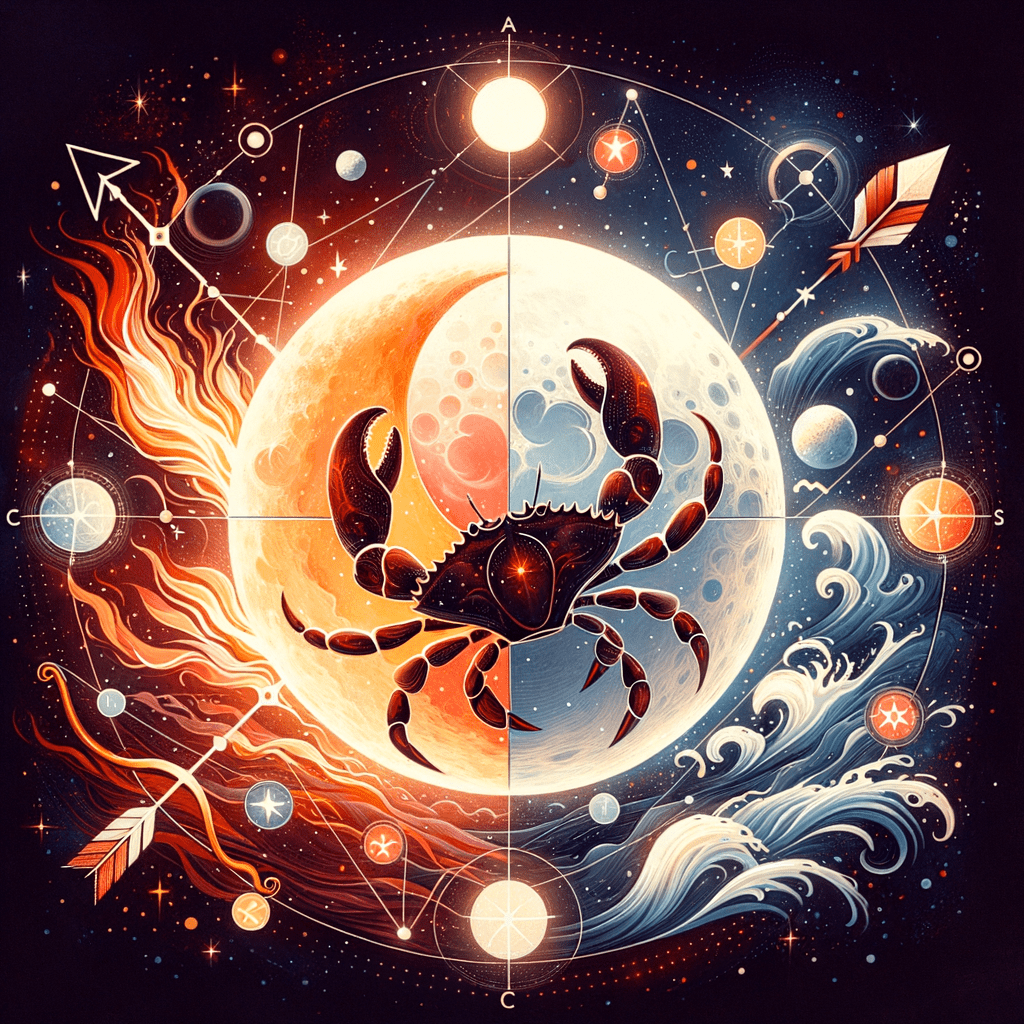
Cancer Moon and Sagittarius Moon compatibility is a puzzle in the old books. The two signs sit five signs apart. That gap forms no classic aspect at all. By one reading of Ptolemy, the pair is “disjunct,” which means alien, with no link.
Count in degrees, though, and the same two signs line up as mirror twins around the spring equinox. By that reading, Ptolemy calls them “commanding” and “obeying,” a real tie of rank. And the ruler of Sagittarius, Jupiter, is exalted in Cancer.
So this couple is alien by sign and linked by degree. This page sets out both readings, checks them in the source texts, and adds what we measured over eight centuries of real Moon positions.
Six quick answers
| Question | Answer. |
|---|---|
| What angle do the signs form? | A quincunx, five signs or 150 degrees apart. |
| Is that an aspect in Ptolemy? | No, he names only four aspects. |
| Elements and modes? | Water and fire, one cardinal and one mutable. |
| Rank of each Moon? | At home in Cancer, no major rank in Sagittarius. |
| Any hidden tie? | By degrees, Cancer commands and Sagittarius obeys. |
| How common is the pair? | About 1 couple in 72, like any mixed Moon pair. |
First, what astrology cannot claim
Astrology is not a science. No study has shown that two Moon signs predict the fate of a couple. The largest test of love signs came from the sociologist David Voas in 2007. He used the 2001 census of England and Wales, with 10.3 million married couples. Sun signs had no effect on who married whom. A small excess of same-sign couples came from errors on the forms.
A census has no birth times, so no one can run that test on Moon signs. Read this page as a map of old ideas and real sky facts. It can start a talk. It cannot grade a couple.
The angle with no name in Ptolemy
Claude Ptolemy wrote the Tetrabiblos in Alexandria around 150 AD. In Book 1, chapter 13, he names four aspects. An aspect is a fixed angle between two points of the sky. The four are the opposition at 180 degrees, the trine at 120, the square at 90 and the sextile at 60.
Cancer and Sagittarius sit 150 degrees apart. Later astrologers called that angle a quincunx, or an inconjunct. It is a modern minor aspect. Ptolemy does not count it.
In chapter 16, he goes further. Signs one or five apart, he writes, “divide the whole circle into unequal parts.” If they share no other tie, he calls them disjunct and alien. The word means they have nothing in common.
The key phrase is “no other tie.” Ptolemy lists two other kinds of bond in chapters 14 and 15. If a pair has one of those, it is not disjunct. So the question for this couple is simple. Do Cancer and Sagittarius share one of those bonds?
Two readings of the same rule
In chapter 14, Ptolemy says signs at the same distance from an equinox sign “command” and “obey.” His reason is that they rise in equal times and sit on equal parallels. The sign in the summer half of the year commands. The sign in the winter half obeys, because its days are shorter.
Reading by degrees
Measure from the exact point of the spring equinox, where the Sun sits in late March. Cancer runs from 90 to 120 degrees past that point. Sagittarius runs from 240 to 270, which is 90 to 120 degrees before it. The two signs are mirror images. By this reading, Cancer commands and Sagittarius obeys.
Lilly uses the same mirror in degrees. He calls matching points on either side of the equinox line contra-antiscia. Their degrees in the two signs add up to 30.
Reading by whole signs
Frank Robbins, who translated the Tetrabiblos, gives a different list in note 80. He counts whole signs away from Aries itself. On his list, Cancer pairs with Capricorn, not with Sagittarius. Aries and Libra are left out as the starting signs. By that list, Cancer and Sagittarius share no bond, so they are disjunct.
We do not pick a winner. Both readings are old, and both are honest. By sign, this is an alien pair. By degree, it is a chain of command, with the Cancer Moon at the head.
How many couples truly mirror
A contra-antiscia link needs the two Moons’ degrees to add up to about 30. A Cancer Moon at 10 degrees and a Sagittarius Moon at 20 degrees would fit. We measured how many couples come close.
| Margin allowed | Couples with a mirror in degrees. |
|---|---|
| Within 1 degree | 6.56 percent of couples. |
| Within 3 degrees | 19 percent of couples. |
So even by degrees, the tight mirror is a minority case. About 1 couple in 15 has it within 1 degree.
Jupiter’s high seat
Every sign has a ruler. The Moon rules Cancer. Jupiter rules Sagittarius. In Book 1, chapter 19, Ptolemy gives Jupiter its exaltation in Cancer. His reason is that Jupiter “reaches farthest north in Cancer” and brings its power to fullness there. Exaltation is the sign where a planet is honored, like a guest of state.
So the Cancer Moon lives in the sign where the Sagittarius partner’s ruler is most honored. Read as a symbol, the Sagittarius side finds its best self on the Cancer side’s ground. The big hopes of Jupiter land well in a warm home.
The favor does not run back the other way. The Moon has no major rank in Sagittarius. It is not at home, not exalted, not in exile and not in fall. Astrologers call that peregrine, which means a traveler. Ptolemy gives the fire triangle to the Sun by day and Jupiter by night. The Moon has no share in it.
The word traveler fits the Sagittarius Moon well. It calms through room, movement and a sense of meaning. Our guide to the Moon in Sagittarius covers it in full. The Cancer Moon is the opposite case, the Moon in its own house. Ptolemy gave Cancer to the Moon because it is one of the two most northern signs. Our guide to the Moon in Cancer explains that home rank.
Water and fire, nest and road
The elements pull apart here. Water is the element of feeling. Fire is the element of drive and faith. Steam is the old image: each changes the other, and not always gently.
The modes differ too. Cancer is cardinal, a sign that opens a season. Sagittarius is mutable, a sign that closes one and gets ready for change. The polarity differs as well. Cancer is a receptive sign, and Sagittarius an active one.
In daily life, the Cancer Moon wants a nest. It feels safe with a base and familiar faces. The Sagittarius Moon wants a road. It feels safe when the future is open. Neither need is wrong. Each can look like a threat to the other.
Among the 78 Moon pairs, this is the only water and fire quincunx between a cardinal and a mutable sign. The quincunx asks for constant small adjustments rather than one big deal.
What we measured: new moon and full moon births
A person born near a new moon has the Moon in the same sign as the Sun. A person born near a full moon has the Moon in the sign opposite the Sun. We counted both cases for each Moon sign over the years 1600 to 2400.
| Moon sign | Sun in the same sign | Sun in the opposite sign. |
|---|---|---|
| Cancer Moon | 8.48 percent, with a Cancer Sun | 7.92 percent, with a Capricorn Sun. |
| Sagittarius Moon | 7.96 percent, with a Sagittarius Sun | 8.44 percent, with a Gemini Sun. |
The two Moons lean in opposite ways. The Cancer Moon has the highest new moon share of all twelve signs. The Sagittarius Moon leans to the full moon. The cause is the Earth’s orbit. The Earth is farthest from the Sun in early July, so the Sun moves slowest in early summer. It lingers in Cancer and Gemini, and races through Sagittarius and Capricorn in early winter.
Tradition reads a new moon birth as will and needs pointing the same way. It reads a full moon birth as a pull between the two. So this couple can join a partner born in one mood of the month with a partner born in the other. For the couple, 15.76 percent include at least one partner born with the Moon in their own Sun sign. In 15.69 percent, at least one partner has the Moon opposite their Sun.
The gap is small and will not decide anything. Our guide to moon phase compatibility shows how to find your own phase.
When the degrees cross the sign line
Signs are fixed boxes of 30 degrees, but the Moons can sit anywhere inside them. So a pair of signs five apart does not always form 150 degrees in the sky. An early Cancer Moon and a late Sagittarius Moon can sit close to 180 degrees apart. That is a real opposition. A late Cancer Moon and an early Sagittarius Moon can sit close to 120 degrees. That is a real trine.
Astrologers allow a margin around each exact angle, called an orb. With an 8 degree orb, 7.11 percent of these couples form one of those other aspects across the sign line. With a 10 degree orb, the share rises to 11.11 percent. For them, the reading changes a lot.
| Orb allowed | Couples with an exact quincunx. |
|---|---|
| Within 3 degrees | 19 percent of couples. |
| Within 8 degrees | 46 percent of couples. |
These quincunx shares hold for every Moon pair, since the Moon moves at a near even pace through a sign.
Check both Moons first
Every mixed Moon pair shows up in about 1 couple in 72. The Moon spends close to the same time in each sign, so no Moon pair is rare. Same-sign pairs come to about 1 couple in 144.
The real trap is the birth time. The Moon stays in a sign for 54.6 hours on average, and changes sign on 43.92 percent of all days. Free tools with no birth time use noon. That guess gives the wrong Moon sign in 10.98 percent of charts, and the wrong pair for about 1 couple in 5. Our pivot page on Moon sign compatibility gives the full count.
For this pair, a Cancer Moon near a sign change might be a Gemini or Leo Moon. A Sagittarius Moon might be a Scorpio or Capricorn Moon. A single hour can turn this alien pair into a trine or an opposition.
Three talks worth having
- How much change feels good? Set a rhythm of trips and home time that both can plan around.
- What does support look like? The Cancer Moon offers care. The Sagittarius Moon offers a bigger picture. Ask which one the moment needs.
- Who leads? By degrees, the old rule puts Cancer at the head. Talk about where each of you wants to lead.
The same two signs meet through the Sun on our page about Cancer and Sagittarius Sun sign compatibility. For a Moon at home next to a sign that cannot see it, see Gemini Moon and Cancer Moon compatibility. For the Sagittarius Moon with a Moon of honor, see Taurus Moon and Sagittarius Moon compatibility.
How we measured
We used two separate routes over the years 1600 to 2400, with every moment given the same weight. Route one used the astronomy-engine library. It found each sign change of the Moon and the Sun to a tenth of a second, then added up the exact time in each case. Route two used the Swiss Ephemeris and checked the sky once an hour, on a grid shifted by half an hour. The two routes agree to within 0.05 points.
The degree shares come from an hourly scan of Moon positions inside each sign. The noon test uses calendar days in Greenwich time, with a chart at 12:00. For the old rules, we read the Tetrabiblos, Book 1, chapters 13 to 19, in the Robbins translation, with his notes 80 and 83. We checked the ranks against Lilly’s Christian Astrology.
Frequently asked questions
Are a Cancer Moon and a Sagittarius Moon compatible?
Astrology reads them as a quincunx, a pair with no classic aspect. By whole signs, Ptolemy’s rules call them alien. By degrees, Cancer commands and Sagittarius obeys. No study has shown that Moon signs predict how a couple does.
What is a quincunx?
It is an angle of 150 degrees, or five signs. Ptolemy did not count it as an aspect. Modern astrologers treat it as a minor link that asks for steady adjustment.
Why does Jupiter matter for this pair?
Jupiter rules Sagittarius and is exalted in Cancer, according to Ptolemy. So the Sagittarius partner’s ruler is honored in the Cancer partner’s sign.
Do Cancer and Sagittarius Moons ever form a trine?
Yes, across the sign line. A late Cancer Moon and an early Sagittarius Moon can sit near 120 degrees. With an 8 degree orb, 7.11 percent of couples form a trine or an opposition this way.
Can I find my Moon sign from my birth date?
On 56 percent of days, yes, since the Moon stays in one sign all day. On the other days, you need a birth time. A noon guess is wrong in about 1 chart in 9.
Go deeper with your personal Astrovision report
Reading about astrological concepts is a great start, but nothing compares to hearing how they apply directly to you. Our users love our audio-first approach, calling it “friendly, personal, and easy to understand.” While this article gives you the “what,” a personal report gives you the “so what.” Discover your unique path with an Astrovision report—your personal ‘user manual’ delivered in our celebrated podcast format.