
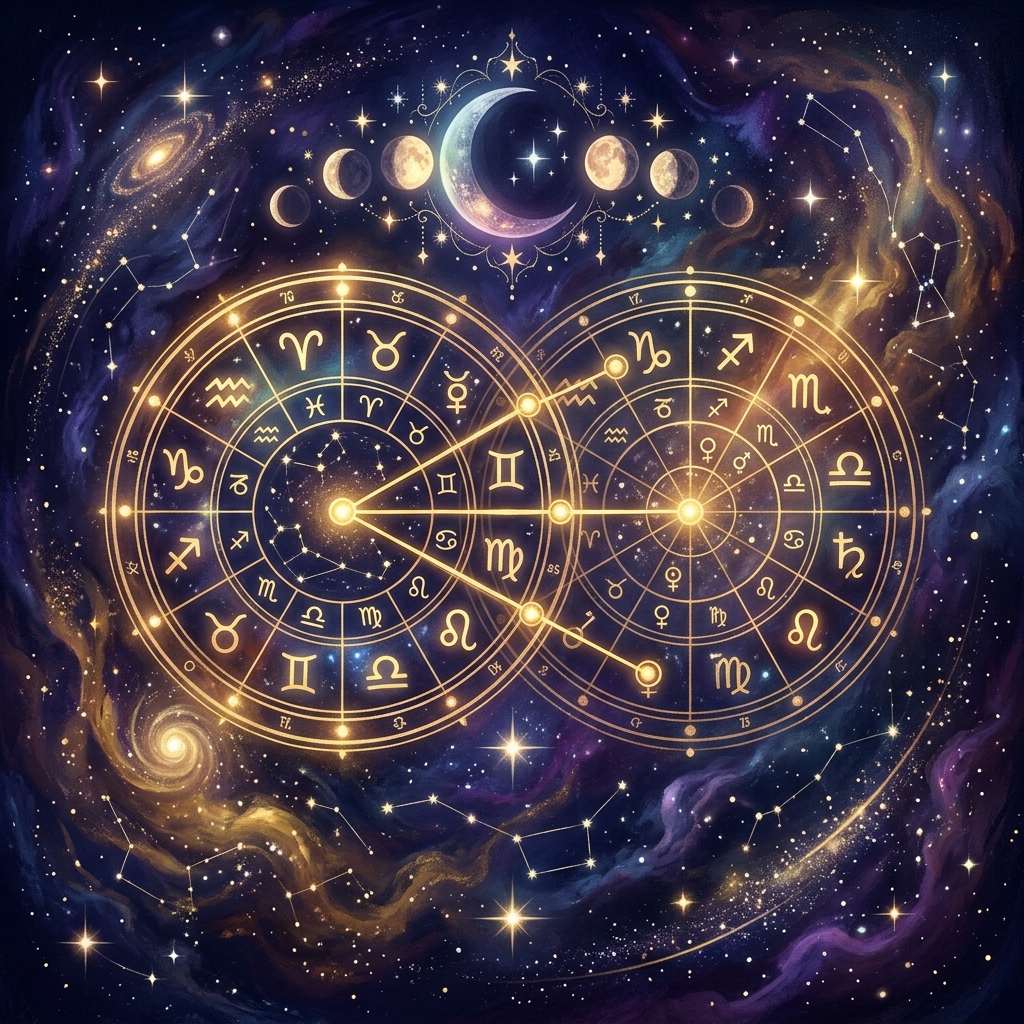
Birth chart compatibility compares two whole charts, not just two Sun signs. Most free tools run the same short checklist. Do your Sun signs fit? Do your Moons fit? Does one Sun fit the other’s Moon? Does one Venus fit the other’s Mars? Do your two Venus signs fit? Each yes is a box ticked, and the tool turns the boxes into a score.
We wanted to know what that score looks like for two people who have never met. So we built 1 million couples from real US births, and ran the checklist on each one. The result is simple. A couple picked at random ticks 3 of the 5 boxes on average. Seven couples in ten tick at least 3. One couple in twenty ticks all five.
There is a second finding. Most people search with a date of birth and no birth time. For 3 couples in 5, the missing time could change the score. This guide shows you which parts of a chart a date can fix, which parts need a time, and what order to read them in.
One more point before we start. Astrology is not a science. No study has shown that two charts can predict how a couple will do. Read this as a way to talk about two people, not as a forecast.
What is birth chart compatibility?
Your birth chart is a map of the sky at the moment you were born. It shows where the Sun, the Moon and the planets stood in the twelve signs of the zodiac. If the signs are new to you, start with our guide to the zodiac signs. It explains the elements and the real dates of each sign.
Sun sign compatibility looks at one point in each chart. Birth chart compatibility looks at several. It asks how the key parts of one chart meet the key parts of the other. The old word for this is synastry, from the Greek for “stars together.”
There are two ways to do it. The first works by sign. You ask which sign each planet is in, and how far apart the two signs sit. That is what this page covers. It needs little more than a birth date. The second works by degree. You lay both charts on one wheel and list every exact angle between them. That needs birth times, and it is the job of a full synastry chart. A third tool blends the two charts into one. We cover it in our page on synastry vs composite charts.
What you can compare with a date of birth
A date of birth fixes some parts of a chart and leaves others open. The reason is speed. The Sun moves about one degree a day, so it sits in one sign for a month. The Moon moves about thirteen degrees a day, so it changes sign every two to three days. The Ascendant, or rising sign, is the sign on the eastern horizon at birth. It turns through all twelve signs every single day.
We timed each of these with real sky positions for every day from 2000 to 2014. Here is what a date alone tells you.
| Part of the chart | What it stands for in love | Can a date alone fix it? |
|---|---|---|
| Sun sign | Your core self and what you build your life around. | Yes, except on the day the Sun changes sign. |
| Moon sign | Your needs, moods and what makes you feel safe. | No on about 44 in 100 days, when the Moon changes sign. |
| Venus sign | What you find lovely and how you show love. | Yes, except on about 1 day in 29. |
| Mars sign | Desire, drive and how you handle a fight. | Yes, except on about 1 day in 56. |
| Ascendant | Your first way of meeting the world. | Never, since it passes all twelve signs each day. |
| Houses | Which part of life a planet acts on. | Never, since they hang on the Ascendant. |
So a date gives you a good Sun sign, a good Venus sign and a good Mars sign. It gives you a Moon sign that is right a bit more than half the time. It gives you no Ascendant and no houses at all. Our page on the houses in astrology explains why those need an exact time.
The five checks, in the order to read them
Most compatibility tools, and most books, read two charts in about the same order. They start with the lights, the Sun and the Moon. Then they move to the planets of love, Venus and Mars. Here is that order, one step at a time.
1. Sun with Sun
Start with the two Sun signs. The Sun shows what each of you is here to do. Two Suns in the same element share a basic pace. Fire signs are Aries, Leo and Sagittarius. Earth signs are Taurus, Virgo and Capricorn. Air signs are Gemini, Libra and Aquarius. Water signs are Cancer, Scorpio and Pisces. We have a page for each of the 78 Sun sign pairs. The Leo and Virgo pair is the most common couple in US births, and Capricorn and Capricorn is the rarest.
2. Moon with Moon
Next, compare the two Moon signs. The Moon shows how each of you rests, eats, sulks and heals. Two Moons that fit are said to make a home feel easy. Our guide to moon sign compatibility covers every pair. It also shows how many birth dates alone get the Moon sign wrong.
3. One Sun with the other Moon
This is the oldest check of all. You compare your Sun with your partner’s Moon, and your Moon with your partner’s Sun. If either link fits, the box is ticked. Our page on Sun and Moon signs explains how these two lights work inside one chart. Some people add the shape of the Moon on each birthday. We tested that trend in our page on moon phase compatibility.
4. One Venus with the other Mars
Venus is what you find lovely. Mars is what you go after. So the classic test of pull is one person’s Venus against the other person’s Mars. Again, either way round counts.
5. Venus with Venus
Last, compare the two Venus signs. This shows if you like the same kind of love, the same gifts and the same kind of date. Our guide to Venus sign compatibility covers every pair. It shows that your Sun sign limits your Venus sign, since Venus stays close to the Sun.
6. With a birth time: the Ascendant and the seventh house
If you both know your birth times, you can go one step further. You can compare the two Ascendants. You can see where each person’s planets land in the other’s houses. The seventh house, the house of partners, gets the most weight. None of this works with a date alone.
How many boxes does a random couple tick?
Each check asks whether two signs “fit.” Most tools use the element rule for that. Two signs fit if they share an element, or if their elements help each other. Fire helps air, and earth helps water. So Aries fits Leo and Sagittarius, and it fits Gemini, Libra and Aquarius too.
Here is the catch. That rule calls half of all sign pairs a match. Around the wheel, the signs take turns: fire, earth, air, water, then fire again. Every second sign is fire or air. The others are earth or water. So each sign fits six signs out of twelve, itself included. A coin toss would do as well.
We ran all five checks on 1 million couples. Each partner was a real US birth from 2000 to 2014, picked at random. Then we counted the boxes.
| Boxes ticked, out of five | Share of random couples | About how many |
|---|---|---|
| None | 1.8 percent of couples. | 1 couple in 55. |
| One box | 7.8 percent of couples. | 1 couple in 13. |
| Two boxes | 19.4 percent of couples. | 1 couple in 5. |
| Three boxes | 35.6 percent of couples. | 1 couple in 3. |
| Four boxes | 30.3 percent of couples. | 3 couples in 10. |
| All five boxes | 5.1 percent of couples. | 1 couple in 20. |
The average is 3.0 boxes out of 5. That means a score of 60 percent is what two strangers get. A tool that shows “60 percent compatible” is showing you the middle of the pack. Seven couples in ten reach 3 boxes or more.
The two cross checks tick the most. One Sun fits the other Moon in 75 percent of couples. One Venus fits the other Mars in 75 percent too. That is because each cross check gets two tries. The other three checks tick in 50 percent of couples each, just as the coin toss says.
So what does a high score tell you? Mostly that your pair landed on the lucky side of a coin toss. It does not tell you how you talk, how you fight, or what you want from life.
The stricter rule from Ptolemy
The element rule is modern shorthand. The old rule is tighter. In the second century, the Greek astronomer Ptolemy wrote the Tetrabiblos. In book four, in the chapter on marriage, he looked at the Sun and Moon of both partners. He wrote that marriages last when these lights sit in trine or sextile. A trine links signs four apart. A sextile links signs two apart. He liked it best when the link runs across, from one person’s Sun to the other’s Moon.
He also named the hard links. Signs three apart form a square. Signs six apart form an opposition. Signs one or five apart are what he called disjunct: they do not “see” each other at all. For Ptolemy, those links brought quarrels.
So we ran the checklist again with his rule. Only a trine or a sextile counts. A shared sign and an opposition no longer count.
| Boxes ticked, out of five | Share of random couples with the strict rule. |
|---|---|
| None | 6.7 percent of couples. |
| One box | 23.1 percent of couples. |
| Two boxes | 34.2 percent of couples. |
| Three boxes | 25.9 percent of couples. |
| Four boxes | 9.2 percent of couples. |
| All five boxes | 1.0 percent of couples. |
With the strict rule, the average falls to 2.1 boxes. A full house drops to one couple in a hundred. So the same two charts can score 3 out of 5 on one site and 2 out of 5 on another. Neither site is wrong. They use two rules. Ask which rule a tool uses before you trust its number.
Birth chart compatibility without a birth time
Most free tools ask for two dates and guess the rest. The usual guess is noon. That guess is fine for the Sun, Venus and Mars on most days. It is weak for the Moon.
We checked every couple in our run. In 68.5 percent of couples, at least one partner was born on a day when the Moon changed sign. For those people, the date gives two possible Moon signs, and only the hour picks one. That matches what our Moon sign guide found by another method.
Then we asked a sharper question. Could the missing times change the box count? For each couple, we tried every sign that each planet could hold on each birth date. In 61.6 percent of couples, the count changed with the hour. So for about 3 couples in 5, a date-only score is a guess. It could be one box too high or one box too low.
The Ascendant is worse. Without a time, it is unknown for every single couple. That is why a report built on dates alone leaves out the Ascendant and the houses. If a tool shows them without asking for a time, it made them up.
Here is what to do if you have no time. Use the Sun, Venus and Mars signs as they are. For the Moon, look up both possible signs for your birth date. If both fall in the same element, your Moon check is safe. If not, treat that box as open. A birth certificate, a baby book or a hospital record can give you the time.
Which zodiac signs go well together?
By the element rule, signs in the same element go best together. Next come fire with air, and earth with water. By Ptolemy’s rule, the best links are trines and sextiles between the two lights. Squares and oppositions are the hard ones.
But these are Sun sign rules, and a Sun sign is one point in a chart with at least ten. Two people with “hard” Sun signs can tick four other boxes. Two with “easy” Sun signs can tick none. That is the whole case for reading the full chart.
Which two signs are not compatible?
No two signs are ruled out. The tradition calls some links hard, not hopeless. Squares, like Aries and Cancer, bring friction. Oppositions, like Leo and Aquarius, bring a strong pull between two poles. Ptolemy’s disjunct pairs, one or five signs apart, bring two ways of life that do not overlap.
A hard link in one check means little on its own. In our run, a couple with a Sun square still ticked 2.5 other boxes on average. The chart as a whole is the unit, not the single pair.
Who is your soulmate based on your birth chart?
No chart can name a soulmate. Astrology has no test for that, and the numbers above show why a checklist can’t do it. One couple in twenty ticks every box by pure chance. In a town of 10,000 single adults, that is hundreds of perfect matches for each person.
Some astrologers look for repeated themes instead of a score. They might note a Sun on the other person’s Moon, a Venus on the other’s Ascendant, and a tight Venus and Mars link. Writers such as Stephen Arroyo and Liz Greene read these as signs of a strong bond. They do not read them as fate.
Is birth chart compatibility accurate?
As a prediction, no. The biggest test so far is by the British sociologist David Voas. In 2007 he looked at the 2001 census of England and Wales. It held 10.3 million married couples. He found no link between Sun signs and who marries whom. The small excess of same-sign couples came from typing errors in the census. Our page on Virgo and Virgo tells that story in full.
Voas tested Sun signs, not whole charts. Still, no study since has shown that full charts do better. What a chart comparison can do is give two people words for how they differ. One of you needs quiet to recharge. The other needs to talk it out. That is useful whether or not the planets had a hand in it.
Birth chart compatibility calculator and percentage
A compatibility calculator runs a checklist like ours. Then it turns the boxes into a percentage. Some tools weight the boxes. The Sun and Moon count more, and Mercury or Saturn get added. A few use exact degrees with a birth time.
Keep two facts in mind when you see a number. First, the middle score for two strangers is about 60 percent with the element rule. Second, the score can move by a full box when a birth time is missing. So a result of 55 or 65 percent says almost nothing. This page does not have a calculator, and we do not claim one.
Where to go next
Each check on the list has its own guide on this site. Use this table to jump to the one you need.
| Question | Where to read it |
|---|---|
| What are the signs, and what are their real dates? | Zodiac signs guide. |
| How do our two Moon signs fit? | Moon sign compatibility. |
| How do our two Venus signs fit? | Venus sign compatibility. |
| Do our birth Moon phases match? | Moon phase compatibility. |
| How do the Sun and Moon work in one chart? | Sun and Moon signs. |
| We both have birth times. What next? | How to read a synastry chart. |
| What is a composite chart? | Synastry vs composite. |
| What does a house mean? | Houses in astrology. |
How we measured this
All positions are tropical and seen from the center of the Earth.
Births come from the US Social Security Administration counts for 2000 to 2014, as published by FiveThirtyEight. That file holds 62.2 million births, one count per day. Each partner in a couple was a birth picked at random from that file, so busy days were picked more. The time of birth was spread evenly over the local day, in US Central time.
Route one used the open astronomy-engine library. We found every moment the Sun, Moon, Venus and Mars changed sign from 2000 to 2014, to within one second. We then built 1 million couples with the computer’s secure random source, and scored each one.
Route two used the Swiss Ephemeris, a separate set of planet tables, and a separate random source. It sampled every day in five-minute steps and scored 400,000 couples. The two routes agree to within 0.3 points on every figure above. The average score was 3.00 boxes on route one and 3.00 on route two. The share of couples whose count depends on the hour was 61.6 percent on route one and 61.3 percent on route two.
The element rule counts a match when the two signs are an even number of signs apart. Ptolemy’s rule counts a match only at two or four signs apart, either way round. Ptolemy’s text is book four, chapter five, of the Tetrabiblos, in the Robbins translation.
Birth chart compatibility FAQ
How do you know if your birth chart is compatible?
Compare five things, in order. Check Sun with Sun, Moon with Moon, and each Sun with the other Moon. Then check each Venus with the other Mars, and Venus with Venus. Keep in mind that two strangers tick 3 of the 5 boxes on average.
Can I check birth chart compatibility by date of birth only?
In part. A date fixes the Sun, Venus and Mars signs on most days. It leaves the Moon open on about 44 days in 100. It never fixes the Ascendant or the houses. For 3 couples in 5, the missing times could change the score.
What is a good birth chart compatibility percentage?
There is no good or bad score. With the common element rule, two strangers score about 60 percent on average. A result near that is normal. It does not mean a match is weak or strong.
What is the difference between synastry and birth chart compatibility?
People use both words for the same idea. On this site, birth chart compatibility means the sign checklist you can run with dates. Synastry means the full chart with exact angles, which needs birth times.
Is birth chart compatibility real?
It is a real tradition, but it is not a proven test. The largest study, by David Voas on 10.3 million married couples, found no link between signs and marriage. Use it to talk about how you differ, not to decide a relationship.
Which part of the chart matters most for love?
Ptolemy put the Sun and Moon first, above all when one person’s Sun fits the other’s Moon. Modern astrologers add Venus and Mars. With birth times, the seventh house and the Ascendant join the list.
Go deeper with your personal Astrovision report
Reading about astrological concepts is a great start, but nothing compares to hearing how they apply directly to you. Our users love our audio-first approach, calling it “friendly, personal, and easy to understand.” While this article gives you the “what,” a personal report gives you the “so what.” Discover your unique path with an Astrovision report—your personal ‘user manual’ delivered in our celebrated podcast format.