



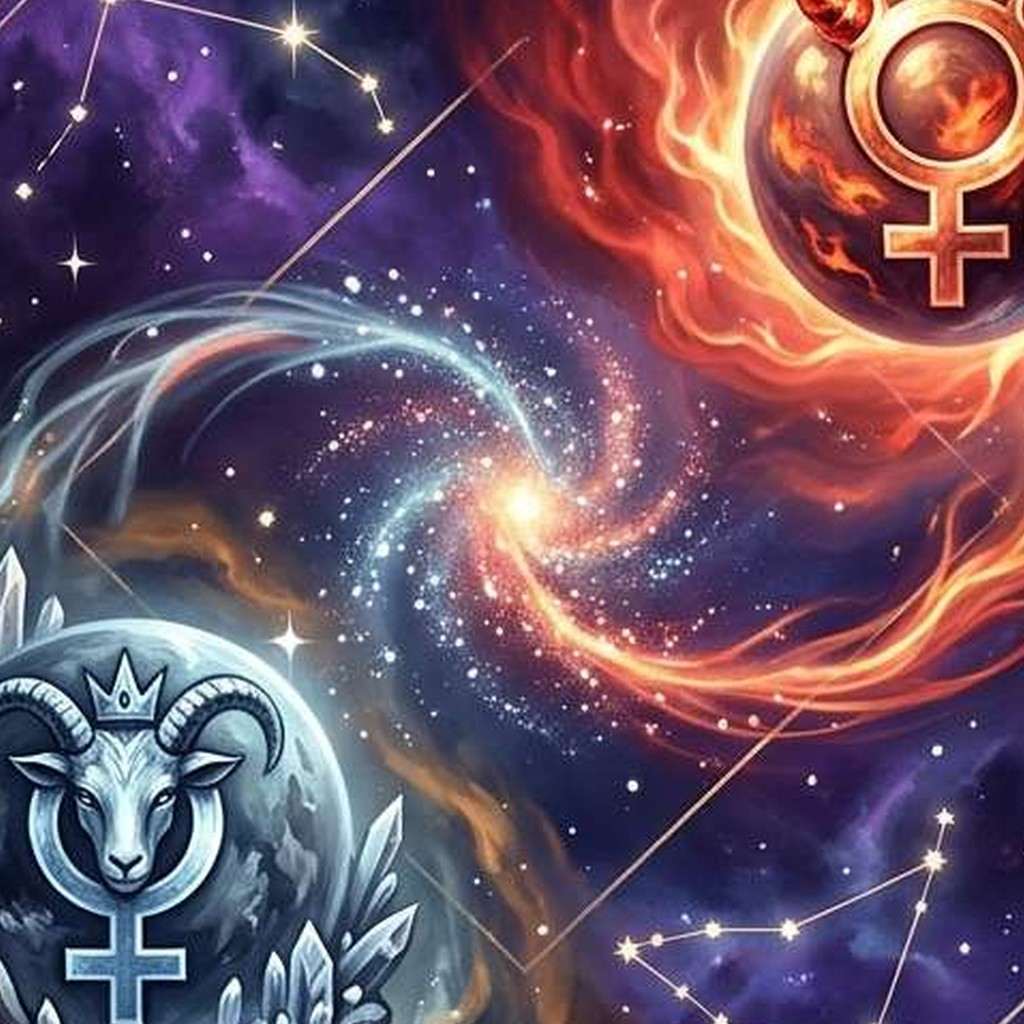
Aries Venus and Capricorn Venus compatibility joins two extremes of the Venus count. Venus in Capricorn is the rarest Venus sign of all, over eight centuries of sky. Venus in Aries is one of the two signs where old astrology calls her weakest. The two signs sit at right angles, a link called a square. Yet this couple shares a Sun sign far more than most Aries pairs do.
This guide explains each of those facts with numbers we measured from 1600 to 2400. It shows how common each Venus is, which Sun signs come with it, and what Ptolemy and Lilly say about Venus in these signs. Read it as a lens, not a forecast. Astrology is not a science, and no study has shown that a Venus sign predicts how a couple does.
What this pair is, in plain terms
Your Venus sign is the sign Venus stood in at your birth. Astrologers read it as your style of love: what draws you in and how you show care. It is not your Sun sign, the one you read in a horoscope. This page is about two people, one with Venus in Aries and one with Venus in Capricorn.
Aries is the first sign and Capricorn the tenth. Count from one to the other and you get three signs, or 90 degrees. That angle is a square, read in the tradition as friction. Aries is fire and Capricorn is earth. Both are cardinal, which means each one opens a season. Aries opens spring, and Capricorn opens winter.
Out of all 78 Venus pairs, this is the only square that joins fire and earth with two cardinal signs. Two starters, then, with two very different ideas of how to start.
The rarest Venus meets an exiled one
Venus is a fast planet. It crosses a sign in about four weeks. About every 19 months, it turns backward for some six weeks, a phase called a retrograde. That loop makes Venus stay longer in some signs than in others. Venus repeats its path in an eight-year cycle, so we used eight full centuries to even it out.
| Venus sign | Share of all time, 1600 to 2400 | Rank out of twelve. |
|---|---|---|
| Venus in Aries | 8.29 percent | Eighth, just under the middle. |
| Venus in Capricorn | 8.04 percent | Twelfth, the rarest. |
| Most common: Venus in Cancer | 8.62 percent | First of the twelve. |
| Flat share, if all were equal | 8.33 percent | One in twelve. |
The word rarest needs care. The gap between the top and the bottom is under 0.6 points. Venus in Capricorn is last, but it still turns up in about one chart in twelve.
Now pick two people at random. What are the odds that one has Venus in Aries and the other Venus in Capricorn? The pair can form two ways, so you double the product of the two shares. The answer is 1.33 percent, or one couple in 75. That ranks 62nd of the 78 pairs.
How the old books rank each Venus
Old astrology ranks each planet by the sign it stands in. The rank is called dignity. In the Tetrabiblos, written around 150 AD, Ptolemy gives Venus two homes: Taurus and Libra. The sign facing a home is her exile, also called detriment.
Libra faces Aries, so Venus in Aries is in exile. Aries belongs to Mars, whose homes sit opposite hers. William Lilly, in Christian Astrology (1647), read a planet in detriment as one that works harder for less. Our guide to Venus in Aries covers it in full.
Capricorn is a quieter case. Venus holds none of the four major ranks there: no home, no exaltation, no fall and no exile. She keeps two minor ones. In a daytime chart, Venus rules the earth signs as a group, a rank called triplicity. She owns a small band of degrees in the sign, called her terms. Our guide to Venus in Capricorn walks through both.
So the ranks are uneven. One Venus sits in a hostile house. The other is a guest with a few small rights. A weak seat is a label from the books, not a flaw in a person.
The rulers trade places
The two host planets add a twist. Mars rules Aries, and Saturn rules Capricorn. In chapter 19, Ptolemy lists the exaltations, the signs where a planet is lifted up. Mars is exalted in Capricorn. Saturn falls in Aries, which means it is at its lowest there.
Put simply, the ruler of the Aries Venus is honored in the partner’s sign. The ruler of the Capricorn Venus is brought low in the partner’s sign. Astrologers who read hosts this way see an uneven give and take. The Aries side gains standing in Capricorn’s world. The Capricorn side loses some footing in Aries’s world.
What Ptolemy says about the square
In Book I, chapter 13, Ptolemy names the aspects. He calls the trine and the sextile harmonious and the square clashing. The reason he gives is gender. A square joins a masculine sign with a feminine one. Here, fire Aries is masculine and earth Capricorn is feminine.
Ptolemy gives two more links in chapters 14 and 15. Signs that command and obey sit on each side of the spring point. Signs that behold each other give days of the same length. Scholars read these rules two ways: by whole signs, or by exact degrees, as Lilly did with mirror points. Frank Robbins, whose Loeb edition is the standard English text, discusses both in his notes 80 and 83.
By whole signs, Aries stands outside the command scheme. Capricorn pairs with Gemini for command and with Sagittarius for equal days. By degrees, we counted couples whose two Venuses sit on mirror points. For this pair the count is zero. Both readings agree. The square is the only thread.
Is the square exact in degrees?
Two Venuses three signs apart can be anywhere from 60 to 120 degrees apart. The square is exact at 90 degrees. The allowed gap around it is called the orb. We measured it with the real spread of Venus inside each sign.
| Orb allowed | Couples with an exact square. |
|---|---|
| Within 3 degrees | 19.0 percent of couples. |
| Within 6 degrees | 36.0 percent of couples. |
| Within 8 degrees | 46.2 percent of couples. |
| Within 10 degrees | 55.6 percent of couples. |
These values are close to the same for every Venus pair, so they are not a trait of this couple. The edges are more telling. With an 8 degree orb, 7.1 percent of these couples form a sextile or a trine in degrees instead. Say Venus sits at 2 degrees of Aries and at 28 degrees of Capricorn. The gap is 64 degrees, close to a sextile. By sign it is a square. In the sky it is a friendly link.
Two Sun signs these partners can share
Seen from Earth, Venus stays close to the Sun. The widest gap in eight centuries was 47.3 degrees. So Venus sits in the Sun’s own sign, in one of the two next to it, or at the edge of the sign after those. Each Venus sign allows five Sun signs.
| Sun sign | Share of Venus in Aries people | Share of Venus in Capricorn people. |
|---|---|---|
| Scorpio | None at all | 9.6 percent. |
| Sagittarius | None at all | 28.8 percent. |
| Capricorn | None at all | 23.2 percent. |
| Aquarius | 9.1 percent | 29.0 percent. |
| Pisces | 28.5 percent | 9.4 percent. |
| Aries | 23.6 percent | None at all. |
| Taurus | 29.9 percent | None at all. |
| Gemini | 8.9 percent | None at all. |
The two lists overlap on Aquarius and Pisces. Both partners can be Aquarius Suns, or both can be Pisces Suns. Add the two cases and you get 5.3 percent of these couples, about one in 19.
That is high for an Aries pair. With Venus in Sagittarius, the two Suns match in only one couple in 119. With Venus in Scorpio, they never match at all. Here, one couple in 19 has a square between the Venuses and the same Sun sign, both born in late winter.
The likeliest single combination is a Taurus Sun with an Aquarius Sun, at 8.7 percent of these couples. Those Suns form a square as well. Next come Taurus with Sagittarius, at 8.6 percent, and Pisces with Aquarius, at 8.3 percent.
| Angle between the two Suns | Share of these couples. |
|---|---|
| Square, three signs apart | 24.1 percent of couples. |
| Trine, four signs apart | 19.1 percent of couples. |
| Sextile, two signs apart | 18.9 percent of couples. |
| Quincunx, five signs apart | 13.8 percent of couples. |
| Next-door signs | 13.5 percent of couples. |
| Opposition, six signs apart | 5.4 percent of couples. |
| Same Sun sign | 5.3 percent of couples. |
So about one couple in four has a square by Sun too. For the other three, the Sun story differs from the Venus story. Read both.
An Aries and Capricorn by Sun sign is not this couple
Many readers land here because they are an Aries and a Capricorn by Sun sign. Does that make them this Venus pair? Most of the time, no.
An Aries Sun has Venus in Aries 23.6 percent of the time. A Capricorn Sun has Venus in Capricorn 23.2 percent of the time. Both must hold at once, which happens in about 5.5 percent of Aries and Capricorn Sun couples, or one in 18.
From the Venus side, 41.3 percent of these couples have at least one partner with Venus in their own Sun sign. That ranks 61st of the 78 pairs. A free birth chart shows your Venus sign. If your birth time is unknown and Venus sits near the edge of a sign, the time can decide it.
Reading the pair the old way
Nothing below has been tested. It is how the tradition, and modern writers such as Liz Greene and Robert Hand, read Venus in these signs.
Venus in Aries loves by leading. It moves first and wants a clear yes. Venus in Capricorn loves by building. It shows care through effort, time and follow-through, and it wants proof before it commits.
- Two starters. Both like to set the plan. Each wants to steer.
- Speed and structure. Aries acts today. Capricorn asks what it will cost next year.
- Warmth and reserve. Aries shows affection out loud. Capricorn shows it through deeds.
- Respect. Both admire drive. That shared value can bridge the square.
- After a fight. Aries flares and forgets. Capricorn goes quiet and keeps score.
Take this reading as an invitation to talk about pace and who leads. It is not a verdict on the couple.
What the evidence says
The largest test of zodiac love signs came from the sociologist David Voas. In a 2007 paper called Ten Million Marriages, he used the 2001 census of England and Wales. He compared the birth dates of more than ten million married couples. No Sun-sign pair married more or less than chance would give. The few odd peaks came from data errors.
Voas tested Sun signs only. No one has run such a test for Venus signs, as far as we know. So the figures on this page describe the sky, not the fate of a couple.
How we measured it
We used two separate methods over the years 1600 to 2400, with every moment weighted the same. The first found each moment Venus and the Sun changed sign, to a tenth of a second, with the astronomy-engine library, and added up the time exactly. The second used the Swiss Ephemeris and placed Venus once an hour on a grid shifted by 30 minutes, for 7,012,656 moments in all. The two methods agree to within 0.01 points on every Venus figure here.
Pair odds treat two people as born at unrelated moments. Sun pairs multiply each partner’s Sun-sign shares. Ptolemy is cited from the Loeb edition by Frank Robbins, Book I, chapters 13 to 19.
Other Aries Venus pairs
For the Aries pair whose Suns never match, see Aries Venus and Scorpio Venus. For the easy fire trine, see Aries Venus and Sagittarius Venus. For Capricorn Venus with a fixed air partner, see Capricorn and Aquarius Venus. Every pair is listed in our guide to Venus sign compatibility.
Questions about Aries and Capricorn Venus
Are Venus in Aries and Venus in Capricorn compatible?
By the old grid, they form a square, a link of friction between two cardinal signs. No study has shown that Venus signs predict how a couple does. Read the pair as speed meeting structure.
Is Venus in Capricorn the rarest Venus sign?
Yes, over 1600 to 2400 it holds 8.04 percent of the time, last of the twelve. The gap to the top sign, Cancer, is under 0.6 points.
Can a Venus in Aries and a Venus in Capricorn share a Sun sign?
Yes, if both are Aquarius Suns or both are Pisces Suns. That covers about 5.3 percent of these couples, or one in 19.
How common is an Aries Venus and Capricorn Venus couple?
Over 1600 to 2400, about 1.33 percent of random couples, or one in 75. It ranks 62nd of the 78 Venus pairs.
Is the square exact for every couple?
No. It is within 8 degrees for 46 percent of couples and within 3 degrees for 19 percent. About 7 percent form a sextile or a trine in degrees instead.
Go deeper with your personal Astrovision report
Reading about astrological concepts is a great start, but nothing compares to hearing how they apply directly to you. Our users love our audio-first approach, calling it “friendly, personal, and easy to understand.” While this article gives you the “what,” a personal report gives you the “so what.” Discover your unique path with an Astrovision report—your personal ‘user manual’ delivered in our celebrated podcast format.