

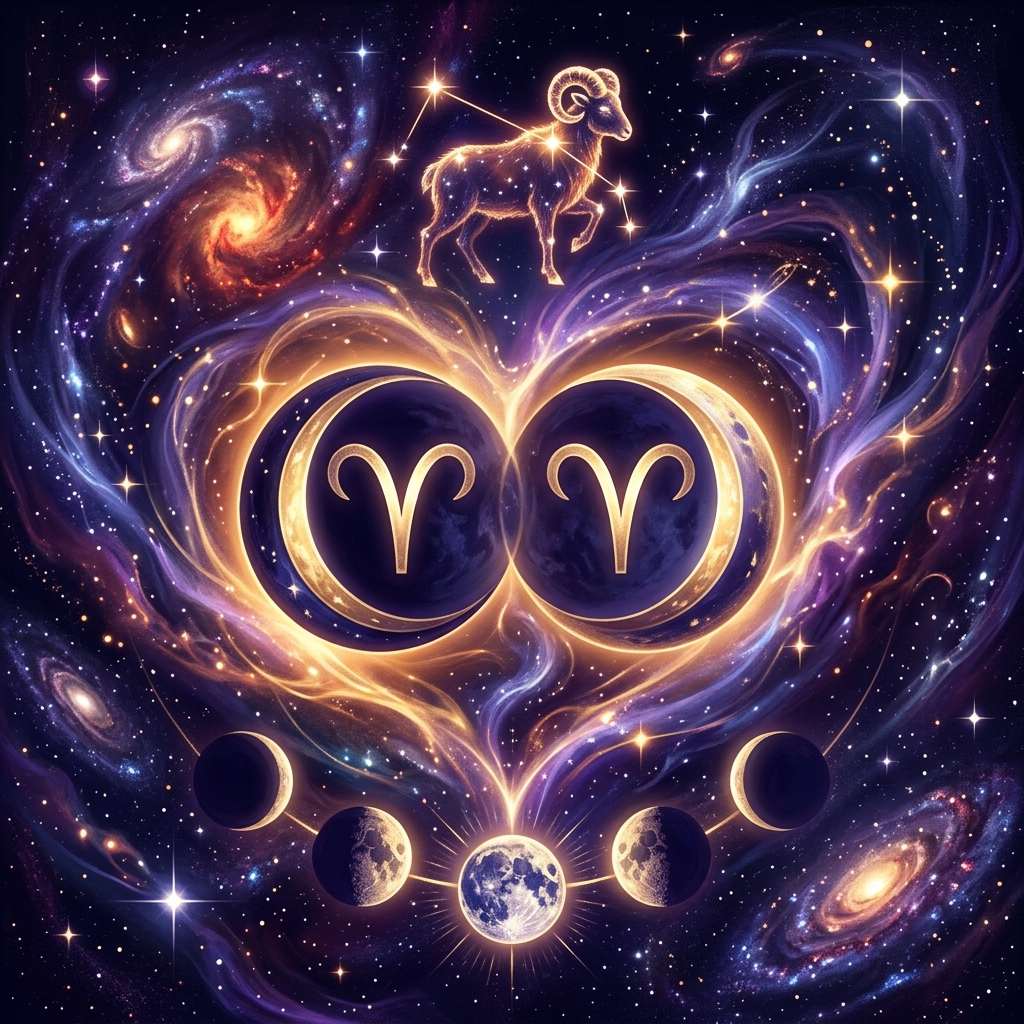
Two people with the Moon in Aries share a sign. That sounds like a close match, and in the old books it is one. But a sign is 30 degrees wide, and two Moons can sit anywhere inside it. We checked how many pairs of Aries Moons are truly close. The answer is fewer than half the time. This page explains what that means, what the tradition says about the pair, and where the reading stops.
First, a plain warning. Astrology is not a science. No study has shown that a Moon sign pair makes a couple last. Read what follows as a way to talk about needs, not as a forecast.
What an Aries Moon pair is
Your Moon sign is the sign the Moon stood in when you were born. Astrologers read it as your inner weather. It shows what calms you, what you need when you are tired, and how you give care. Your Sun sign is a different thing. It is the sign you read in a daily horoscope.
This page is about a couple where both partners have the Moon in Aries. Their Sun signs can be anything. If you want the sign itself, our Moon in Aries guide covers it in depth. For all twelve signs at once, start with our Moon sign compatibility guide.
Aries is the first sign of the zodiac. It is a fire sign, like Leo and Sagittarius. It is also a cardinal sign, the kind that starts a season. Its ruler, the planet in charge of the sign, is Mars. So both Moons in this couple answer to the same planet.
What the evidence says
The largest test of love signs came from the sociologist David Voas. In a 2007 paper called “Ten million marriages”, he used the 2001 census of England and Wales. He looked at about 10.3 million married couples. He found no sign pair that wed more than chance would give. A small excess of same-sign couples did show up at first. It came from data entry errors, not from the stars.
Voas only tested Sun signs. The census holds birth dates, not birth hours, so it cannot give a Moon sign. As far as we know, no one has run a test like that for the Moon. So nothing here is proven. It is a lens that can help two people name how they react.
Same sign, but how close?
When two Moons share a sign, astrologers call the link a conjunction. The word means the two points sit together. In the strict sense, though, a conjunction is measured in degrees. A degree is one part in 360 of the full circle of the sky. Each sign holds 30 of them.
So one partner can have the Moon at 1 degree Aries and the other at 29 degrees. They share a sign, yet they sit 28 degrees apart. Most astrologers would not call that a real conjunction. They use a margin, called an orb, to decide when two points count as joined. Common orbs run from 3 to 10 degrees.
We worked out the share of Aries Moon couples who fall inside each orb. The Moon moves through a sign at a near even pace, so each degree holds about the same share of births. That makes the sums simple, and our long count of Moon positions gives the same result.
| Orb used | Share of Aries Moon couples inside it | Put simply. |
|---|---|---|
| Within 3 degrees | 19 percent | About one couple in five. |
| Within 6 degrees | 36 percent | A bit more than one in three. |
| Within 8 degrees | 46.22 percent | Fewer than half. |
| Within 10 degrees | 55.56 percent | A bit more than half. |
Take the common 8 degree orb. Only 46 couples in 100 with two Aries Moons have a true conjunction. The other 54 share a sign and little else in degrees. That is the gap between a sign match and a close match.
These shares are not special to Aries. They hold for any two Moons in the same sign. What Aries adds is the reading of the sign itself, which comes next.
How common is this couple?
The Moon spends almost exactly one twelfth of its time in each sign. We counted every Moon sign change from the year 1600 to the year 2400. Aries came out at 8.33 percent, the same as every other sign to two decimals.
So a random couple has two Aries Moons about once in 144 tries. That is the rate for any same-sign Moon pair. A couple with two different Moon signs, such as Aries and Taurus, is twice as likely, at about one in 72. That is because either partner can hold either sign. The gaps between signs are far too small to mean anything. Do not trust any page that calls one Moon pair rare and another common.
What the old rules say about the Moon in Aries
The old astrologers gave each planet ranks in each sign. They called these ranks dignities. A planet in a sign it rules is at home. A planet in its best sign is exalted. The opposite signs are its weak spots.
For the Moon, the home sign is Cancer and the best sign is Taurus. The weak spots are Capricorn and Scorpio. Aries is none of these. In the words of William Lilly, the English astrologer who wrote Christian Astrology in 1647, the Moon there is peregrine. That means a wanderer, a guest with no rank in the house.
Lilly also used three smaller ranks. The Moon holds none of them in Aries. It has no share in the fire signs by day or by night. It rules none of the three ten-degree slices of Aries, which go to Mars, the Sun and Venus. And the Moon never holds the small ranks called terms in any sign. So from the first degree of Aries to the last, the Moon has no rank at all. Lilly counted that as a weakness worth five points in his scoring scheme.
In a couple with two Aries Moons, both partners share that trait. Neither Moon is strong by the book. That is not a verdict on the people. It is the old way of saying the Moon is not at ease there. It has to work through the style of Mars, its host.
What two Mars-ruled Moons look like
Modern writers such as Liz Greene and Stephen Arroyo read the Moon as the part of you that reacts before you think. In Aries, that reaction is fast. Mars is the planet of drive, heat and courage. So an Aries Moon feels first and acts at once.
Put two of them together and you get a couple that moves fast. Plans are made on the spot. A bad mood flares and then clears within the hour. Neither partner wants to sit and process a feeling for days. That can be a relief. Each one gets a partner who does not sulk.
The same speed has a cost. When both people flare at the same time, nobody holds the calm. Arguments start fast and hit hard. Both want to win the round. Both want to be the one who moves on first. The risk is not a slow freeze. It is a quick burn, repeated.
The tradition would add one more point. Aries and Aries share an element, a mode and a ruler. The fire element stands for heat and drive. The cardinal mode stands for starting things. So this is the one Moon pair that is fire, cardinal and joined in a single sign. There is no other sign in the mix to slow it down.
Where the reading helps
Used with care, the pair gives a couple some useful words.
Both of you need action to feel better. Talk alone does not settle an Aries Moon. A walk, a task, a change of scene does more.
Both of you need room to cool off. A short pause is not a snub. Agree on a signal that means “I need ten minutes” and use it.
Both of you like to lead. Take turns. One of you picks the plan this week, the other next week. It sounds small. It keeps the race from turning into a fight.
Both of you forgive fast. That is a real gift. Keep it, and do not bring up an old fight to win a new one.
Check your Moon before you trust the match
All of this rests on one fact: both of you really have the Moon in Aries. That is less certain than it looks.
The Moon moves fast. It changes sign every two and a quarter days on average. We timed its trips from 1600 to 2400. A pass through one sign lasts 54.6 hours on average, and anywhere from 46.9 to 61.1 hours. So on many days the Moon starts in one sign and ends in the next. Over those eight centuries, 43.92 percent of all days held a sign change.
Free tools ask for your birth date only. They then place your birth at noon. For people born on a day of change, that guess can be wrong. Across all births in our count, a noon chart names the wrong Moon sign 10.98 percent of the time. That is about one chart in nine.
For a couple, the risk doubles. If either chart is wrong, the pair is wrong. We found that noon charts give the wrong Moon pair for 20.75 percent of couples. That is about one couple in five. For an Aries pair, a wrong noon chart turns one partner into a Pisces Moon or a Taurus Moon, the signs on either side.
So before you read too much into two Aries Moons, find your real birth times. A birth certificate is the best source.
Moon and Sun in the same sign
One more count, which goes a little deeper. Some people are born with the Moon in the same sign as the Sun. That is close to a new Moon, the dark phase at the start of the cycle. Others are born with the Moon in the sign opposite the Sun, close to a full Moon.
These shares are not the same in every sign. The Sun moves a little slower in early July, when the Earth is farthest from it. So it stays longer in the summer signs, and the Moon meets it there more. Among Aries Moons, 8.21 percent have the Sun in Aries too, and 8.18 percent have it in Libra, the opposite sign.
For a couple of two Aries Moons, that gives these shares.
| Who is in the couple | Share of Aries Moon couples | Put simply. |
|---|---|---|
| At least one partner born with Sun and Moon in Aries | 15.75 percent | About one couple in six. |
| At least one partner born with the Sun in Libra | 15.69 percent | Also about one couple in six. |
If you are that partner, your chart doubles the Aries theme. Your Sun and Moon agree, and your partner’s Moon agrees too. Our Moon phase compatibility guide looks at the phase of both Moons in more detail.
How we measured it
We used two routes that share no code. The first used the Astronomy Engine library. It found every Moon sign change from 1 January 1600 to 1 January 2400, to within a tenth of a second. It then added up the time in each sign, and the time the Moon and Sun spent in each pair of signs.
The second route used the Swiss Ephemeris, a star table used by many astrology programs. It read the Moon and Sun once an hour over the same eight centuries, on a grid set half an hour apart from the first. That is more than seven million moments. We drew no random numbers in either route.
The two routes agree to within 0.05 points on every figure here. We used the tropical zodiac, the one most Western astrologers use. The couple odds treat each partner as a random birth. Real couples are not random, but nothing in birth data ties one person’s Moon to a partner’s.
Other Aries Moon pairs
If one of you is not an Aries Moon after all, read the pair that fits. Our guide to an Aries Moon and a Taurus Moon covers the sign next door. Our guide to an Aries Moon and a Gemini Moon covers the pair two signs apart. For the sign as a whole, see our page on the Aries sign.
Frequently asked questions
Are two Aries Moons compatible?
In the tradition, the pair shares an element, a mode and a ruling planet, so the two react in the same way. That brings quick ease and quick clashes. No study has shown that it makes a couple last longer.
How rare is an Aries Moon and Aries Moon couple?
About one random couple in 144 has it. That is the same rate as any other pair of same-sign Moons. Each Moon sign holds 8.33 percent of all moments.
Is a same-sign Moon pair a real conjunction?
Not always. The two Moons can sit up to 30 degrees apart. With an 8 degree orb, only 46.22 percent of these couples have a true conjunction.
Is the Moon weak in Aries?
By the old rules, it has no rank there. William Lilly called such a planet peregrine, a guest without dignity. In a double Aries Moon couple, both partners share that trait.
Can I trust a free Moon match without a birth time?
Not fully. A noon chart gives the wrong Moon sign 10.98 percent of the time. For a couple, it gives the wrong pair 20.75 percent of the time, about one in five.
Go deeper with your personal Astrovision report
Reading about astrological concepts is a great start, but nothing compares to hearing how they apply directly to you. Our users love our audio-first approach, calling it “friendly, personal, and easy to understand.” While this article gives you the “what,” a personal report gives you the “so what.” Discover your unique path with an Astrovision report—your personal ‘user manual’ delivered in our celebrated podcast format.