



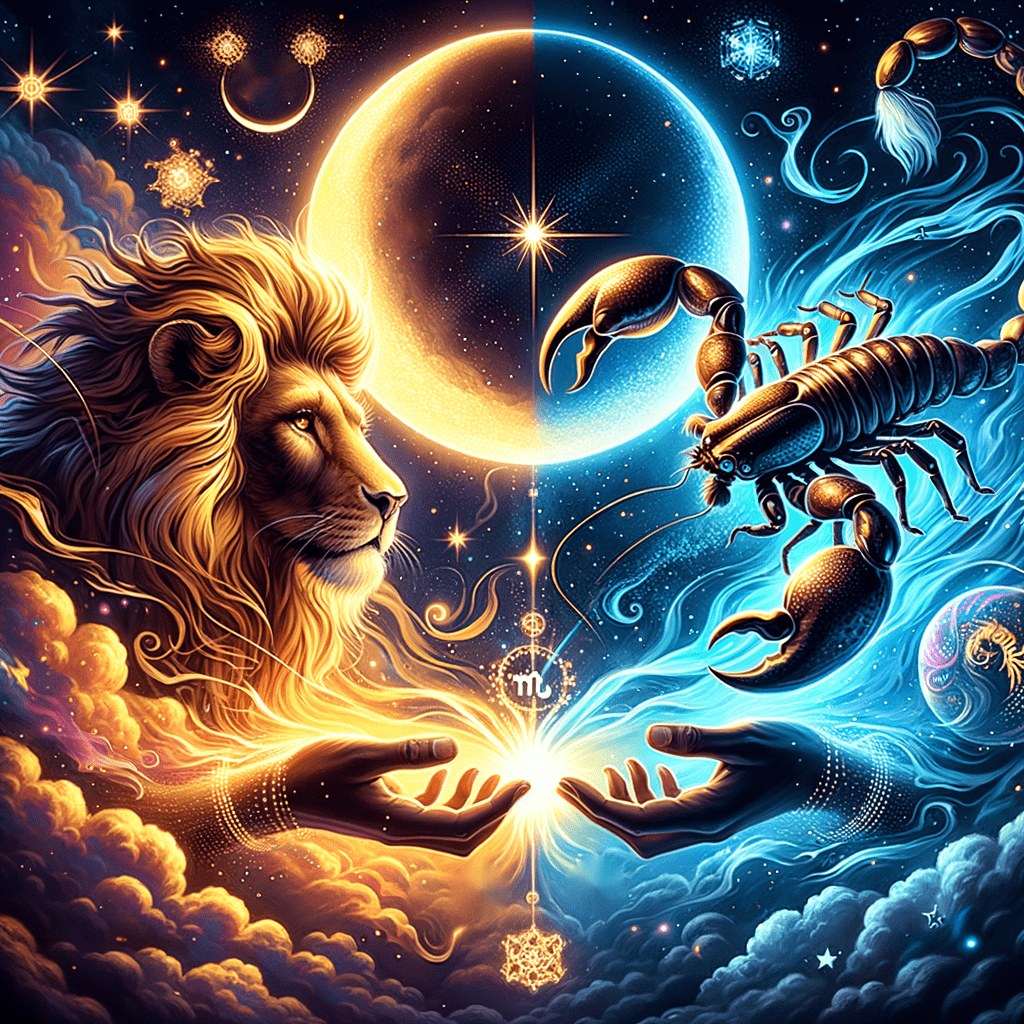
Leo Moon and Scorpio Moon compatibility brings together two signs that do not bend. Both are fixed signs, the kind that hold on once they choose. One is fire and one is water. They meet at a square, the tense angle of 90 degrees. Among all 78 Moon pairs, this is the only square that joins fire and water in two fixed signs.
There is more. The Moon in Scorpio sits in its fall, its weakest place in the old books. And by one reading of Ptolemy, Leo commands Scorpio. This page explains each of these ideas, what we measured, and what it can mean for a couple.
The short version
| Question | Answer. |
|---|---|
| What angle do the signs form? | A square, three signs or 90 degrees apart. |
| Elements and modes? | Fire and water, both fixed. |
| Who rules each sign? | The Sun rules Leo, Mars rules Scorpio. |
| Rank of each Moon? | No rank in Leo, in its fall in Scorpio. |
| Any special bond in Ptolemy? | Leo commands Scorpio, but only when counted by degree. |
| How common is the couple? | About 1 couple in 72, like any mixed pair. |
A word of honesty first
Astrology is not a science. No study has shown that Moon signs predict how a couple will do. The biggest test of love signs came from the sociologist David Voas in 2007. He used the 2001 census of England and Wales, with 10.3 million married couples. He found no effect of Sun signs on who marries whom.
A census has no birth times, so no one can run that test on Moon signs. Read this page as a guide to old ideas and real sky facts. It can start a good talk. It cannot grade your couple.
Two fixed signs at right angles
Ptolemy wrote the Tetrabiblos in Alexandria around 150 AD. In Book 1, chapter 13, he lists four links between signs. The trine and the sextile join signs of the same kind, so he calls them friendly. The square and the opposition join signs of opposite kinds, so he calls them tense.
Leo is a fire sign, which the old books call masculine. Scorpio is a water sign, which they call feminine. That is why the square between them counts as a hard angle.
Now add the mode. A mode says how a sign moves. Fixed signs sit in the middle of each season and keep things going. There are four of them: Taurus, Leo, Scorpio and Aquarius. They form four squares with each other. Only one of those squares is fire against water, and it is this one.
So this couple joins two Moons that both dig in. The Leo Moon holds on to pride and warmth. The Scorpio Moon holds on to trust, and to hurts. Neither gives ground fast. That is the core of the pair, for good and for bad. When they agree, they are loyal for years. When they fight, the fight can last just as long.
A Moon in its fall
The old books rate the Moon in each sign. The Moon rules Cancer. It is exalted, or at its best, in Taurus. It is in exile in Capricorn, the sign opposite its home. It falls in Scorpio, the sign opposite its exaltation.
Fall does not mean bad feelings or a bad person. It means the Moon works in a place that does not suit its nature. The Moon likes calm, flow and care. Scorpio is ruled by Mars, the planet of heat and struggle. So a Scorpio Moon feels deeply, but it keeps those feelings under guard. Our guide to the Moon in Scorpio explains why astrologers call it a fall.
The Moon in Leo has no rank at all. William Lilly, in Christian Astrology in 1647, called that peregrine, a traveler with no home in town. A peregrine Moon leans on the ruler of its sign, here the Sun. Our guide to the Moon in Leo says this Moon needs a witness more than a crowd.
Put side by side, one Moon is open and wants to be seen. The other is guarded and wants to be sure first. The Leo Moon can read the guard as coldness. The Scorpio Moon can read the openness as a show.
The Sun and Mars
Behind each Moon stands its ruler. The Sun rules Leo. It is the center, the light that others circle. Mars rules Scorpio in the old system. Modern astrologers add Pluto as a second ruler, but Ptolemy and Lilly used Mars alone.
Ptolemy built an angle into these homes, in Book 1, chapter 17. Mars has one home a square from the Sun’s, and one a square from the Moon’s. Scorpio is a square from Leo. Aries is a square from Cancer. He tied the square, a tense angle, to Mars, a hot and harsh planet. So the angle in this couple is the very angle that ties Mars to the Sun.
The Sun wants to lead in the open. Mars wants to win, and in Scorpio it fights in the dark. In the old books, Scorpio is the night house of Mars, the quiet side of the warrior.
So in this couple, the Leo Moon deals with a problem by bringing it into the light. The Scorpio Moon deals with it by holding it close until it knows the full story. Both want to protect the bond. They just pick opposite tools.
Leo commands Scorpio, by degree
Ptolemy had two more bonds, in chapters 14 and 15. Some signs command and others obey. Some signs see each other as equals. Modern readers count these bonds in two ways, and the lists do not match.
The reading by degree
Signs that sit at the same distance from the start of Aries rise over the horizon in the same span of time. Ptolemy said the sign in the summer half of the zodiac commands, and the one in the winter half obeys. Counted by exact degree, Leo and Scorpio are such a pair. They mirror each other across the start of Aries and Libra. Lilly called these mirror points contra-antiscia.
On that reading, Leo commands and Scorpio obeys. The square is softened, because the two signs share a kind of rhythm. We measured how close the mirror is in real couples. The two Moons fall within 1 degree of an exact mirror in 6.56 percent of couples, and within 3 degrees in 19 percent.
The reading by whole signs
The translator Frank Robbins, in his notes to Ptolemy, gives the lists by whole signs. There, the pairs shift by one sign. Leo commands Sagittarius. Virgo commands Scorpio. Scorpio sees Pisces. So by whole signs, Leo and Scorpio have no special bond at all.
Both readings are worth knowing. Neither is a verdict. If you use the degree reading, the Leo Moon sets the tone, and the Scorpio Moon follows, with a veto kept in reserve.
What we measured: new moons and full moons
Every Moon sign spends close to the same time in the sky, between 8.33 and 8.34 percent. So no Moon pair is rare. Any mixed pair comes out at about 1 couple in 72. A pair of the same sign is 1 couple in 144.
One real gap does show up by sign. It is about the phase of the Moon at birth. A person born near a new moon has the Moon in the same sign as the Sun. A person born near a full moon has the Moon in the sign opposite the Sun.
| Moon sign | New moon type, Sun in the same sign | Full moon type, Sun in the opposite sign. |
|---|---|---|
| Leo Moon | 8.43 percent, with a Leo Sun | 7.96 percent, with an Aquarius Sun. |
| Scorpio Moon | 8.06 percent, with a Scorpio Sun | 8.33 percent, with a Taurus Sun. |
The two Moons lean opposite ways. The Earth is farthest from the Sun in early July, so the Sun moves slowest in the northern summer. It lingers in Leo, which gives more new moons there. In late autumn, the Sun speeds up through Scorpio, so fewer new moons land there. In late spring, it moves slower through Taurus, so more Scorpio Moons are born near a full moon than near a new one.
For the couple, 15.81 percent include at least one partner born with the Moon in their own Sun sign. In 15.63 percent, at least one was born near a full moon. The gap is small but real, and it shows up on both routes we used.
In the old reading, a full moon birth sets the self and the needs in opposite signs. A Taurus Sun with a Scorpio Moon wants calm on the outside and depth on the inside. Our guide to moon phase compatibility shows how to find your own phase.
How close are the two Moons in degrees?
An angle by sign is not always exact in degrees. Astrologers allow a margin around the exact angle, called an orb. The Moon moves at a near even pace through each sign, so plain geometry gives the share of couples inside each orb.
| Orb allowed | Couples with a true 90 degree angle. |
|---|---|
| Within 3 degrees | 19 percent of couples. |
| Within 6 degrees | 36 percent of couples. |
| Within 8 degrees | 46 percent of couples. |
| Within 10 degrees | 56 percent of couples. |
These shares are the same for every Moon pair. They come from geometry, not from Leo or Scorpio. Two edge cases matter here. An early Leo Moon and a late Scorpio Moon can sit close to 120 degrees apart, a real trine. A late Leo Moon and an early Scorpio Moon can sit close to 60 degrees apart, a real sextile. At an 8 degree orb, the two cases add up to 7.11 percent of couples. In those couples, the square by sign hides a softer angle by degree.
Check both Moons before you read
A reading needs two correct Moon signs. The Moon stays in a sign for 54.6 hours on average, from 46.9 to 61.1 hours. It changes sign on 43.92 percent of all days. A birth on such a day has two possible Moons.
Tools with no birth time use noon. That guess gives the wrong Moon sign in 10.98 percent of charts. For a couple, it gives the wrong pair in about 1 case in 5, or 20.75 percent. Only 31 percent of couples have both Moons fixed by the date alone. Our main page on Moon sign compatibility gives the full count.
For this pair, a late Leo Moon can turn out to be an early Virgo Moon. An early Scorpio Moon can turn out to be a late Libra Moon. Either change swaps the square for a milder angle. The birth time settles it.
Sun, Moon and Venus: three different pairs
The same two signs mean different things for each planet. Our page on Leo and Scorpio Sun sign compatibility looks at the core self. Our page on Venus in Leo and Venus in Scorpio looks at how each partner loves and wants to be loved.
The Moon pair is about comfort. It shows what each of you needs after a hard day. A couple can share a Moon pair and have very different Suns. Read all three before you draw any line.
Three talks worth having
- What does trust look like? The Scorpio Moon needs time and proof. The Leo Moon needs to be believed now. Agree on what proof looks like.
- Where do feelings go? The Leo Moon says them out loud. The Scorpio Moon keeps them inside until it is sure. Set a time to share, so nothing builds up.
- Who backs down first? Both of you are fixed. Take turns giving ground, and say thank you when the other one does.
For another fixed square with a Leo Moon, see Taurus Moon and Leo Moon compatibility. For the Moon at its best and worst, see Taurus Moon and Scorpio Moon compatibility.
How we measured
We used two separate routes over the years 1600 to 2400, with every moment weighted the same. Route one used the astronomy-engine library. It found each sign change of the Moon and the Sun to within a tenth of a second, then added up the exact time in each case. Route two used the Swiss Ephemeris and checked the sky once an hour, on a grid shifted by half an hour. The two routes agree to within 0.05 points.
The noon test uses calendar days in Greenwich time, with a chart at 12:00. For the old rules, we read the Tetrabiblos, Book 1, chapters 13 to 19, in the Robbins translation, with his notes 80 and 83, and Lilly’s Christian Astrology.
Frequently asked questions
Are a Leo Moon and a Scorpio Moon compatible?
Astrology reads them as a tense square between two fixed signs, fire and water. Both are loyal, and both are stubborn. No study has shown that Moon signs predict how a couple does, so use the reading as a lens.
Why is the Moon in its fall in Scorpio?
The Moon is exalted in Taurus. The sign opposite an exaltation is the fall, and that is Scorpio. The Moon’s calm nature sits poorly in a sign ruled by Mars.
Does Leo command Scorpio?
Only when you count by exact degree. The two signs mirror each other across the start of Aries and rise in equal times. Counted by whole signs, as in Robbins’s notes, they share no such bond.
Is the square always exact?
No. The two Moons are within 6 degrees of a true square in 36 percent of couples. In about 7 percent, they form a trine or a sextile by degree instead.
Can I find my Moon sign from my birth date?
On 56 percent of days, yes, since the Moon stays in one sign all day. On the other days, you need a birth time. A noon guess is wrong in about 1 chart in 9.
Go deeper with your personal Astrovision report
Reading about astrological concepts is a great start, but nothing compares to hearing how they apply directly to you. Our users love our audio-first approach, calling it “friendly, personal, and easy to understand.” While this article gives you the “what,” a personal report gives you the “so what.” Discover your unique path with an Astrovision report—your personal ‘user manual’ delivered in our celebrated podcast format.