

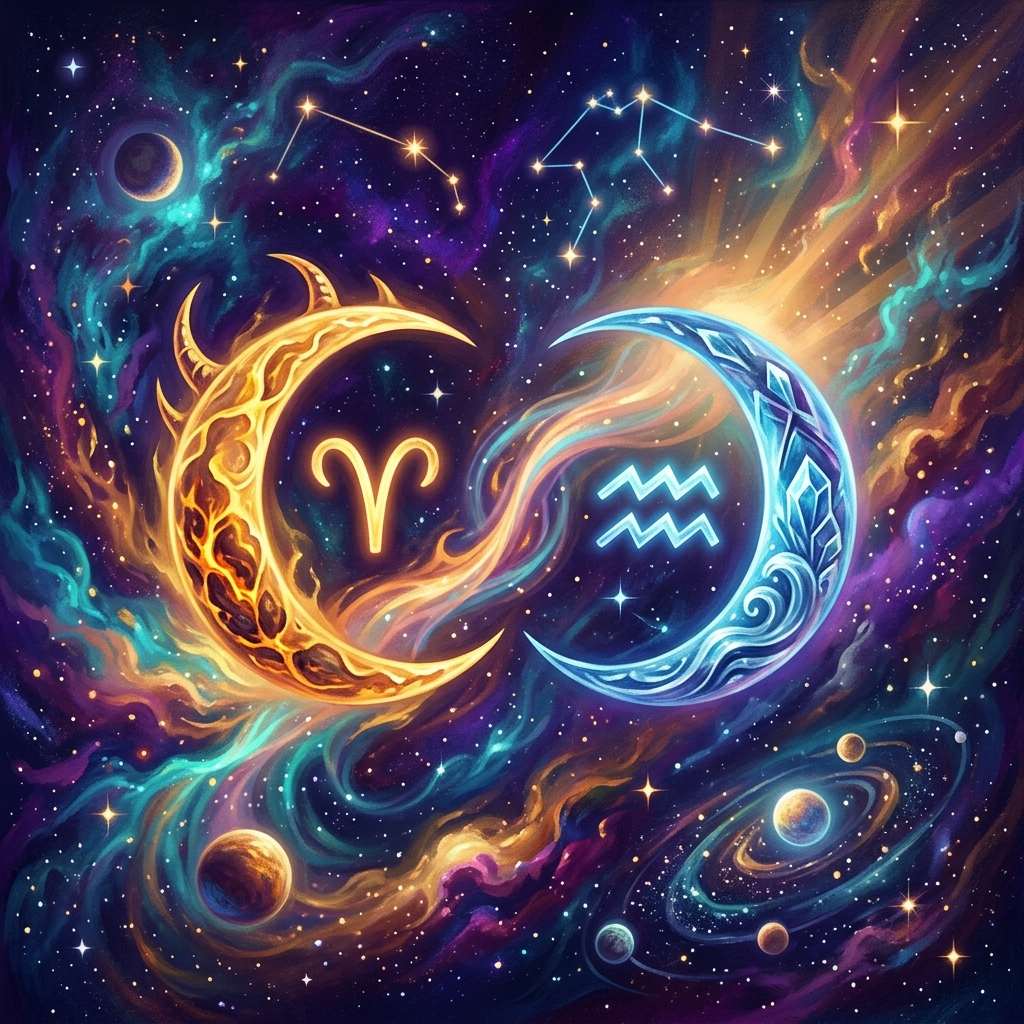
Aries Moon and Aquarius Moon compatibility starts with an easy angle and an odd fit. The angle is a sextile, one of the two links the old books call friendly. The odd fit is this: the Moon is a night planet, and both of these Moons sit in day signs.
Ptolemy sorted the twelve signs into day signs and night signs. Aries and Aquarius are both day signs. He also sorted the planets. The Moon, for him, is a planet of the night. So in this couple, both Moons work in a setting that is not their own kind. That shared trait shapes how the old symbols read the pair.
We cover the sextile, the day and night rule, the ranks each Moon holds, and the numbers behind the pair. We measured them over eight centuries of real Moon positions. Astrology is not a science. Read this page as a way to talk about needs, not as a forecast.
The pair at a glance
| Point | Aries Moon and Aquarius Moon. |
|---|---|
| Distance on the wheel | Two signs apart, or 60 degrees, a sextile. |
| Elements | Fire and air, the pair the old books call a good mix. |
| Modes | Aries is cardinal and Aquarius is fixed. |
| Day or night signs | Both are day signs, while the Moon is a night planet. |
| Ranks of the Moon | No main rank in either sign. |
| Share of couples | About 1 couple in 72, like any mixed Moon pair. |
What we mean by a Moon sign
Your Moon sign is the slice of sky the Moon held when you were born. The zodiac is cut into twelve slices of 30 degrees. The Moon runs through all of them in about 27.3 days. It stays a little over two days in each.
In a chart, the Sun is your will and the self you show. The Moon is the self you keep at home. It is how you react before you think, and what you need to feel safe. Moon sign compatibility compares those two inner selves. Our main guide to moon sign compatibility sets out the rules for every pair.
What no chart can promise
No study has shown that the Moon signs of two people predict how their love will go. The biggest test so far used Sun signs. David Voas looked at 10.3 million married couples in the 2001 census of England and Wales. The signs had no effect on who married whom. A small excess of same-sign couples traced back to errors when the forms were typed in.
Moon signs have not been tested at that scale. So this page gives no score. It reads the old symbols as a language for two styles of feeling.
A sextile: the friendly angle
Start at Aries and count back along the wheel. Pisces is one step. Aquarius is two. Signs two apart sit 60 degrees from each other. That angle is called a sextile.
Claudius Ptolemy wrote the Tetrabiblos in Alexandria around 150 AD. He names four classic aspects, or set angles between points in the sky. He calls the trine and the sextile harmonious, and the square and the opposition hard. His reason is simple. A sextile joins signs of the same kind, both masculine or both feminine. Aries and Aquarius are both masculine, an old label for the signs that come first, third, fifth and so on around the wheel.
In book four, on marriage, Ptolemy turns to the Sun and Moon of both partners. He writes that a union lasts when these lights are in harmony, which means a trine or a sextile. By that rule, two Moons in a sextile is the easy case. It does not mean the couple will last. It means the old books would not flag the angle as a strain.
Fire and air fit the same story. Fire signs are Aries, Leo and Sagittarius. Air signs are Gemini, Libra and Aquarius. The common image is air feeding a flame. An Aries Moon reacts with heat. An Aquarius Moon reacts with ideas and a bit of distance. Each gives the other something to work with.
Two night lights in day signs
This is the angle that sets the pair apart from most. In book one, chapter 12, Ptolemy splits the signs into masculine and feminine. He says the masculine signs are also the day signs. They start with Aries and take turns around the wheel. So Aries, Gemini, Leo, Libra, Sagittarius and Aquarius are day signs.
In chapters 6 and 7, he sorts the planets the same way. The Sun is a day planet. The Moon is a night planet, and a feminine one. Later writers built a rule on this. William Lilly, in Christian Astrology of 1647, counts it a plus when a planet sits in a sign of its own kind. A night planet likes a night sign.
Neither Moon gets that plus here. Both sit in day signs. What does that mean as a symbol? It suggests two people who meet feelings in the open, by the light of day. They talk, they act, they move. Neither one is built, in this reading, for the long, quiet, private kind of care that the night signs stand for.
| Couple type | Both Moons in | Share of random couples. |
|---|---|---|
| Like Aries and Aquarius | Day signs | 25 percent, or 1 in 4. |
| Like Cancer and Pisces | Night signs | 25 percent, or 1 in 4. |
| One of each | One day sign, one night sign | 50 percent, or 1 in 2. |
So the trait is common. One couple in four shares it. What it gives this pair is a shared style, not a rare gift. When both partners handle feelings in daylight, no one is left to sit in the dark with a mood. That can be a relief. It can also mean some hurts get talked about and never quite felt.
What rank each Moon holds
The old books give each planet ranks in the signs, called dignities. The four main ones are home, exaltation, exile and fall. For the Moon, Lilly lists home in Cancer, exaltation in Taurus, exile in Capricorn and fall in Scorpio.
Aries and Aquarius are on none of those lists. So both Moons hold no main rank. The old word is peregrine, which means a wanderer. A wanderer Moon is neither helped nor held back by its sign. It acts in its own way.
There is one small rank in play. The old books also cut each sign into three parts of 10 degrees, called faces. In the scheme Lilly uses, the Moon rules the last face of Aquarius, from 20 to 30 degrees. That is a minor rank, worth little in his scoring. But it means about one Aquarius Moon in three has a small tie to the Moon’s own nature. The Aries Moon has no face at all.
You can read more on each Moon on its own page. Our page on the Moon in Aries timed its passages through the sign. Our page on the Moon in Aquarius counts how many dates alone give the wrong sign.
Starter and keeper
The modes add a second layer. Cardinal signs open a season. Fixed signs hold it steady. Aries is cardinal. It opens spring. Aquarius is fixed. It sits in the middle of winter.
So an Aries Moon wants to start: to say the thing, to fix it, to move on. An Aquarius Moon wants to keep: its views, its friends, its own space. The friction in this couple is not heat against cold. It is speed against stance. Aries asks for a change today. Aquarius asks why the change is needed at all.
Only one other pair of the 78 has this same mix, a fire and air sextile between a cardinal and a fixed sign. It is Leo and Libra, with the roles swapped. There, the fire sign is fixed and the air sign is cardinal. Our page on Leo and Libra Moons covers that mirror case.
What the old reading sees in the pair
- Both talk about feelings out loud rather than hint at them.
- Aries brings the spark. Aquarius brings a wider view.
- Both value freedom and dislike being managed.
- Aries can push Aquarius to act on what it believes.
- Aquarius can help Aries step back before a fight grows.
- The weak spot is comfort. Neither one reaches first for soft, quiet care.
New Moon and Full Moon births
Some people are born with the Moon in the same sign as the Sun. That is close to a New Moon. Others are born with the Moon across from the Sun. That is close to a Full Moon. These shares differ a little by Moon sign, and the gap is real.
It comes from the Sun’s pace. Earth moves slowest around the Sun in early July. So the Sun spends more time in the summer signs. An Aquarius Moon at Full Moon needs the Sun in Leo, a summer sign. So Full Moon births are more common for an Aquarius Moon than New Moon ones.
| Moon sign | Near a New Moon | Near a Full Moon. |
|---|---|---|
| Aries Moon | 8.21 percent | 8.18 percent. |
| Aquarius Moon | 7.97 percent | 8.43 percent. |
For the couple, about 15.5 percent include at least one partner born near a New Moon. About 15.9 percent include one born near a Full Moon. Our page on moon phase compatibility explains how astrologers read those phases.
How common the pair is
We tracked the Moon from the year 1600 to the year 2400. Every Moon sign holds almost exactly one twelfth of that time, between 8.33 and 8.34 percent. The tiny gaps between signs are smaller than the gap between our two methods. They carry no meaning.
So the odds are plain. Any mixed Moon pair, like this one, comes up for about 1 couple in 72. Any same-sign Moon pair comes up for about 1 couple in 144. No Moon pair is rare.
How close is the sextile?
A sextile by sign is not always one by degree. Two Moons in Aries and Aquarius can sit from 30 to 90 degrees apart. A chart reader counts the aspect only when it is near 60. The room allowed is called the orb.
With the Moons spread evenly through their signs, about 19 percent of couples fall within 3 degrees of a true sextile. About 36 percent fall within 6 degrees. About 56 percent fall within 10. Those shares are the same for every pair two signs apart. So a tight sextile belongs to about one Aries and Aquarius couple in three.
Is your Moon sign right?
The Moon changes sign every two and a quarter days. We counted every change over eight centuries. On 43.92 percent of days, the Moon starts the day in one sign and ends it in the next.
A free tool with no birth time uses noon. That guess gives the wrong Moon sign for about 11 percent of births, or 1 in 9. For a couple, it gives the wrong Moon pair about 21 percent of the time, or 1 in 5. Only about 31 percent of couples have both Moon signs fixed by the date alone. So check both birth times before you read the pair.
Our method
We used two separate methods. The first used the Astronomy Engine library to find every sign change of the Moon, Sun and Venus from 1600 to 2400, to a tenth of a second. It then added up the exact time in each sign. The second used the Swiss Ephemeris, stepping through the same years once an hour on a grid set half an hour apart from the first.
The two agree within 0.04 points on every Moon share. Days and noon charts use Greenwich time. The sign and planet rules come from Ptolemy’s Tetrabiblos, book one, and from Lilly’s Christian Astrology.
Frequently asked questions
Are Aries Moon and Aquarius Moon compatible?
By the old rules, the signs form a sextile, which Ptolemy called harmonious. Fire and air are also read as a good mix. No study shows that Moon signs decide how a couple does.
Why does it matter that both are day signs?
Ptolemy calls the Moon a night planet. Lilly counts it a plus when a planet sits in a sign of its own kind. Both Moons here sit in day signs, so both lack that plus. As a symbol, it points to feelings handled in the open.
Is the Moon strong or weak in Aries and Aquarius?
Neither. The Moon holds no main rank in either sign. It is a wanderer in both. The last 10 degrees of Aquarius give it a small rank called a face.
How many couples have Aries and Aquarius Moons?
About 1 couple in 72. Every Moon sign holds close to one twelfth of the time. So every mixed pair comes up at about the same rate.
Can I find my Moon sign without a birth time?
On about 56 percent of days, yes, because the Moon stays in one sign all day. On the other days, you need the time. A noon guess is wrong for about 1 chart in 9.