


If your Sun is in the 6th house, you were born after sunset. Under the house method most US apps use, the Sun had just dropped below the west edge of the sky. You came in the first third of the night. At the equinox, that is 6 p.m. to 8 p.m. by the Sun.
On the clock, the window moves with the season. In New York on the shortest day, it runs from 4:27 to 6:56 p.m. That is the end of the working day. On the longest day, it runs from 8:26 to 9:56 p.m. That is late evening.
That shift matters, because US babies are not born at an even pace. So the hospital clock favors the winter window and trims the summer one. This guide measures that with every US birth of 2024. It gives the clock times for your city. It also says what the old books make of a Sun that has just set, in the room the Greeks called Bad Fortune.
The 6th house, in plain words
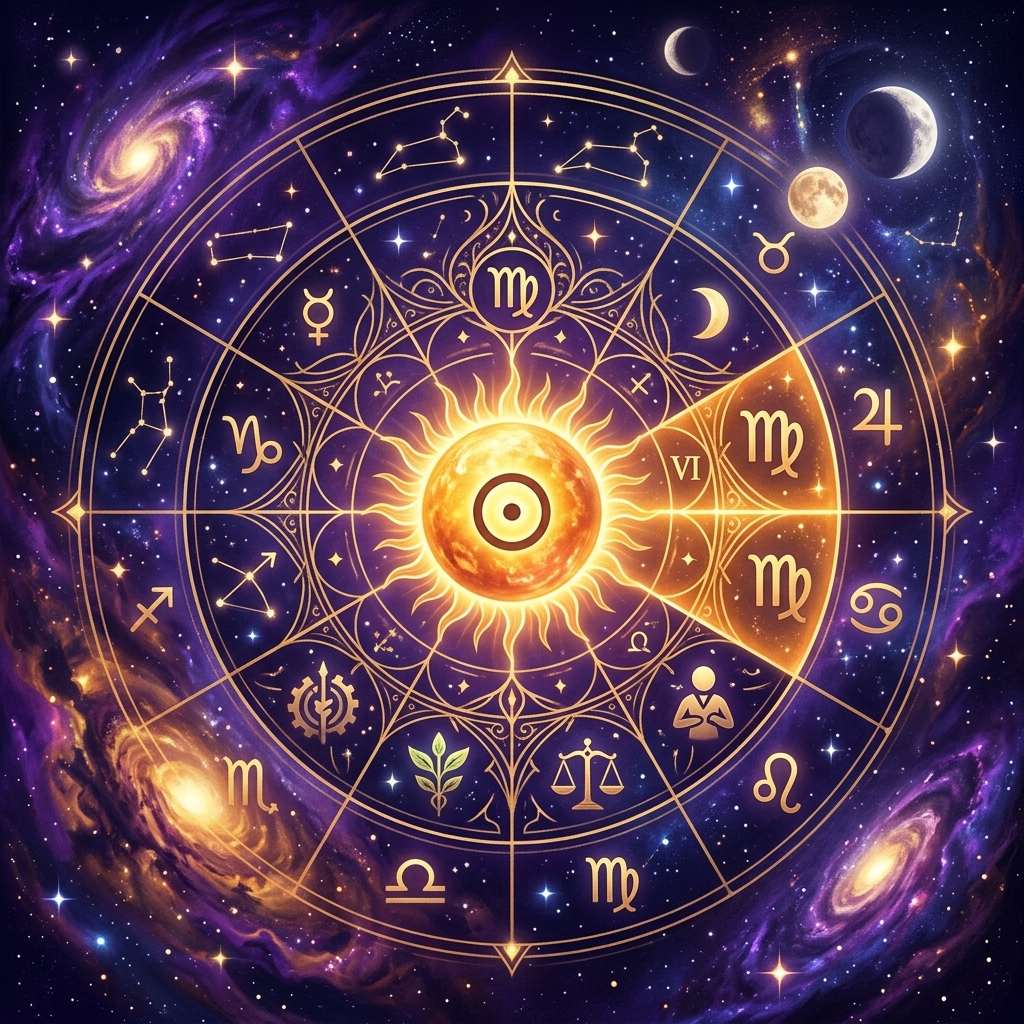
Your birth chart is a map of the sky at the minute you were born. Astrologers cut that map into twelve slices called houses. Think of a house with twelve rooms. Each room covers one field of life, and the planets are the furniture.
The 6th house is the room of what repeats. It covers daily work, tasks, routine, coworkers and staff, and the upkeep of the body. The Greek writers gave it a harsh name: Kakē Tychē, which means Bad Fortune. Our guide to 6th house astrology tells how that name softened into daily habits.
The Sun stands for the core of you: the self you grow into, and the place where you want to shine. Put it in the 6th house and the self wants to shine through work done well, day after day. It proves itself by what it keeps doing, not by one grand act.
Now the sky part. The houses are not fixed to the stars. They are fixed to the ground under your feet. The 7th house starts at the west edge, where the Sun sets. The 6th house is the band just below that edge, in the part of the sky you cannot see. Each evening, the Sun sinks under the west edge and slides down through the 6th. That is why this placement is tied to the clock.
Two ways to draw the houses
There are two common ways to cut the sky into rooms. For the 6th house they agree about half the time.
Whole sign houses are the oldest way. The sign rising in the east at your birth is your whole 1st house. The next sign is your 2nd house, and so on. The Greek writers used this and nothing else.
Placidus houses cut the sky by time. The Sun’s path from sunset down to its lowest point is split into three equal parts of time. Most US sites and apps use this one.
For the Sun, Placidus gives a clean rule. The Sun is in the 6th house during the first third of the time from sunset to its lowest point. We give both systems below, and we say which one each number uses.
The first third of the night
Start with Sun time. At noon by the Sun, the Sun stands highest in your sky. At midnight by the Sun, it stands lowest, straight down through the earth. On the two equinox days, when day and night have the same length, the Sun sets at 6 p.m. by the Sun.
So the slide from sunset to the lowest point takes six hours. Split it into thirds of two hours. The first third runs from 6 p.m. to 8 p.m. by the Sun. That is the 6th house. The next third is the 5th house, and the last third, which ends at midnight by the Sun, is the 4th house.
The rest of the year the window stretches and shrinks with the night. It always opens at sunset. In June the nights are short, so the window lasts about an hour and a half. In December the nights are long, so it lasts about two and a half hours. Over all US places and all days, it lasts 1.99 hours on average.
One small point about the start. The house opens when the center of the Sun meets the west edge. The sunset time in your weather app counts the moment the top rim drops out of sight, and it adds the bending of light by the air. So the 6th house opens four to five minutes before the sunset in your app.
Sun time is not clock time
Your birth record shows clock time, not Sun time. Two things pull them apart.
First, your time zone is wide. The clock is the same across the whole zone, but the Sun sets later the farther west you live. Second, daylight saving time moves the clock one hour ahead from March to November. So 7 p.m. by the Sun in July reads close to 8 p.m. on the wall.
Here is the Placidus window for the Sun in the 6th house in three big US cities, in local clock time. We found each start and end with the Swiss Ephemeris, the same engine many chart apps use. We checked the house of the Sun every thirty seconds.
| Evening of birth in 2026 | New York | Chicago | Los Angeles. |
|---|---|---|---|
| February 1 | 5:09 to 7:29 p.m. EST | 5:01 to 7:22 p.m. CST | 5:19 to 7:35 p.m. PST. |
| March 20, equinox | 7:04 to 9:04 p.m. EDT | 6:58 to 8:58 p.m. CDT | 7:01 to 9:01 p.m. PDT. |
| June 21, longest day | 8:26 to 9:56 p.m. EDT | 8:24 to 9:53 p.m. CDT | 8:03 to 9:40 p.m. PDT. |
| August 1 | 8:07 to 9:45 p.m. EDT | 8:04 to 9:41 p.m. CDT | 7:49 to 9:33 p.m. PDT. |
| September 22, equinox | 6:49 to 8:49 p.m. EDT | 6:43 to 8:43 p.m. CDT | 6:45 to 8:45 p.m. PDT. |
| November 15 | 4:33 to 6:56 p.m. EST | 4:25 to 6:48 p.m. CST | 4:45 to 7:02 p.m. PST. |
| December 21, shortest day | 4:27 to 6:56 p.m. EST | 4:17 to 6:48 p.m. CST | 4:43 to 7:06 p.m. PST. |
EST, CST and PST are winter clock time. EDT, CDT and PDT are summer clock time. At the two equinoxes, all three cities match the 6 p.m. to 8 p.m. Sun rule, once you undo the time zone and the summer shift.
Look at the two ends of the year. In New York, the December window has closed before the June window opens. A baby born at 7 p.m. has the Sun in the 6th house in February, but not in June. In June the Sun is still up at 7 p.m., in the 7th house. Other years move these times by a minute or two, no more. Before 2007, summer time started in April and ended in late October, so check the clock rule for your birth year.
The start of each window is the end of the 7th house window. Our guide to the Sun in the 7th house gives the hours just before sunset, and its times meet ours to the minute.
The odds at each clock hour
We then asked a plain question. Of all US babies born in a given clock hour, how many have the Sun in the 6th house under Placidus? We used every day from 1940 to 2030, with the exact start and end of each window.
| Clock hour of birth | Share with the Sun in the 6th house. |
|---|---|
| Before 4 p.m. | Almost none. |
| 4 p.m. to 5 p.m. | 4.6 percent of births. |
| 5 p.m. to 6 p.m. | 23.1 percent of births. |
| 6 p.m. to 7 p.m. | 42.6 percent of births. |
| 7 p.m. to 8 p.m. | 46.2 percent of births. |
| 8 p.m. to 9 p.m. | 47.9 percent of births. |
| 9 p.m. to 10 p.m. | 31.7 percent of births. |
| 10 p.m. to 11 p.m. | 2.9 percent of births. |
| 11 p.m. or later | Almost none. |
Over the whole year, no single hour gets past one chance in two. Almost all US cases fall between 4 p.m. and 11 p.m. on the clock. But the year hides two very different seasons. In December, a baby born in the 6 p.m. hour has the Sun in the 6th house 95 percent of the time, and a baby born at 8 p.m. almost never does. In June, the 9 p.m. hour gives 86 percent, and the 6 p.m. hour gives nothing at all.
How common is it? Just under one in twelve
If babies were born at the same rate every minute of the day, the Sun would sit in each house one time in twelve. That is 8.33 percent. Our even clock count gave 8.30 percent under Placidus. The 6th house is a night room. US nights are a little shorter than US days over the year, so it comes out a hair under one in twelve.
But babies do not come at an even pace. The CDC, the US public health agency, puts every birth record into one public file each year. The 2024 file holds 3,638,436 births. Only 666 of them lack a time of birth. On an even clock, each hour would get 4.2 percent of births. The 4 p.m. and 5 p.m. hours each hold about 4.7 percent of births. The 6 p.m. hour holds 4.3 percent. The 7 p.m. hour holds only 3.7 percent, and the 9 p.m. hour 3.8 percent.
So we weighted our count by the real 2024 birth hours, with the month and the day of the week kept apart.
| Birth hours used | Placidus houses | Whole sign houses. |
|---|---|---|
| Even clock | 8.30 percent | 8.30 percent. |
| Real US hours, 2024 | 8.07 percent | 7.69 percent. |
With real hours, the Sun in the 6th house drops a little, from 8.30 to 8.07 percent under Placidus. That is still close to one birth in twelve. The evening is not the dead zone of the ward. The small hours are.
The count falls step by step as the Sun sinks. Our guide to the Sun in the 7th house found 8.79 percent in the hours just before sunset. The 6th house, just after sunset, gets 8.07 percent. The 5th house, deeper in the evening, gets about 7.5 percent in our count. The Sun in the 4th, near midnight by the Sun, gets 6.8 percent.
Winter babies have it far more
The 6th house window grows with the night, so your birth month shifts the odds a lot. The table gives the share of births with the Sun in the 6th house for each month of birth, under Placidus.
| Month of birth | Even clock | Real US hours, 2024. |
|---|---|---|
| Born in January | 9.9 percent | 10.2 percent. |
| Born in February | 9.3 percent | 9.1 percent. |
| Born in March | 8.4 percent | 8.0 percent. |
| Born in April | 7.6 percent | 7.1 percent. |
| Born in May | 6.9 percent | 6.4 percent. |
| Born in June | 6.5 percent | 5.9 percent. |
| Born in July | 6.7 percent | 6.2 percent. |
| Born in August | 7.3 percent | 6.9 percent. |
| Born in September | 8.1 percent | 7.6 percent. |
| Born in October | 9.0 percent | 8.7 percent. |
| Born in November | 9.7 percent | 10.2 percent. |
| Born in December | 10.1 percent | 10.7 percent. |
Read the even clock column first. It only tracks the length of the night. A long December night gives the 6th house a long window, so December gets 10.1 percent. A short June night gives it a short one, so June gets 6.5 percent. December wins by a factor of 1.55.
Now read the real hours column. In December the window opens at 4:27 p.m. on the New York clock, while the ward is still busy. The share climbs to 10.7 percent. In June the window opens after 8 p.m., when the ward has calmed down. The share drops to 5.9 percent. With real hours, December beats June by a factor of 1.82, not 1.55.
So the hospital clock pulls the seasons further apart. That is the mirror image of the 7th house, where the same clock pulls them closer.
Since the window follows the season, your Sun sign shifts the odds too. The even clock column holds for any hour pattern of the past. The real hours column is for a baby born under the 2024 pattern.
| Sun sign | Even clock | Real US hours, 2024. |
|---|---|---|
| Aries | 7.9 percent | 7.4 percent. |
| Taurus | 7.1 percent | 6.7 percent. |
| Gemini | 6.6 percent | 6.0 percent. |
| Cancer | 6.6 percent | 6.1 percent. |
| Leo | 7.1 percent | 6.7 percent. |
| Virgo | 7.9 percent | 7.4 percent. |
| Libra | 8.8 percent | 8.3 percent. |
| Scorpio | 9.5 percent | 9.8 percent. |
| Sagittarius | 10.1 percent | 10.7 percent. |
| Capricorn | 10.1 percent | 10.5 percent. |
| Aquarius | 9.5 percent | 9.6 percent. |
| Pisces | 8.7 percent | 8.4 percent. |
A Sagittarius Sun is about 1.8 times as likely as a Gemini Sun to sit in the 6th house. There is a small irony here too. Modern books pair the 6th house with Virgo, the 6th sign. Yet a Virgo Sun lands in the 6th house only 7.4 percent of the time with real hours, below the average.
Which kind of birth lands here
The CDC file says how each baby was born. For a C-section, it also says if labor had started first. A C-section with no labor first is a birth planned ahead. So we ran the count for each kind of birth.
| Kind of birth in 2024 | Share of all births | Sun in the 6th house, Placidus. |
|---|---|---|
| C-section with no labor first | 23 percent of births | 5.6 percent of these births. |
| C-section after labor had started | 9 percent of births | 9.7 percent of these births. |
| Vaginal birth, labor not induced | 40 percent of births | 8.1 percent of these births. |
| Labor induced with drugs, any delivery | 34 percent of births | 9.6 percent of these births. |
Planned C-sections are the one group well below the even clock rate. Hospitals book them from 8 a.m., and by evening the surgery list is done. Our guide to the Sun in the 11th house found 17.9 percent of them in that morning room.
Induced births and C-sections after labor lead. Induced means labor was started on purpose with drugs. The drip goes in during the day, and in 2024 induced births peaked in the 5 p.m. hour. In the winter months, that hour falls inside the 6th house window. The last row overlaps the second, since some induced labors end in a C-section.
Put it together and one figure stands out. Planned C-sections were 23 percent of US births in 2024. Yet they made up only 16 percent of the babies born with the Sun in the 6th house. This room belongs to labor, not to the surgery list.
Weekdays and weekends
Hospitals book far fewer births on the weekend. For this house, the day of the week barely matters.
| Day of birth | Sun in the 6th house, Placidus, real hours. |
|---|---|
| Monday | 8.47 percent. |
| Tuesday | 8.11 percent. |
| Wednesday | 8.04 percent. |
| Thursday | 8.12 percent. |
| Friday | 7.85 percent. |
| Saturday | 7.85 percent. |
| Sunday | 8.01 percent. |
A weekday birth has the Sun in the 6th house 8.12 percent of the time. A weekend birth has it 7.92 percent of the time. The evening sits between the busy day and the quiet night, so the weekly schedule hardly moves it.
Whole sign houses: a later window
In whole sign houses, the Sun is in the 6th house when it sits five signs past your rising sign. The rule has nothing to do with sunset. So the window drifts through each month, and it runs later in the evening.
| Evening in 2026 | Whole sign 6th house, New York | Placidus 6th house, New York. |
|---|---|---|
| February 1 | 6:35 to 9:07 p.m. EST | 5:09 to 7:29 p.m. EST. |
| March 20 | 9:34 p.m. to 12:06 a.m. EDT | 7:04 to 9:04 p.m. EDT. |
| June 21 | 10:17 to 11:43 p.m. EDT | 8:26 to 9:56 p.m. EDT. |
| August 1 | 9:02 to 10:13 p.m. EDT | 8:07 to 9:45 p.m. EDT. |
| December 21 | 6:49 to 9:21 p.m. EST | 4:27 to 6:56 p.m. EST. |
On June 21, the two windows do not share a single minute. A baby born at 9 p.m. that evening has the Sun in the 6th house in one system and not in the other.
With real US birth hours, 7.69 percent of births have the Sun in the whole sign 6th house. But they are not the same babies. Of the babies with the Sun in the Placidus 6th house, 49 percent have it in the whole sign 6th house too. Another 49 percent have it one room back, in the whole sign 7th. One thing holds in both systems. In our 400,000 random US charts, not one whole sign 6th house Sun was above the horizon. At US latitudes, both kinds of 6th house Sun are night births.
The joy of Mars, and a night chart
The Greeks gave each planet a house where it was glad to be. They called it the planet’s joy. Mercury rejoices in the 1st house, the Moon in the 3rd, Venus in the 5th, Mars in the 6th, the Sun in the 9th, Jupiter in the 11th and Saturn in the 12th. Firmicus Maternus and Paulus of Alexandria both give this list in the 4th century.
So the 6th is not the Sun’s room. It is the room of Mars. Chris Brennan, in Hellenistic Astrology from 2017, shows the logic. The day planets, the Sun, Jupiter and Saturn, have their joys above the horizon. The night planets, the Moon, Venus and Mars, have theirs below it. Our guide to Mars in the 6th house explains why a harsh planet was said to be glad in a harsh room.
The old writers also split every chart into day and night. They called this sect. A chart is a day chart when the Sun is above the horizon, and a night chart when it is below. A 6th house Sun has just set, so it always gives a night chart. In a night chart, the Moon leads the team. The Sun, the light of the day, has handed over.
The Greeks saw a second problem. The 6th house sits 150 degrees from the 1st. That angle is not on their list of aspects, the set angles through which two places can see each other. So the 6th cannot see the rising point, which stands for you. They called it a falling place, cut off from the self. Vettius Valens, in his Anthologies from the 2nd century, fills it with illness, injury, slaves and hard labor.
William Lilly, in Christian Astrology from 1647, keeps score with points. A planet in the 1st or the 10th house gets five points. A planet in the 6th or the 8th house loses two. Only the 12th house scores worse, at minus five. For Lilly, a Sun here is weakened, but it is not ruined.
Two bad houses, twelve hours apart
Here is the part the old lists do not spell out, and the sky makes it plain. The Greeks had two rooms of bad fortune: the 6th and the 12th. Under Placidus, the Sun sits in the 12th house in the first third of the day, just after sunrise. It sits in the 6th in the first third of the night, just after sunset.
So the two bad houses are the same slot on the clock face, twelve hours apart. One is the first leg after the Sun comes up. The other is the first leg after it goes down. Saturn, a day planet, rejoices in the morning one. Mars, a night planet, rejoices in the evening one.
The hospital clock takes sides here too. With the same 2024 birth hours, our grid puts 9.5 percent of US births in the 12th house for the Sun. The 6th house gets 8.07 percent. The morning room wins, because planned C-sections start at 8 a.m. Our guide to the Sun in the 12th house covers the morning twin.
What modern writers add
The modern reading turned the 6th house from a verdict into a practice. Liz Greene reads the Sun as the hero’s road, the self you grow into over a life. In the 6th house, that road runs through daily work and daily care. Robert Hand, in Horoscope Symbols from 1981, calls the 6th the house of adjustment: the place where you tune the machine. Stephen Arroyo reads the house of the Sun as the field of life where a person wants to feel most alive. Demetra George, who spent years bringing the Greek texts back, keeps the older and harder sense in view.
Here is how those readings show up in a life. We give them as the tradition gives them, not as a forecast.
The work is the stage. With the Sun in the room of tasks, the self comes out in craft and in method. Modern authors see these natives as the ones who make a system work.
Service without the spotlight. The Sun has set, so the light is out of view. A 6th house Sun can do its best work where no one is watching, and it can wait too long to be thanked.
The trap is the old one. Valens saw toil in this room, and the modern word for it is burnout. The tradition asks this Sun to rest on purpose, not only when the body forces it.
The body is part of the topic. In old books the 6th house holds illness, and modern books turn that into habits. That is history and symbol, nothing more. A birth chart holds no information about your health. Nothing on this page is medical advice, and any health question belongs with a doctor.
The rooms on each side change the tone. One room further down, deeper in the evening, is the Sun in the 5th house, the room of play and children.
Is your Sun in the 6th house? Check these three things
First, you need a birth time you can trust. Look for the time on your long form birth record, not a family memory. A US birth outside the 4 p.m. to 11 p.m. clock range almost never has the Sun in the 6th house under Placidus.
Second, know which house system your app uses. The two systems can give very different answers. On June 21, 2026, in New York, the Placidus window is 8:26 to 9:56 p.m. EDT. The whole sign window that day is 10:17 to 11:43 p.m. EDT.
Third, allow for error near the edges. A time off by half an hour can move the Sun one room. Near the start of the window, the Sun climbs back above the west edge into the 7th house. Near the end, it slides on into the 5th house.
How we counted
We want you to be able to check this, so here is the full method. It is the same setup as our other Sun in the houses guides, so the pages can be read side by side.
Places: every US county, placed at its 2020 center of people from the Census Bureau and weighted by its head count. We grouped the counties into 303 cells, each with its own time zone. Puerto Rico is left out, as it is in the CDC file.
Dates: every day from January 1, 1940 to December 31, 2030. We turned each clock time into world time with the official time zone rules, war time and summer time included.
Birth hours: the CDC natality file for 2024, split by month, day of the week and minute of birth. For the kinds of birth, we used three fields of the same file: the way the baby was born, if labor was induced, and, for a C-section, if labor was tried first. We used the 2024 pattern for every year. Births in the 1970s had far fewer planned births, so for older readers the true share sits between the even clock value and the 2024 value.
Route one: an exact sum. For the Sun, Placidus has a simple rule. The Sun is in the 6th house during the first third of the time from sunset to its lowest point. We solved for the start and end of that window each day, in each place, with our own formulas for the Sun. Then we added up the births that fall inside it. This gave 8.07 percent, and every figure by month, weekday, kind of birth and sign.
Route two: 400,000 charts drawn at random with a fixed seed, each one built with the Swiss Ephemeris and its own Placidus houses. It gave 8.03 percent, give or take 0.04. It also gave 7.69 percent for the whole sign 6th house, and the match between the two systems.
Route three: a regular grid every fifth day and every two minutes, with our own formulas for the Sun and the rising degree. It was built for our 4th house guide, from the same places and birth hours. It gives 8.07 percent for the Placidus 6th house and 7.65 percent for the whole sign 6th house with real hours. The routes agree.
Questions people ask
How common is the Sun in the 6th house?
On an even clock, a hair under one chart in twelve, or 8.30 percent under Placidus. With real US birth hours from 2024, it is 8.07 percent under Placidus and 7.69 percent under whole sign houses. Winter births have it far more than summer births.
What time of day gives the Sun in the 6th house?
Under Placidus, the first third of the time from sunset to midnight by the Sun. That is 6 p.m. to 8 p.m. by the Sun at the equinox. In New York it runs from 4:27 to 6:56 p.m. EST on the shortest day, and from 8:26 to 9:56 p.m. EDT on the longest day.
Does being born after sunset put the Sun in the 6th house?
Under Placidus, yes, if the birth came in the first hours after sunset. The house opens a few minutes before the sunset time in your weather app. A birth just before sunset puts the Sun in the 7th house.
Is the 6th house the joy of the Sun?
No. The Greeks gave the 6th house to Mars as its joy, and they called the room Bad Fortune. The Sun’s joy is the 9th house, in the early afternoon. A 6th house Sun is a day planet in a night chart, in a room that belongs to Mars.
Does the Sun in the 6th house say anything about my health?
No. The old books tied this house to illness, but a birth chart holds no information about your body. Read the placement as a symbol of work and routine. For any health question, see a doctor.
Go deeper with your personal Astrovision report
Reading about astrological concepts is a great start, but nothing compares to hearing how they apply directly to you. Our users love our audio-first approach, calling it “friendly, personal, and easy to understand.” While this article gives you the “what,” a personal report gives you the “so what.” Discover your unique path with an Astrovision report—your personal ‘user manual’ delivered in our celebrated podcast format.