

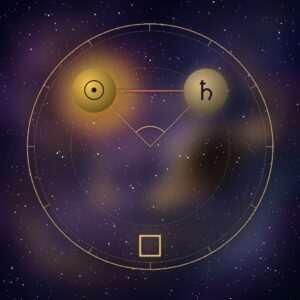
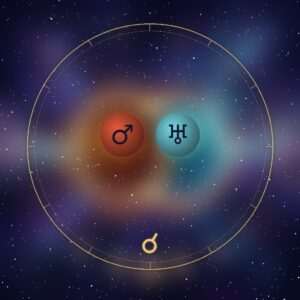

Most guides read Mercury in the 7th house as the mind that thinks best in a pair. You talk things out. You sign deals. You look for a partner who can keep up with you. That reading is fine. But it skips the part of the placement that you can check on a clock.
Mercury in the 7th house means Mercury was low in the west when you were born, close to setting. Since Mercury never strays far from the Sun, that puts the birth in the late afternoon or early evening. Many pages add that this is the “evening star” placement, with Mercury shining after sunset. We tested that idea on US births. It holds for only one chart in five.
We built US charts for 1940 to 2030, every ten minutes of the day, and weighted them by the real hours of every US birth in 2024. This guide gives the count and the method. Then it turns to what the old and new books say about a mind that sits at the setting point.
The 7th house, in plain words
Your birth chart is a map of the sky at the minute you were born. Astrologers cut that map into twelve slices called houses. Each house covers one field of life.
The 7th house covers the person in front of you. Marriage lives here. So do business partners, signed contracts, lawsuits and the rival you can name. Our guide to the 7th house and its open enemy explains why the spouse and the rival share one room.
Mercury is the planet of the mind at work. It rules speech, reading, trade and deals. In the old books it is the scribe, the clerk and the go-between. Put it in the 7th house and the mind does its work across a table, with one other person.
Where Mercury sits in the sky
The houses are tied to the ground under your feet, not to the stars. The 1st house starts at the east edge of the sky, where things rise. The 7th house starts at the west edge, where things set. Astrologers call that point the Descendant, which means the setting point.
Here is the detail most guides skip. The 7th house is the band of sky just above the west edge, not below it. The sky turns from east to west. A planet climbs in the east, crosses the top of the sky, then sinks through the 9th, the 8th and the 7th. The 7th is the last stretch before it sets.
So Mercury in the 7th house means Mercury had not set yet. It was on its way down, and it would drop below the west edge within about two hours.
The Sun follows the same rule each day, and our guide to the Sun in the 7th house shows its window moving from 3 p.m. in December to 7 p.m. in June. Mars is looser, since it can sit anywhere around the Sun. Our guide to Mars in the 7th house finds it most likely at 6 p.m. and least likely at dawn.
Evening star or morning star
Seen from Earth, Mercury never gets more than 28 degrees from the Sun. That angle is called the elongation, which just means the gap between the two as we see them. Our guide to Mercury in the 8th house measured the widest gap over 800 years: 27.8 degrees.
Mercury can sit on either side of the Sun. When it sits east of the Sun, it sets after the Sun. You can look for it low in the west after sunset. That is an evening star. When it sits west of the Sun, it rises and sets before the Sun. You can look for it low in the east before dawn. That is a morning star.
Now apply this to the 7th house.
- An evening star sets after the Sun. So it reaches the 7th house late, near or after sunset. Some of these births fall after the Sun has gone down.
- A morning star sets before the Sun. So it reaches the 7th house early, in the middle of the afternoon. The Sun is still up, higher in the sky, in the 8th house or the 7th.
So the two kinds of Mercury in the 7th house belong to two different parts of the day. That split is the heart of this guide.
Three real days in New York
To make this concrete, we worked out the exact Placidus window for a birth in New York City on three days of 2026. Placidus is the house method most US apps use. We checked the house of Mercury every thirty seconds with the Swiss Ephemeris, the planet tables many chart apps use. Times are New York clock time.
| Date in 2026 | Kind of Mercury | Mercury in the 7th house | Sunset. |
|---|---|---|---|
| April 3 | Morning star, 28 degrees west of the Sun | 3:04 to 4:58 p.m. EDT | 7:23 p.m. EDT. |
| June 15 | Evening star, 24 degrees east of the Sun | 7:37 to 10:04 p.m. EDT | 8:29 p.m. EDT. |
| November 20 | Morning star, 20 degrees west of the Sun | 1:49 to 3:32 p.m. EST | 4:34 p.m. EST. |
EDT is summer clock time and EST is winter clock time. On April 3, Mercury had set more than two hours before the Sun did. A baby born at 3:30 p.m. that day has Mercury in the 7th house in full daylight. On June 15, the window starts before sunset and runs well into the dark. On November 20, it ends at 3:32 p.m., an hour before sunset.
The same placement can mean a 2 p.m. birth or a 10 p.m. birth. The kind of Mercury decides which.
What hour of the day gives it
We then asked a plain question. Of all US babies born in a given clock hour, how many have Mercury in the 7th house? Clock time is the legal local time on the birth record, with summer time when it applied.
| Clock hour of birth | Placidus houses | Whole sign houses. |
|---|---|---|
| Before 1 p.m. | none at all | almost none. |
| 1 p.m. to 2 p.m. | 1.2 percent | 0.7 percent. |
| 2 p.m. to 3 p.m. | 10.7 percent | 5.2 percent. |
| 3 p.m. to 4 p.m. | 20.9 percent | 14.5 percent. |
| 4 p.m. to 5 p.m. | 31.3 percent | 24.5 percent. |
| 5 p.m. to 6 p.m. | 41.3 percent | 32.7 percent. |
| 6 p.m. to 7 p.m. | 39.0 percent | 37.1 percent. |
| 7 p.m. to 8 p.m. | 29.9 percent | 34.5 percent. |
| 8 p.m. to 9 p.m. | 17.6 percent | 26.1 percent. |
| 9 p.m. to 10 p.m. | 6.1 percent | 15.6 percent. |
| 10 p.m. to 11 p.m. | 0.4 percent | 6.0 percent. |
| 11 p.m. to midnight | none at all | 0.9 percent. |
These rows use real 2024 birth hours, but the hour pattern barely moves on an even clock. Read one row to see the scale. A US baby born in the 5 p.m. hour has a 41 percent chance of Mercury in the 7th house under Placidus. A baby born at 10 a.m. has none.
The window is wider than the Sun’s. The Sun sits in the 7th house between 2 p.m. and 9 p.m. on the clock. Mercury stretches that by an hour at each end, from 1 p.m. to 11 p.m. The morning star pulls it earlier and the evening star pulls it later.
The season moves the window
Clock hours hide the season. In winter the Sun sets early, so Mercury sets early too. In summer both set late, and summer time moves the clock one more hour ahead.
In December, US births with Mercury in the 7th house fall between 1 p.m. and 8 p.m. on the clock. The best hour is 3 p.m., at 44 percent. In June, they fall between 3 p.m. and 11 p.m. The best hours are 6 p.m. and 7 p.m., at 52 and 53 percent.
Sun time tells the same story without the clock rules. Sun time is the time the Sun keeps, where noon means the Sun is at its highest. We ran a second grid at 40 degrees north, on a line where the clock matches mean Sun time, with no summer time. There, Mercury in the 7th house runs from about 1 p.m. to 7 p.m. by the Sun in December. It runs from about 3 p.m. to 10 p.m. by the Sun in June.
September is the odd month. Near the fall equinox, the window is short and sharp. At 40 degrees north, a baby born between 5 p.m. and 6 p.m. by the Sun has Mercury in the 7th house 79 percent of the time.
Real US birth hours lift the share
If babies came at the same rate every minute, Mercury would land in the 7th house in 8.26 percent of US charts under Placidus. That is a bit less than one in twelve.
But US babies do not come at an even pace. The National Center for Health Statistics, part of the CDC, puts every US birth record into one public file each year. We used the CDC natality file 2024. It holds 3,638,436 births, and only 666 lack a time of birth. The busiest hour is 8 a.m., the hour of planned C-sections. Births after an induced labor, one started on purpose with drugs, peak in the late afternoon.
So we weighted each chart by the real 2024 birth hours, with the month and the day of the week kept apart.
| Birth hours used | Placidus houses | Whole sign houses. |
|---|---|---|
| Even clock | 8.26 percent | 8.29 percent. |
| Real US hours, 2024 | 8.72 percent | 8.42 percent. |
| Real hours, weekdays only | 8.86 percent | 8.52 percent. |
| Real hours, weekends only | 8.21 percent | 8.05 percent. |
The rise is about 6 percent under Placidus. It matches the Sun. Our Sun in the 7th house guide found 8.79 percent with the same file, and our grid gives the Sun 8.81 percent. The 8th house gains more. Our guide to Mercury in the 8th house found 9.48 percent, because the 8th house holds the busy mid-afternoon hours.
The season shifts too. With an even clock, June births have Mercury in the 7th house 10.0 percent of the time and December births 6.6 percent. With real hours, June has 9.9 percent and December 7.6 percent. The winter window falls in busy working hours, so the hospital clock pulls the two seasons closer.
The hospital clock favors the morning star
This is the count we set out to make. Over 1940 to 2030, Mercury is an evening star on 50.1 percent of days. So if the clock were even, both kinds of Mercury would get the 7th house at close to the same rate. They do: 8.31 percent for the evening star and 8.20 percent for the morning star, under Placidus.
Real birth hours break that tie.
| Kind of Mercury, real 2024 hours | Placidus houses | Whole sign houses. |
|---|---|---|
| Morning star, set before the Sun | 9.08 percent | 9.18 percent. |
| Evening star, set after the Sun | 8.37 percent | 7.68 percent. |
On a US hospital clock, a morning-star Mercury is 8.5 percent more likely than an evening-star Mercury to sit in the 7th house under Placidus. Under whole sign houses the gap grows to 20 percent.
The reason is the hour. A morning star reaches the 7th house in the afternoon, when induced births peak. An evening star reaches it in the evening, when the wards grow quiet. Under whole sign houses the evening window runs later still, up to 11 p.m., so the gap is wider.
This is the mirror image of the 12th house. Our guide to Mercury in the 12th house found a 44 percent edge for evening stars in that house. There, the evening star rises later in the morning, during the busy hours. The same hospital clock picks a different winner at each edge of the sky.
Is it a Mercury you could see after sunset?
Here is the test of the evening star idea. Take every US chart with Mercury in the 7th house under Placidus, with real 2024 hours. Where is the Sun?
| Place of the Sun | Share of these charts | What the sky looked like. |
|---|---|---|
| In the 8th house, still well up | 26.5 percent | Mercury is a morning star, in full daylight. |
| In the 7th house, with Mercury | 51.8 percent | The Sun is low in the west and still up. |
| In the 6th house, just set | 21.3 percent | Mercury is an evening star over a darkening sky. |
| Anywhere else | 0.4 percent | Almost never. |
So the Sun had set in only about one of these charts in five. Just 9.8 percent were born after the Sun had dropped 6 degrees below the skyline. That is the point when street lights come on and the first bright stars show. Only 2.4 percent came after the Sun was 12 degrees down, when the sky is close to dark.
So most people with Mercury in the 7th house were born under a Sun that was still up. Mercury was in the sky, but lost in the glare. The evening star you could point at is a small slice of this placement.
Whole sign houses give a different picture. There the Sun had set in 46 percent of these charts. The reason is that whole sign houses keep the 7th house open well after dark, as the next section shows.
Close to the Sun is not always burned
Old astrology has a word for a planet too close to the Sun. It is combust, which means burned. William Lilly, in Christian Astrology in 1647, calls a planet combust when it is within 8.5 degrees of the Sun.
The Sun shares the 7th house with Mercury in about half these charts. But sharing a house is not the same as being close. Among US charts with Mercury in the 7th house, 25 percent have it within 8.5 degrees of the Sun. So three in four are not combust by Lilly’s rule. Check the degrees, not just the house.
Two house systems, two answers
You have seen two columns in the tables. Here is why. Whole sign houses make each house one full sign, starting with the sign that was rising at your birth. Placidus houses cut the sky by time, so each house holds the stretch of sky that passes in a set share of the day.
Whole sign is the oldest method on record. Chris Brennan, in his book Hellenistic Astrology, argues it was the standard method of the Greek authors. Placidus came in the 1600s and now fills most US chart apps.
Under Placidus, the 7th house ends where the path of the planets meets the west skyline. So Mercury there is above the skyline, or within a hair of it. Under whole sign houses, the 7th house is a whole sign, and part of that sign can already be below the skyline. So an app using whole sign houses can put a set Mercury in your 7th house. That is why the whole sign column runs to 11 p.m. If one app shows Mercury in your 7th house and another shows it in your 6th, neither app is broken. They use two rules.
What the old books say
The Greek writers gave each planet a house where it was glad to be. They called it the planet’s joy. Mercury’s joy is the 1st house, the house of the self. Firmicus Maternus and Paulus of Alexandria both list it there.
The 7th house is the exact opposite of the 1st. So Mercury in the 7th house stands across the chart from its joy. It looks back at the self from the other side of the table. The Greeks called the setting point the Dysis, and they read the four angles of the chart as the strong places.
Vettius Valens, in his Anthologies, files marriage and the wife under the setting place. Ptolemy, in the Tetrabiblos, says Mercury takes on the nature of the planets it meets. On its own it is neither good nor bad. When he judges the quality of the mind, he looks at Mercury and asks if it rose before or after the Sun.
William Lilly keeps score with points. He gives four points to a planet in the 7th house. Only the 1st and the 10th score more, with five. He also scores the two kinds of Mercury. An evening-star Mercury, which he calls occidental, gains two points. A morning-star Mercury, which he calls oriental, loses two.
Put that next to our count, and there is an irony. Lilly prefers the evening star. The US hospital clock hands out more of the morning star. By Lilly’s score, the most common Mercury in the 7th house is the weaker one.
Lilly gives Mercury the clerks, the lawyers, the merchants and the men of letters. He gives the 7th house marriage, contracts, lawsuits and open enemies. Put the two lists side by side, and the old reading is plain. Mercury in the 7th house is the one who drafts the deal and argues the case.
What modern writers add
The modern reading turned the 7th house into a mirror. Liz Greene draws on Carl Jung and the idea of projection. We hand the traits we will not own in ourselves to other people, then meet them there. With Mercury in the 7th house, the trait handed over is the voice. You find the clever partner, and you let them talk.
Stephen Arroyo reads Mercury as the way you take in facts and pass them on. In the 7th house, you learn best through dialogue. Robert Hand reads houses as fields of life where a planet acts. Mercury in the field of partners acts through talk, trade and terms.
Demetra George and Chris Brennan have done the most to bring the Greek sources back into English. Their work reads the houses first as real topics: the actual spouse, the actual contract. A good reading today holds both the old and the new.
What it looks like in a life
This is where the count stops and the reading starts. We give it as the tradition gives it, not as a forecast.
- You think out loud. Your best ideas come in the middle of a talk, not alone at a desk.
- You want a partner you can talk with. A quiet match leaves you restless. Wit counts as much as looks.
- Deals are home ground. You read the terms, you haggle well, and you like the moment both sides shake hands.
- You speak for others. Agents, lawyers, brokers and go-betweens fit this shape.
- The risk is to let the other voice lead. You can give up your view too fast to keep the peace. The work is to hold your own view in the room.
The two kinds of Mercury add a shade. A morning star sets first and leaves the Sun behind in the 8th or the 7th. Here the mind runs ahead of the self. You name the deal before you know what you want from it. An evening star sets after the Sun. Here the mind trails the self and has the last word. That split is an old idea, and the chart shows which one you have.
Next door: the 6th and the 8th house
A shift of an hour can move Mercury one room over. So it helps to know the rooms on each side.
Earlier in the day, Mercury sits higher, in the 8th house, with the fine print of shared money and trust. After it sets, it drops into the 6th house. Our guide to Mercury in the sixth house follows the same mind into daily work and health.
Is your Mercury in the 7th? A quick check
You can rule it out in ten seconds. Look at your birth time.
Born in the US before 1 p.m. on the clock? Then Mercury is not in your 7th house under Placidus. Born between 4 p.m. and 8 p.m.? The odds run from about one in three to two in five. Born between 8 p.m. and 11 p.m.? Check both house systems, since this is where they part ways.
For a real answer, you need your birth time to the minute and your birth town. Then check which house system your app uses, and where your Sun sits. If the Sun is in your 8th house, your Mercury is a morning star. If it is in your 6th, it is an evening star.
How we measured it
A number you cannot repeat is worth nothing. So here is the full method.
Route one, a grid. Dates: every 11th day from January 1, 1940 to December 31, 2030. We picked a step of 11 days so the grid does not land on the same weekday each time. Hours: every ten minutes of local clock time. Places: the 40 largest US metro areas, from New York to Milwaukee, weighted by their 2020 census count. Each clock time was turned into world time with the real time zone rules of that city and year, with war time and summer time included.
The Sun and Mercury came from the Swiss Ephemeris, in the tropical zodiac used in the US. We used the same house code as our Mercury in the 8th house guide. It was checked against the Swiss Ephemeris house routine on 3,000 random charts. The Sun time grid used every day at one place, 40 degrees north and 75 degrees west, on a clock set to mean Sun time.
Birth hours: either an even clock, or each ten minutes weighted by its share of 2024 births in the CDC file, for each month and day of the week. We used the 2024 pattern for every year. Planned births were far rarer in the 1960s. For older readers, the true share sits between the even clock value and the 2024 value.
Route two, a random draw. We cast 200,000 charts one by one with the Swiss Ephemeris house routine, using a known random number tool with a fixed seed. Places came from every US county, weighted by head count. It gave 8.74 percent under Placidus, give or take 0.06, and 8.37 percent under whole sign houses. It gave the same split for the Sun: 52.0 percent of these charts had the Sun in the 7th house as well. A second draw on an even clock gave 8.33 percent.
The New York windows came from a third route: a scan every thirty seconds, with the house of each planet taken straight from the Swiss Ephemeris.
Questions people ask
How common is Mercury in the 7th house?
On an even clock, 8.26 percent of US charts under Placidus, a bit less than one in twelve. With real US birth hours from 2024, it rises to 8.72 percent under Placidus and 8.42 percent under whole sign houses.
What time of day gives Mercury in the 7th house?
The late afternoon and early evening. Under Placidus, US births with this placement fall between 1 p.m. and 11 p.m. on the clock. The odds peak in the 5 p.m. hour, at 41 percent. In December the window runs from 1 p.m. to 8 p.m. In June it runs from 3 p.m. to 11 p.m.
Is Mercury in the 7th house an evening star?
About half the time. With real US birth hours, 48 percent of these charts have an evening star and 52 percent a morning star. The Sun had already set in only 21 percent of them under Placidus.
If Mercury is in my 7th house, where is my Sun?
In the 7th house too, about half the time: 51.8 percent under Placidus. Otherwise it sits one room away. It is in the 8th house in 26.5 percent of cases and in the 6th house in 21.3 percent.
Is Mercury in the 7th house combust?
Not most of the time. William Lilly calls a planet combust within 8.5 degrees of the Sun. About one in four US charts with Mercury in the 7th house meets that rule.
Is Mercury in the 7th house a good placement?
In the old score books, the house is strong. Lilly gives a planet in the 7th house four points, one short of the best seats. He adds two points for an evening-star Mercury and takes two away for a morning star. Modern writers read a mind that works best in dialogue.
Your own chart, read properly
Everything above is general. Your chart is not. Your Mercury sits in one sign, in one house, on one side of your Sun, and the reading changes with each.
Astrovision builds that reading from your birth date, hour and town. It comes as a written guide and a personal podcast. Same chart, two formats, and every term explained.