

A birth chart looks vague until you meet the degrees. Then it turns sharp. A degree is a number that pins a planet to one exact spot on the wheel. It is the finest measure the whole craft owns.
And here is the twist. That fine measure rests on your birth time. Most people know their birth time to the nearest five or ten minutes. Some know it to the nearest hour. We ran the numbers on that gap, and they are worth seeing before you read a single degree.
What a degree is, in plain words
The zodiac is a circle. A circle has 360 degrees. There are twelve signs. So each sign gets exactly 30 of them, numbered 0 through 29.
Think of a street with twelve blocks. Each block has thirty houses. The sign is the block. The degree is the house number.
Chart software writes it like this: 18°25′ Sagittarius. The first number is the degree, or house number. The little mark after the second number stands for arcminutes. There are 60 arcminutes in one degree. So 18°25′ means you are past the 18th house and a bit down the street.
One useful habit: the count starts at zero, not one. A planet at 0° Leo has just walked into Leo. A planet at 29° Leo is about to walk out.
How fast each thing moves — measured, not guessed
We ran a script against the astronomy-engine library, which is a standard tool for planet positions, and checked it against the Swiss Ephemeris. We stepped through the 800 years from 1600 to 2400, one day at a time, and read how far each planet moves in an hour. Then we averaged the shifts.
Here is what came back, in degrees per hour of birth time:
- Rising sign point: about 15° per hour. That is one degree every four minutes.
- Moon: 0.55° per hour. One degree takes just under two hours.
- Mercury: 0.05° per hour.
- Sun: 0.04° per hour. One degree takes a full day.
- Venus: 0.04°. Mars: 0.02°. Jupiter: 0.006°. Saturn: 0.003°.
The rising sign point is the one to watch. Astrologers call it the ascendant: the exact spot climbing over the eastern skyline at the moment of your birth. The Earth spins. So that spot races round the whole wheel once a day.
Its pace is not steady, though. We logged the pace for US births, counted the way we describe below. The middle value was 12.9° per hour. One birth in ten ran slower than 11.7°, and one in ten ran faster than 22.1°. Where you were born changes it, because the tilt of the sky changes with how far north or south you are.
How much birth time error it takes to break a degree
This is the part nobody puts a number on. We counted every day of US births from 1950 to 2009, weighted by where people live and by the real hours babies are born (CDC birth records). A second, separate engine gave the same figures. Then we moved each birth time a little earlier and a little later, and looked at what changed.
With a birth time that could be off by ten minutes either way:
- The rising degree changed in 100 charts out of 100.
- The rising sign itself changed in 17 charts out of 100.
- The Moon’s degree changed in 18 charts out of 100.
- The degree of one of the eight planets changed in 4 charts out of 100. The Sun’s degree changed in 1.
Widen the error and it gets worse. Off by a quarter of an hour either way, the rising sign is in doubt in 25 charts out of 100. Off by half an hour, it is in doubt in 50. That is a coin toss. Off by a full hour, it is in doubt in 89.
So a birth time rounded to the nearest hour, which is what many old records give, tells you almost nothing about your rising degree. It barely tells you your rising sign.
How close is the average chart to a border?
A planet near the edge of a sign is the fragile case. Nudge it and it lands in a new sign, with a new meaning. We counted how common that is.
On the same US births, we checked the Sun, the Moon and the eight planets, plus the rising point. We flagged any that sat within one degree of a sign border, meaning below 1° or at 29° and above.
The result: 53.5 percent of charts had at least one such placement. More than half. Broken out, the Sun sat that close in 6.7 charts out of 100, the Moon in 6.7, and the rising point in 6.7.
Read that again. In over half of all charts, one piece of the picture is one degree away from changing sign. That is the single best reason to hunt down your real birth certificate.
A real chart, checked against a known record
Numbers need a test case. Diana, Princess of Wales, was born on 1 July 1961 at 19:45 British Summer Time in Sandringham, England. Astro-Databank, the birth data archive run by Astrodienst, rates that record as firm.
Our script gives Sun 9°40′ Cancer, Moon 25°02′ Aquarius, Mercury 3°12′ Cancer, Venus 24°24′ Taurus, Mars 1°39′ Virgo, Saturn 27°49′ Capricorn, and a rising point at 18°25′ Sagittarius. Those match the figures published for that chart, which is how we know the script is sound.
Now shift her birth time by ten minutes each way. The rising point runs from 16°25′ to 20°27′ Sagittarius. Four degrees, from a ten minute wobble. Her sign holds, because she was born mid-sign. Someone born at 29°50′ would not be so lucky.
Reading your own degrees, step by step
You need three things: birth date, birth time, and birth place. Then follow this order.
- Grade your birth time first. From a birth record: strong. From a parent’s memory: shaky. Rounded to the hour: treat the rising degree as a guess.
- Read the sign, then the degree. Sign first, always. The degree adds detail to a picture the sign already drew.
- Check the borders. Scan for anything below 1° or above 28°. Those are the placements a bad birth time can steal from you.
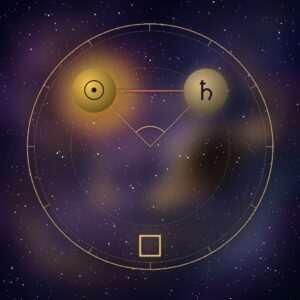
- Compare degrees across planets. Two planets at the same degree number in different signs are linked. That link is called an aspect: a fixed angle between two planets that ties their stories together.
Aspects are where degrees earn their keep. Your Sun at 9° Cancer and a friend’s Moon at 9° Capricorn sit exactly opposite. Astrologers do not eyeball that. They count degrees.
The first degree and the last degree
Two degrees carry more weight than the rest: 0° and 29°.
A planet at 0° has just crossed in. The old word for that crossing is an ingress. The energy reads as raw and new, with nothing learned yet.
The last degree has its own name: the anaretic degree, from a Greek root meaning to destroy or to finish. A planet there is on the doorstep. The reading turns to urgency, to a lesson being closed out. We treat that one at length in our guide to the anaretic degree and its role in your chart.
Notice the trap. Both of these degrees are exactly the ones a wrong birth time destroys. A rising point at 29°30′ Leo becomes 0°30′ Virgo with a two minute error.
Critical degrees, and what they rest on
Some astrologers flag a fixed list of degrees as loaded. The usual list runs: 0°, 13° and 26° for the cardinal signs, 8° to 9° and 21° to 22° for the fixed signs, 4° and 17° for the mutable signs.
Where does that list come from? Not from thin air. It traces back to the lunar mansions, a very old scheme that cuts the zodiac into 28 slices of about 12°51′ each, one for each day of the Moon’s circuit. The listed degrees are roughly where those slices begin. Arabic and later European astrologers carried the scheme forward, and William Lilly wrote about the Moon’s mansions in Christian Astrology in 1647.
Modern astrologers argue about whether the list still earns its place. That debate is worth having, and we lay both sides out in our guide to critical degrees and how to use them.
Decans: the ten degree slices
There is an older and better grounded way to split a sign. Cut each sign into three slices of ten degrees. Each slice gets its own ruling planet. These are the decans, and they reach back to ancient Egypt, where 36 star groups marked the hours of the night.
Vettius Valens, a Greek astrologer writing in the second century, used them. So did Ptolemy in his Tetrabiblos. Two thousand years of use is a stronger claim than most degree systems can make. Our full guide covers the astrological decans and what each one means.
Degree theory: newer than it sounds
Search for degree meanings online and you will hit “degree theory”. The idea: each degree number carries the flavour of a sign. Degree 1 is Aries, degree 2 is Taurus, and so on round the wheel. A planet at 8° Cancer picks up a whiff of Scorpio, because 8 is the eighth sign.
Be clear about its age. This scheme is credited to Nikola Stojanovic, a Serbian astrologer, and it spread through video and social posts in the last decade or two. It is not ancient. Ptolemy does not mention it. Valens does not mention it. Lilly does not mention it.
That does not make it useless. It makes it young. Weigh it as such.
What the named sources actually say
Degrees are not a modern add-on. Ptolemy set out planet strengths by exact degree in the Tetrabiblos, written around 150 AD. He gave each planet a degree of best strength, called its exaltation, such as the Sun at 19° Aries.
Vettius Valens, in his Anthologies, worked with degree-based time methods to date events in a life. William Lilly, the English astrologer of 1647, judged questions by counting degrees between planets down to the arcminute.
Among living writers, Robert Hand has argued at length that exact contacts matter more than loose ones. Demetra George brought the older Greek degree methods back into English use. Chris Brennan traced the whole history in his book Hellenistic Astrology. Liz Greene reads the same placements through a mind-focused lens, where an exact contact marks a theme a person cannot dodge.
None of that is proof. Astrology is a symbolic tradition, not a science, and we will not dress it up as one. It is a record of what careful readers have done with degrees for two thousand years.
What to do if your birth time is shaky
Our numbers say you should care. Here is the order we suggest.
- Get the record. In most of the United States, the state health department holds a long form birth certificate with the time on it. That beats any memory.
- Fall back on the Sun. The Sun moves one degree a day. An hour of doubt either way changes its degree in only 8 charts out of 100.
- Treat the Moon with care. Two hours per degree is forgiving, but a Moon near a border needs a real time.
- Park the rising degree. With no solid time, read your rising sign as a maybe and skip the degree.
- Look into rectification. An astrologer works backwards from dated life events to narrow the birth time. It is slow work, and it is the only route left when no record exists.
Your rising sign is one third of what people call the big three. If it is uncertain, so is that whole reading. Our guide to the big three: Sun, Moon and rising sign covers what rests on it.
The honest summary
Degrees give a chart its edge. They turn “Sun in Cancer” into “Sun at 9°40′ Cancer”, and that extra detail drives aspects, timing and the fine reading of a placement.
They also expose the weakest link in the whole chain. Half of all charts hold a placement within one degree of a border. Half an hour of doubt either way leaves the rising sign in doubt half the time.
The right move is not to drop degrees. It is to know which of yours you can trust. The Sun, always. The slow planets, always. The Moon, with a decent time. The rising point, only with a real record.
Common questions about astrological degrees
What do degrees mean in astrology?
A degree is the exact spot of a planet inside a sign, from 0 to 29. It pins the planet down to the nearest thirtieth of a sign, which lets an astrologer measure angles between planets and time events.
How do I read degrees in my birth chart?
Look for a number and a small circle next to each planet, like 18°25′. Read the sign first, then the degree. Then scan for anything below 1° or above 28°, since those sit near a border.
What are critical degrees in astrology?
They are a traditional list of loaded degrees: 0, 13 and 26 for cardinal signs, 8 to 9 and 21 to 22 for fixed signs, 4 and 17 for mutable signs. The list traces back to the lunar mansions, an old 28-part split of the zodiac.
What is the 29th degree?
It is the anaretic degree, the last full degree of a sign. A planet there is on the way out. Astrologers read it as urgent and unfinished.
How exact does my birth time need to be?
Our count of US births from 1950 to 2009 says ten minutes of doubt either way changes the rising degree every time and the rising sign 17 times out of 100. An hour of doubt either way changes the rising sign 89 times out of 100. For a usable rising degree, aim for a birth record.
Does the Sun degree change during the day?
Barely. The Sun moves about 0.04 degrees an hour, so a whole degree takes a day. Even with an hour of doubt either way, your Sun degree changes in only 8 charts out of 100.
Are degree meanings from ancient astrology?
Some are. Exaltation degrees come from Ptolemy, and decans reach back to Egypt. The “degree theory” that maps each degree number to a sign is credited to Nikola Stojanovic and is recent by comparison.
See your own degrees
Astrovision builds a full natal chart from your date, time and place, then reads every degree in it for you. You get a written guide and a personal audio version of it, in plain words with no jargon left standing. Start with your own chart.