


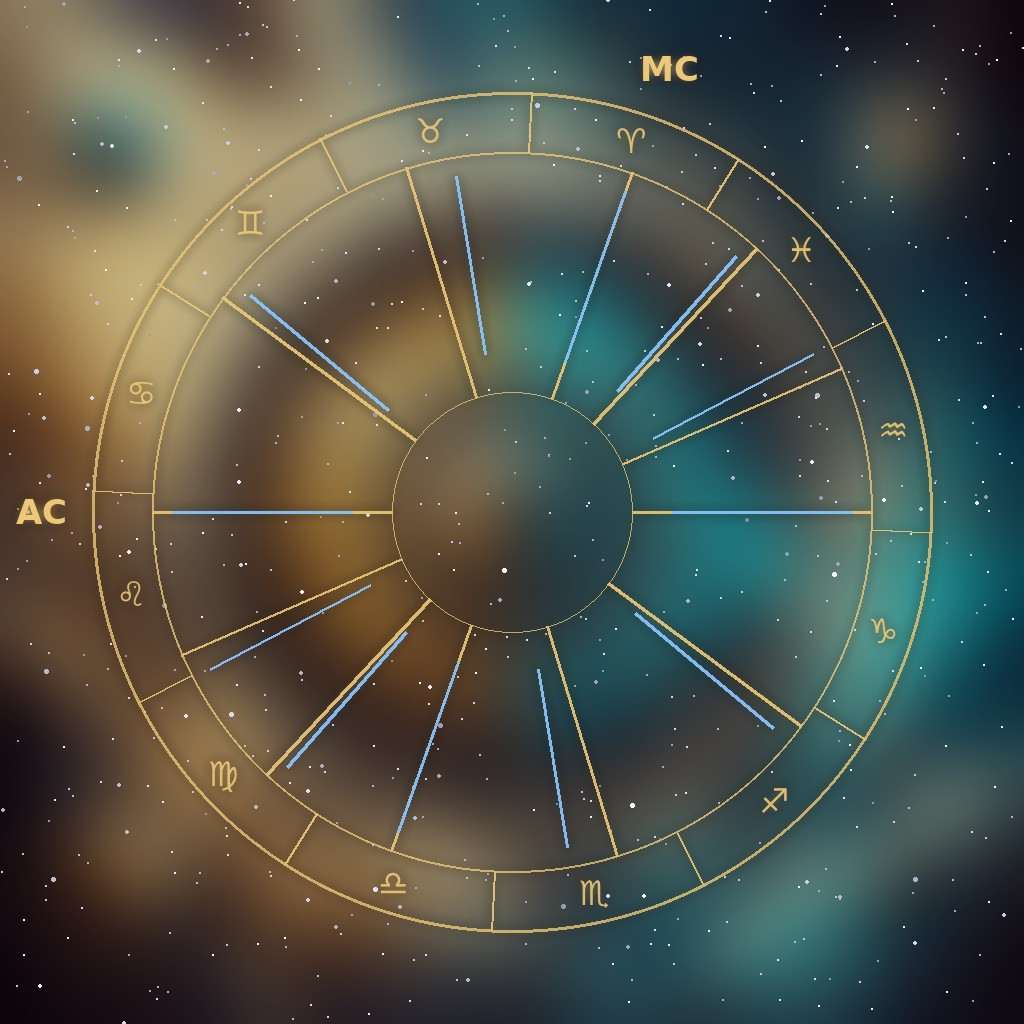
The Porphyry house system takes each quarter of your birth chart and cuts it into three equal parts. The Campanus house system cuts the sky above you into twelve equal slices instead, then maps them onto the zodiac. Both keep your Ascendant and Midheaven in the same place as Placidus, but they move about 1 planet in 11 (Porphyry) and 1 in 8 (Campanus) into a neighboring house.
Those two numbers come from our own test on 120,000 charts cast for 16 US cities. Below, you will see how each system works in plain words, where it came from, and when the choice of system changes a reading.
What the Porphyry house system means in astrology
Think of your birth chart as a house with twelve rooms. Each room is a house, and each one covers an area of life. The planets are the furniture. A house system is simply the rule that decides where each wall stands. The wall between two rooms is called a cusp.
Four walls are fixed by the sky itself. The Ascendant is the point of the zodiac rising on the eastern horizon at your birth. It starts the 1st house. The Midheaven, or MC, is the highest point the zodiac reaches overhead. It starts the 10th house. Their opposite points start the 7th and 4th houses. The 4th house point is called the IC.
These four points split the chart into four quarters. Astrologers call each quarter a quadrant. Porphyry, Placidus, Koch and Campanus all keep these four walls. They only disagree on the eight walls inside the quarters.
The Porphyry answer is the simplest one. Measure each quarter along the zodiac. Divide it by three. Put a wall at each third. That is all there is to it. So when people search for the meaning of Porphyry in astrology, the short answer is this: equal thirds inside each quarter of the chart.
How Porphyry cuts the chart, step by step
You can do it by hand with a pencil. You only need the degree of the Ascendant and of the MC.
- Find the arc from the Ascendant down to the IC, counted forward through the signs. This is the first quarter: houses 1, 2 and 3.
- Divide that arc by three. Add one third to the Ascendant to get the 2nd cusp. Add two thirds to get the 3rd cusp.
- Do the same from the IC to the Descendant for houses 4, 5 and 6.
- The other half of the chart mirrors the first. The 8th cusp sits opposite the 2nd, the 9th opposite the 3rd, and so on.
Here is a real example. For a chart cast in New York on March 15, 1985, at 9:30 a.m. local time (14:30 UTC), the Ascendant is 8°24′ Gemini and the IC is 14°09′ Leo. The arc between them is 65°45′. One third of that is 21°55′. So Porphyry puts the 2nd cusp at 0°19′ Cancer and the 3rd cusp at 22°14′ Cancer. Each of the three rooms is the same size.
The zodiac belt that all these degrees are measured on is called the ecliptic. It is the path the Sun seems to trace across the sky over a year. Porphyry works only on that belt. It never asks how fast each degree rises or how high it climbs.
The Campanus house system: cutting the sky, not the zodiac
Campanus starts from a different circle. Picture a great arc that runs from the east point of your horizon, straight up through the point right above your head, and down to the west point. Astrologers call it the prime vertical.
Campanus cuts that arc into equal slices of 30 degrees. Then it draws a line from the north point of the horizon, through each mark, to the south point. Picture the segments of an orange, all joined at the north and south. Where each line crosses the zodiac belt, you get a cusp.
So the slices are equal in the sky, around you and the place you were born. They are not equal on the zodiac. That is why a Campanus chart can show one tiny house next to a huge one. In our sample, the smallest Campanus house was 10.4 degrees wide and the largest was 72.8 degrees wide. Porphyry stayed between 19.6 and 40.4 degrees. Placidus fell between 17.2 and 54.9 degrees.
For the same 1985 chart, Campanus puts the 2nd cusp at 9°59′ Cancer and the 3rd at 28°17′ Cancer. Compare that with Porphyry’s 0°19′ and 22°14′ Cancer. Same birth, same sky, but the walls stand several degrees apart.
Who made these systems? A short history
Neither system was invented by the man whose name it carries. That is a common story in astrology.
Porphyry of Tyre was a Greek philosopher of the 3rd century AD. He wrote an introduction to the astrology of Ptolemy, and later writers tied the quarter-into-thirds method to his name. Yet the method is older. Vettius Valens describes it in his Anthology in the 2nd century AD. He credits it to an earlier source he calls Orion, of whom nothing else is known. Valens belongs to the Hellenistic tradition. That is the Greek-speaking astrologers whose work, from roughly 100 BC to 600 AD, is where Western astrology begins.
Campanus of Novara lived from about 1220 to 1296. He was an Italian mathematician who worked for the papal court. The method was later linked to his name. But the historian John North showed in 1986 that al-Biruni, a Persian scholar of the 11th century, had already described the prime vertical method. So it reached Europe from the Islamic world, not the other way round.
Today both systems are niche choices. Most US software opens on Placidus by default. Some modern astrologers came back to Porphyry because it is the oldest quadrant method on record. Others prefer Campanus because it is built on the real sky above the birthplace.
We tested 120,000 charts: how many planets change houses?
Most articles say these systems give different results. Few say by how much. So we measured it.
Our method was simple. We drew 120,000 moments at random between 1950 and 2010. Each one was paired with one of 16 large US cities, from Miami to Seattle. For each chart we placed the ten planets, from the Sun out to Pluto. Then we put each planet in its house three times: with Placidus, with Porphyry and with Campanus. All positions come from the Swiss Ephemeris, in the tropical zodiac, with times in UTC.
To check the math, we rebuilt both systems ourselves from the raw sky data. Our own Porphyry and Campanus cusps matched the Swiss Ephemeris to well under a thousandth of a degree in every case we tested.
| Compared with Placidus | Porphyry | Campanus |
|---|---|---|
| Planets that change house. | 9.4 percent, about 1 in 11. | 12.8 percent, about 1 in 8. |
| Charts with at least one planet moved. | 58.6 percent of charts. | 70.0 percent of charts. |
| Mean gap at the 2nd cusp. | 4.4 degrees. | 6.1 degrees. |
| Mean gap at the 3rd cusp. | 4.1 degrees. | 5.4 degrees. |
| Mean gap at the 11th cusp. | 4.1 degrees. | 5.4 degrees. |
| Mean gap at the 12th cusp. | 4.3 degrees. | 6.1 degrees. |
| Largest gap seen at any of these cusps. | 18.1 degrees. | 18.0 degrees. |
Three things stand out.
First, a moved planet never jumps far. In all 120,000 charts, each planet that changed house moved to the very next house, never two houses away. A planet in the 11th with Placidus lands in the 10th or the 12th with the other systems, nothing more.
Second, no planet is safe. Each one changed house in roughly 8 to 10 percent of charts with Porphyry, and close to 13 percent with Campanus. The Sun moves just as much as the Moon.
Third, more than half of all charts have at least one planet that changes rooms. If you switch systems, odds are something in your chart will move.
One real chart, three house systems
Numbers are easier to feel with a single chart. Here is the same New York chart from March 15, 1985. The 1st, 4th, 7th and 10th cusps are the same in all three systems. Only the walls in between move.
| Cusp | Placidus | Porphyry | Campanus |
|---|---|---|---|
| 2nd house. | 1°07′ Cancer. | 0°19′ Cancer. | 9°59′ Cancer. |
| 3rd house. | 21°33′ Cancer. | 22°14′ Cancer. | 28°17′ Cancer. |
| 5th house. | 13°26′ Virgo. | 22°14′ Virgo. | 5°03′ Virgo. |
| 6th house. | 23°44′ Libra. | 0°19′ Scorpio. | 14°22′ Libra. |
| 11th house. | 13°26′ Pisces. | 22°14′ Pisces. | 5°03′ Pisces. |
| 12th house. | 23°44′ Aries. | 0°19′ Taurus. | 14°22′ Aries. |
Now look at three planets. Venus sits at 22°13′ Aries. With Placidus and Porphyry it is in the 11th house, the house of friends and groups. With Campanus it falls in the 12th, the house of what is hidden. Mars sits at 0°17′ Taurus. With Placidus and Campanus it is in the 12th. With Porphyry it stays in the 11th, by just two minutes of arc. Neptune sits at 3°30′ Capricorn. It is in the 8th with Placidus and Porphyry, and in the 7th with Campanus.
Seven of the ten planets stay put in all three systems. That is the norm. Most of a chart holds still, and a few planets near a wall change rooms.
Why the gap grows as you go north
The city you were born in matters more than the system you pick. Here is the share of charts with at least one moved planet, city by city.
| City and latitude | Porphyry vs Placidus | Campanus vs Placidus |
|---|---|---|
| Miami, 25.8° north. | 44.5 percent of charts. | 44.3 percent of charts. |
| Houston, 29.8° north. | 49.1 percent of charts. | 53.3 percent of charts. |
| New York, 40.7° north. | 64.1 percent of charts. | 79.3 percent of charts. |
| Minneapolis, 45.0° north. | 68.6 percent of charts. | 85.8 percent of charts. |
| Seattle, 47.6° north. | 72.8 percent of charts. | 89.8 percent of charts. |
The mean gap at the 2nd, 3rd, 11th and 12th cusps tells the same story. In Miami it is about 2.8 degrees for Porphyry and 2.6 for Campanus. In Seattle it climbs to 6.1 degrees for Porphyry and 9.7 for Campanus.
Why? Near the tropics, the zodiac rises at a fairly even pace. The four quarters of the chart come out close to the same size, so each system draws its walls in nearly the same places. Farther north, some signs rush up over the horizon while others crawl. The quarters grow lopsided. Each system handles that tilt in its own way, so the walls drift apart.
Beyond the Arctic Circle: where Placidus stops
This is the one place where Porphyry and Campanus have a clear practical edge.
Placidus builds its walls from time. It takes how long each degree of the zodiac needs to climb from the horizon to the top of the sky, and cuts that time into thirds. Above the Arctic Circle, at about 66.6 degrees north, some degrees of the zodiac do not rise or set at all on certain days. There is no climbing time to cut. So Placidus has nothing to work with.
We tested this for October 7, 2026, minute by minute, at the longitude of Tromsø in northern Norway. At 66.5 degrees north, Placidus worked for all 1,440 minutes of the day. At 67 and at 70 degrees north, the Swiss Ephemeris refused Placidus for all 1,440 minutes and fell back to Porphyry instead.
Porphyry always gives an answer, because it only needs the Ascendant and the MC. Campanus also gives twelve cusps at any latitude short of the pole. But at 70 degrees north, on that same day, its twelve houses ran out of normal zodiac order for 263 minutes, about 4 hours and 23 minutes. A chart with houses out of order is hard to read. So if you were born far north, Porphyry is the steadier choice of the two.
Porphyry vs Placidus, Koch, equal and whole sign houses
Each system on this site has its own page. Here is where Porphyry and Campanus sit among them.
- The Placidus house system cuts time, not space. It is the default in most US software, and the baseline for all the numbers above.
- The Koch house system is another time-based method from the 20th century, close in spirit to Placidus.
- Equal houses make every room exactly 30 degrees from the Ascendant. The MC then floats free.
- Whole sign houses make each room exactly one sign. It is the oldest method of all.
Porphyry is the halfway house of the group. Like Placidus, it keeps the MC on the 10th cusp. Like equal houses, it uses plain arithmetic. Campanus is the one most tied to the real sky over the birthplace. For a side-by-side view of every system, see our guide to house systems explained.
How to choose between Porphyry and Campanus
No house system has been shown to be the right one. Astrology is a tradition, not a lab science. The choice comes down to what each method means to you, and to a few practical facts.
- Pick Porphyry if you like an old method with simple math. It is the first quadrant system on record, and it never fails at any latitude.
- Pick Campanus if you want the houses tied to the sky around the birthplace. Expect more planets to change rooms than with Porphyry, and some very unequal houses.
- Stay with Placidus if you want to match most books and apps. Then check Porphyry for any planet within about 5 degrees of a cusp. That is the zone where the systems disagree.
- If you were born above 60 degrees north, look at Porphyry or whole sign houses first. Placidus breaks down past the Arctic Circle, and Campanus gets unstable.
Whatever you choose, keep the birth time exact. On average, the Ascendant moves about one degree every four minutes. A birth time that is off by half an hour shifts every wall in every system, which matters far more than the choice between them.
A good habit is to cast your chart in two systems and list the planets that move. If none move, the debate does not touch you. If one or two move, read them both ways and see which reading fits your life.
Frequently asked questions
What does Porphyry mean in astrology?
Porphyry is a house system. It splits each quarter of the birth chart, between the Ascendant, the MC and their opposite points, into three equal parts along the zodiac. It is named after Porphyry of Tyre, a 3rd-century philosopher, but Vettius Valens described it earlier, in the 2nd century AD.
Is Porphyry better than Placidus?
Neither one has been shown to be better. Porphyry is older and works at every latitude. Placidus is more common in US software. In our test of 120,000 US charts, 9.4 percent of planets changed house between them, and each move was to the next house over.
What is the Campanus house system?
Campanus divides the prime vertical, the circle running from east, through the point overhead, to west, into twelve equal slices. Each slice is then projected onto the zodiac. It is named after Campanus of Novara, a 13th-century mathematician, though al-Biruni described the method earlier.
Does changing house system change my zodiac signs?
No. Your Sun, Moon and planets keep the same signs and degrees. Your Ascendant and MC stay the same too. Only the walls between houses move, so a planet near a wall can shift into the next house.
Which house system works if I was born far north?
Porphyry and whole sign houses work at any latitude. Placidus fails above the Arctic Circle, at about 66.6 degrees north. Campanus still gives cusps there, but in our test at 70 degrees north its houses fell out of normal order for over four hours of one day.
Go deeper with your personal Astrovision report
Reading about astrological concepts is a great start, but nothing compares to hearing how they apply directly to you. Our users love our audio-first approach, calling it “friendly, personal, and easy to understand.” While this article gives you the “what,” a personal report gives you the “so what.” Discover your unique path with an Astrovision report—your personal ‘user manual’ delivered in our celebrated podcast format.