


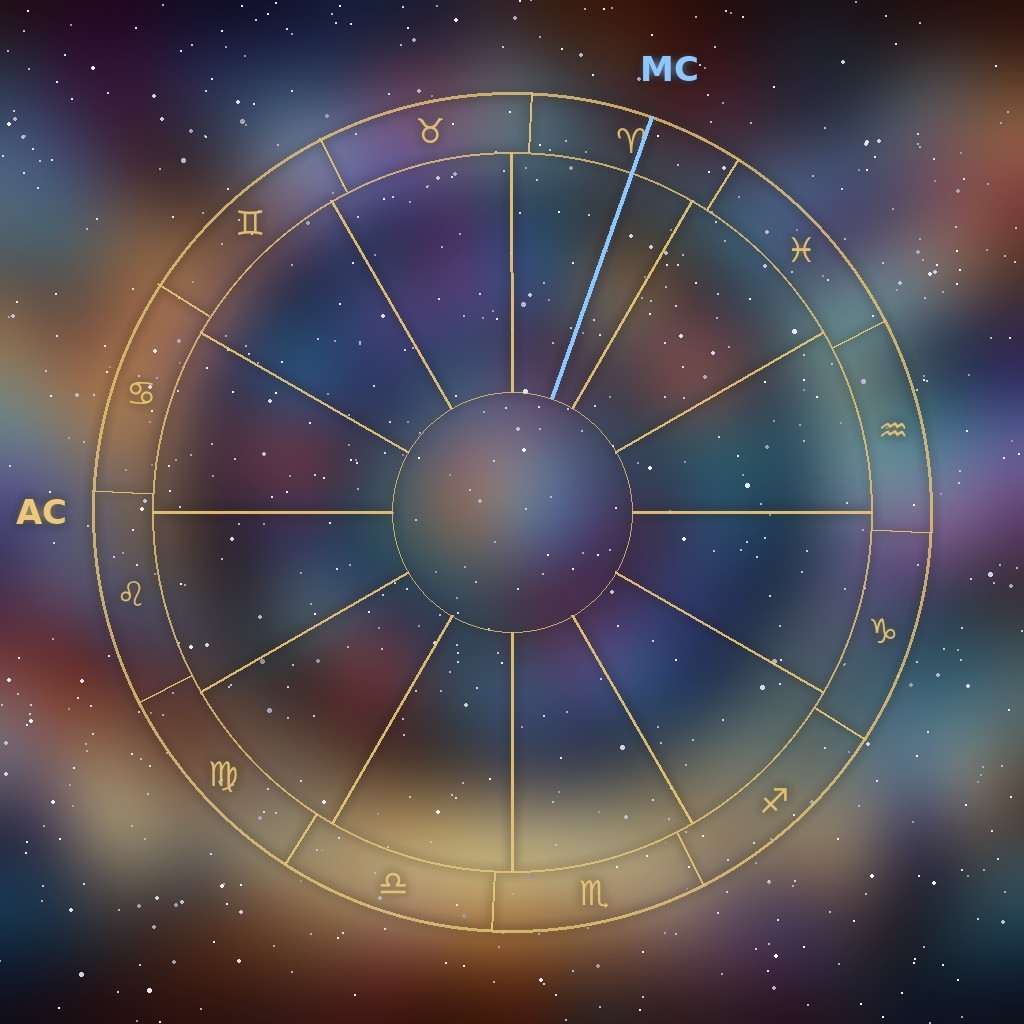
The equal house system in astrology cuts your birth chart into twelve houses of exactly 30 degrees each. The count starts at the exact degree of your Ascendant, the point of the zodiac that was rising in the east when you were born. We checked 120,000 US charts, and the result surprises most readers: in equal houses, the Midheaven sits in the 10th house only about half the time.
This guide shows how equal houses work, how to draw them by hand, and how they compare with whole sign and Placidus houses. Every figure comes from our own calculation, and the method is given in full.
What is the equal house system in astrology?
Think of your chart as a house with twelve rooms. Each room covers one part of life, such as money, home or work. The planets are the furniture. A house system is simply the rule that decides where the walls between the rooms go. Astrologers call each wall a cusp: the line where one house ends and the next begins.
The equal house rule is the simplest one with a fixed start. The first wall goes on the exact degree of the Ascendant. Each next wall goes 30 degrees further along the zodiac. Twelve rooms of 30 degrees make the full circle of 360 degrees. No room is ever bigger than another.
You can draw equal houses yourself in three steps:
- Find the exact degree of your Ascendant. You need your birth date, the exact time and the place. Without the time, there is no Ascendant and no houses.
- Write that degree as the cusp of the 1st house. Say it is 20 degrees of Leo.
- Add 30 degrees for each next house. The 2nd cusp is 20 degrees of Virgo, the 3rd is 20 degrees of Libra, and so on around the wheel.
That is all. Every cusp in an equal house chart shares the same degree number. Only the sign changes. This is why the system is so easy to check by eye.
Is the Midheaven in the 10th house? Only half the time
The Midheaven, or MC, is the highest point the zodiac reaches in your birth sky. Astrologers link it with career and public life. In most house systems you have heard of, such as Placidus, the MC is the cusp of the 10th house by design. In equal houses it is not. The 10th cusp is simply the Ascendant minus 90 degrees, and the MC lives its own life.
Here is what we found. We took 120,000 moments drawn at random between 1950 and 2010. Each moment was placed in one of 16 large US cities, from Miami to Seattle. We computed the Ascendant and the MC with the Swiss Ephemeris, in the tropical zodiac, the zodiac most Western astrologers use. Then we asked in which equal house the MC fell.
| Equal house holding the MC | Share of the 120,000 US charts |
|---|---|
| 8th house | 0.4 percent of charts. |
| 9th house | 49.6 percent of charts. |
| 10th house | 49.6 percent of charts. |
| 11th house | 0.4 percent of charts. |
So the MC lands in the 9th house just as much as in the 10th. A second route gave the same split. We swept the sky in steps of 0.01 degree for each city, with no random draw at all, and got 49.6 percent for each of the two houses.
A rule you can check in five seconds
The split is not random. At US latitudes, it follows the sign of your Ascendant:
- Ascendant in Aries, Taurus, Gemini, Cancer, Leo or Virgo: the MC falls in the 9th equal house.
- Ascendant in Libra, Scorpio, Sagittarius, Capricorn, Aquarius or Pisces: the MC falls in the 10th equal house.
The rare exceptions sit at the edges. With a Gemini or Cancer Ascendant in the far north, the MC can slip back into the 8th. With a Sagittarius or Capricorn Ascendant, it can slip forward into the 11th.
Why does this happen? The MC and the Ascendant are not a fixed 90 degrees apart. The gap stretches and shrinks as the sky turns. In Miami, it ran from about 75 to 105 degrees. In New York, from 65 to 115. In Seattle, from 59 to 121. When the gap is more than 90 degrees, the MC sits before the 10th wall, in the 9th room. When it is less than 90, the MC sits inside the 10th room.
Latitude matters for the rare cases too. In Miami, the MC never left the 9th and 10th houses: 50.2 percent against 49.8 percent. In Seattle, it reached the 8th house in 6.8 percent of charts and the 11th in 6.9 percent.
What astrologers do with a 9th house MC
Equal house users do not move the MC. They read it as a point of its own, with its sign and its aspects, the angles it makes with the planets. The house that holds it adds a note. An MC in the 9th house links career themes with travel, study or belief, the topics of that room. Our guide to the Midheaven and your public role covers the point itself.
A full equal house chart, cusp by cusp
Here is a real chart, with no person attached. It is set for Chicago on May 14, 1987, at noon local time (17:00 UTC). The Ascendant is 20°27′ Leo and the MC is 11°42′ Taurus.
| House | Equal house cusp | Placidus cusp, for comparison |
|---|---|---|
| 1st house | 20°27′ Leo | 20°27′ Leo, the same. |
| 2nd house | 20°27′ Virgo | 12°06′ Virgo. |
| 3rd house | 20°27′ Libra | 8°56′ Libra. |
| 4th house | 20°27′ Scorpio | 11°42′ Scorpio. |
| 5th house | 20°27′ Sagittarius | 17°44′ Sagittarius. |
| 6th house | 20°27′ Capricorn | 21°29′ Capricorn. |
| 7th house | 20°27′ Aquarius | 20°27′ Aquarius, the same. |
| 8th house | 20°27′ Pisces | 12°06′ Pisces. |
| 9th house | 20°27′ Aries | 8°56′ Aries. |
| 10th house | 20°27′ Taurus | 11°42′ Taurus, the MC. |
| 11th house | 20°27′ Gemini | 17°44′ Gemini. |
| 12th house | 20°27′ Cancer | 21°29′ Cancer. |
The MC at 11°42′ Taurus comes before the 10th equal cusp at 20°27′ Taurus. So in this chart the MC sits in the 9th equal house, as the rule predicts for a Leo Ascendant. Only the 1st and 7th cusps match in both systems, because both start from the Ascendant.
Now the planets. The table gives the house of each planet in three systems.
| Planet and position | Equal | Whole sign | Placidus |
|---|---|---|---|
| Sun, 23°22′ Taurus | 10th | 10th | 10th house. |
| Moon, 9°20′ Sagittarius | 4th | 5th | 4th house. |
| Mercury, 2°02′ Gemini | 10th | 11th | 10th house. |
| Venus, 26°37′ Aries | 9th | 9th | 9th house. |
| Mars, 25°48′ Gemini | 11th | 11th | 11th house. |
| Jupiter, 17°12′ Aries | 8th | 9th | 9th house. |
| Saturn, 19°39′ Sagittarius | 4th | 5th | 5th house. |
| Uranus, 25°58′ Sagittarius | 5th | 5th | 5th house. |
| Neptune, 7°41′ Capricorn | 5th | 6th | 5th house. |
| Pluto, 8°09′ Scorpio | 3rd | 4th | 3rd house. |
Six of the ten planets change house between equal and whole sign houses. Two change between equal and Placidus. The pattern is easy to see. With an Ascendant at 20 degrees, any planet in the first 20 degrees of a sign falls one room earlier in equal houses than in whole sign houses.
Equal house vs whole sign vs Placidus
These are the three systems people compare most. Each has its own page on this site, so here is the short version, with numbers.
In whole sign houses, each room is exactly one sign. The whole rising sign is the 1st house, whatever the degree of the Ascendant. In equal houses, the rooms are also 30 degrees wide, but each one straddles two signs. The two systems are the same width but shifted.
In Placidus houses, the walls come from time. Each house is the slice of sky a point takes a set share of time to cross. The 1st cusp is the Ascendant, and the 10th cusp is always the MC. The rooms come out uneven.
Here is the share of planets that change house when you switch, across our 120,000 US charts and the ten planets from the Sun to Pluto:
| Switch | Planets that change house | Charts with at least one change |
|---|---|---|
| Equal to whole sign | 49.9 percent of planets | 90.7 percent of charts. |
| Equal to Placidus | 25.6 percent of planets | 85.0 percent of charts. |
The whole sign figure has a neat cause. The chance that a planet changes room equals the degree of your Ascendant divided by 30. An Ascendant at 3 degrees moves almost nothing. An Ascendant at 27 degrees moves almost everything. On average, that comes to one planet in two.
The Placidus figure depends on how uneven the Placidus rooms are. In our sweep of the sky, the smallest Placidus house was 23.2 degrees in Miami, 19.5 in New York and 17.2 in Seattle. The largest was 39.8 degrees in Miami, 48.1 in New York and 54.9 in Seattle. Equal houses stay at 30 degrees everywhere. The farther north you were born, the more the two systems part ways.
Which one is right? There is no test that settles it. Astrology is a tradition, not a science, and each system has a long line of users. Our hub on house systems explained sets out all of them side by side.
Equal houses never have intercepted signs
An intercepted sign is a sign that sits wholly inside one house, with no cusp in it. It happens in Placidus and other systems with uneven rooms: a 50-degree house can swallow a whole 30-degree sign.
In equal houses, it cannot happen. Each room is exactly 30 degrees, the width of one sign. So each sign holds exactly one cusp, and each house spans parts of two signs. Some guides say otherwise. On this point, they are mistaken.
Born in the far north? Placidus breaks, equal houses do not
Placidus needs every point of the zodiac to rise and set each day. Near the poles, that stops being true. North of about 66.6 degrees, the Arctic Circle, some parts of the zodiac never rise on certain days, and others never set. The Placidus math then has nothing to divide. The Swiss Ephemeris, the software behind most chart programs, gives up at that point and falls back on another system, Porphyry. We tested it: a chart set for 67 degrees north returned an error, while 66 degrees still worked.
Equal houses only need the Ascendant and a ruler. They work at any latitude where an Ascendant exists. This is one reason some astrologers keep them for charts from northern Norway, Finland or Alaska. Our page on Porphyry and Campanus houses covers the two other options people reach for there.
Where equal houses come from
Equal houses are old. The Hellenistic tradition, the Greek-speaking astrologers whose work from about 100 BC to 600 AD is where Western astrology begins, used whole sign houses for the topics of life. But it also knew equal houses. Vettius Valens, a second-century astrologer, describes counting 30 degrees from the exact rising degree to mark out the first place. He presents it as a method from an older text he credits to Asclepius.
Chris Brennan, in his book Hellenistic Astrology (2017), reads these passages as a second layer. In his view, the old authors kept whole sign houses for topics and used a degree-based count to judge how strong or active a planet was. Some readers also see equal houses in a passage of Ptolemy on the length of life. That reading is debated, so we leave it there.
In the twentieth century, equal houses found a steady following in British astrology, where they were taught as a clear, easy system for beginners. Placidus, for its part, owes its spread to printed tables of house cusps. Our Placidus guide tells that story.
How to read your chart in equal houses
The meaning of each house does not change from one system to another. The 2nd house is still money and what you own. The 10th is still work and standing. Our guide to the 12 astrological houses covers each one. What changes is which planets sit in which room. A few habits help.
Read the MC as a point, not a wall
If your Ascendant is in the first six signs, your MC is in the 9th equal house. Read the sign of the MC and the planets that touch it for career. Then add the 9th house note: learning, travel, teaching, belief.
Look twice at planets near a cusp
A planet within a few degrees of a wall is the one most likely to move when you switch systems. Note which room it falls in under each system. If both readings fit your life, the planet speaks to both rooms. If only one fits, that is useful too.
Use the house rulers
Each house has a ruler, the planet that rules the sign on its cusp. In equal houses, the cusp sign is the sign that holds the cusp degree. With a Leo Ascendant at 20 degrees, the 2nd cusp is in Virgo, so Mercury rules the 2nd house. In whole sign houses you would get the same ruler here, because the 2nd house is Virgo in both.
Test the system on your own life
Draw your chart twice, once in equal houses and once in the system you know. List the planets that change room. Then look at the past. When a slow planet crossed a wall by transit, the day-to-day movement of a planet across your chart, did that room’s topic come alive? This is how many astrologers choose. It is a personal test, not a proof.
FAQ
What is the equal house system in astrology?
It is a way to divide the birth chart into twelve houses of exactly 30 degrees each. The 1st house starts at the exact degree of the Ascendant, and each next house starts 30 degrees later. Every cusp has the same degree number in a different sign.
What is the difference between equal house and whole sign?
Both use houses of 30 degrees. In whole sign houses, each house is one full sign, from 0 to 30 degrees. In equal houses, each house starts at the Ascendant degree and spans two signs. In our 120,000 US charts, half of all planets changed house between the two systems.
Is the Midheaven always in the 10th house in equal houses?
No. In our sample, the MC fell in the 10th equal house in 49.6 percent of charts and in the 9th in 49.6 percent. At US latitudes, an Ascendant from Aries to Virgo puts the MC in the 9th, and an Ascendant from Libra to Pisces puts it in the 10th.
Do equal houses have intercepted signs?
No. Each house is exactly as wide as a sign, so every sign holds one cusp. Intercepted signs only appear in systems with uneven houses, such as Placidus or Koch.
Which house system should I use?
No system can be proven right. Equal houses suit people who want even rooms, an easy check by hand, and charts that work at any latitude. Try your chart in two systems and see which placements match your life.
Go deeper with your personal Astrovision report
Reading about astrological concepts is a great start, but nothing compares to hearing how they apply directly to you. Our users love our audio-first approach, calling it “friendly, personal, and easy to understand.” While this article gives you the “what,” a personal report gives you the “so what.” Discover your unique path with an Astrovision report—your personal ‘user manual’ delivered in our celebrated podcast format.