
Electional astrology is the craft of choosing the start time of an event, such as a wedding, a launch or a signing, so that the sky at that minute supports it. In practice, you pick a day with a waxing Moon, skip the stretches when Mercury or Venus is retrograde, keep clear of eclipses, and avoid the hours when the Moon is void of course. Then you set the exact hour so that the planets you need sit in strong places.
This guide gives you the real dates: each Mercury and Venus retrograde and each eclipse of 2026 and 2027, and the new and full Moons of late 2026. Then we walk through one full election for a wedding in New York on Saturday, December 19, 2026. Each date comes from our own calculation.
What is electional astrology?
Picture a chart as a house with twelve rooms. Each room covers one part of life, such as love, money, work or home. The planets are the furniture. A birth chart is the house built for the minute you were born. You cannot change it.
An election works the other way around. You choose the minute, so you choose how the house is built. The word comes from the Latin eligere, which means to pick out. The chart you pick is called an election, or an election chart.
The idea behind it is simple. Every start is a kind of birth. A firm, a marriage or a contract is born at one moment, and astrologers read that moment the way they read a person. Choose the moment, and you choose the chart.
Where the method comes from
Elections are one of the oldest jobs in Western astrology. In the first century, the poet-astrologer Dorotheus of Sidon wrote a long teaching poem. It survives as the Carmen Astrologicum. Its fifth book deals with inceptions, the Greek name for the start of an action. It covers things like buying land, setting out on a trip and signing an agreement.
In 1647, the English astrologer William Lilly published Christian Astrology. The book is mostly about horary work, but it set down rules that election makers still borrow. Lilly defined the void of course Moon as a Moon that has left one planet behind and meets no other before it changes sign. The tradition after him reads a void Moon as a poor time to begin anything.
In 1937, the British astrologer Vivian Robson brought the field together in a book called Electional Astrology. It lists rules for weddings, moves, trips and business, sorted by subject. Many modern guides still follow his order.
These are rules of a tradition, not findings of science. And the tradition never promised a perfect chart. It asks for the best chart inside the dates that real life allows.
A five-step method you can follow
The method runs from the widest filter to the finest. Each step throws out bad days or hours.
- Name the goal and its room. A wedding belongs to the 7th house, the room of partners. A launch belongs to the 10th, the room of career. A move belongs to the 4th, the room of home.
- Strike out the weeks to avoid. A planet is retrograde when, seen from Earth, it seems to move backwards for a few weeks. Remove Mercury retrograde for contracts, talks and launches. Remove Venus retrograde for love and money. Remove the days close to an eclipse.
- Keep the waxing Moon. The Moon waxes when it grows from new to full. Tradition ties that half of the month to growth, so it suits a start.
- Check the Moon hour by hour. Avoid the void of course hours. Prefer a Moon that is about to meet a helpful planet, such as Venus or Jupiter.
- Set the minute. The rising sign, called the Ascendant, changes about every two hours. Choose a minute that puts the right ruler in charge of the room you named in step 1.
Step 5 is why an election needs a place as well as a date: the rising sign depends on where you stand.
A worked example: a wedding on December 19, 2026
Say a couple wants to marry in New York on a Saturday in late 2026. Here is how the five steps play out, in New York time.
Step 1: the goal
The goal is a lasting marriage. The key room is the 7th house. The key planets are Venus, which stands for love, and the Moon, which stands for the day itself and how events unfold.
Step 2: the weeks to avoid
Mercury turns direct on November 13, 2026, at 10:53 AM EST. Venus turns direct a few hours later, at 7:27 PM EST on the same day. So both move forward again by the start of winter. The nearest eclipses fall on August 28, 2026, and February 6, 2027. The wedding month is well clear of both.
Step 3: the waxing Moon
The New Moon falls on December 8 at 7:51 PM EST. The Full Moon falls on December 23 at 8:28 PM EST. So the Moon waxes from the night of the 8th to the 23rd. That leaves two Saturdays: the 12th and the 19th.
The 12th drops out at once. The Moon goes void of course on Thursday the 10th at 2:12 PM EST, and stays void until Saturday at 11:05 AM EST. That is almost 45 hours, the longest void spell of the month.
Step 4: the Moon on the 19th
On the 19th, the Moon is in Aries and about 74% lit. It makes two exact trines that morning. A trine is an angle of 120 degrees, read as easy and helpful. The first is to Jupiter, the planet of growth, at 10:12 AM EST. The second is to the Sun at 11:39 AM EST.
After that, the Moon meets no other planet before it enters Taurus at 3:29 PM EST. So it is void of course from 11:39 AM to 3:29 PM. Any ceremony in that window breaks the rule.
Step 5: the minute
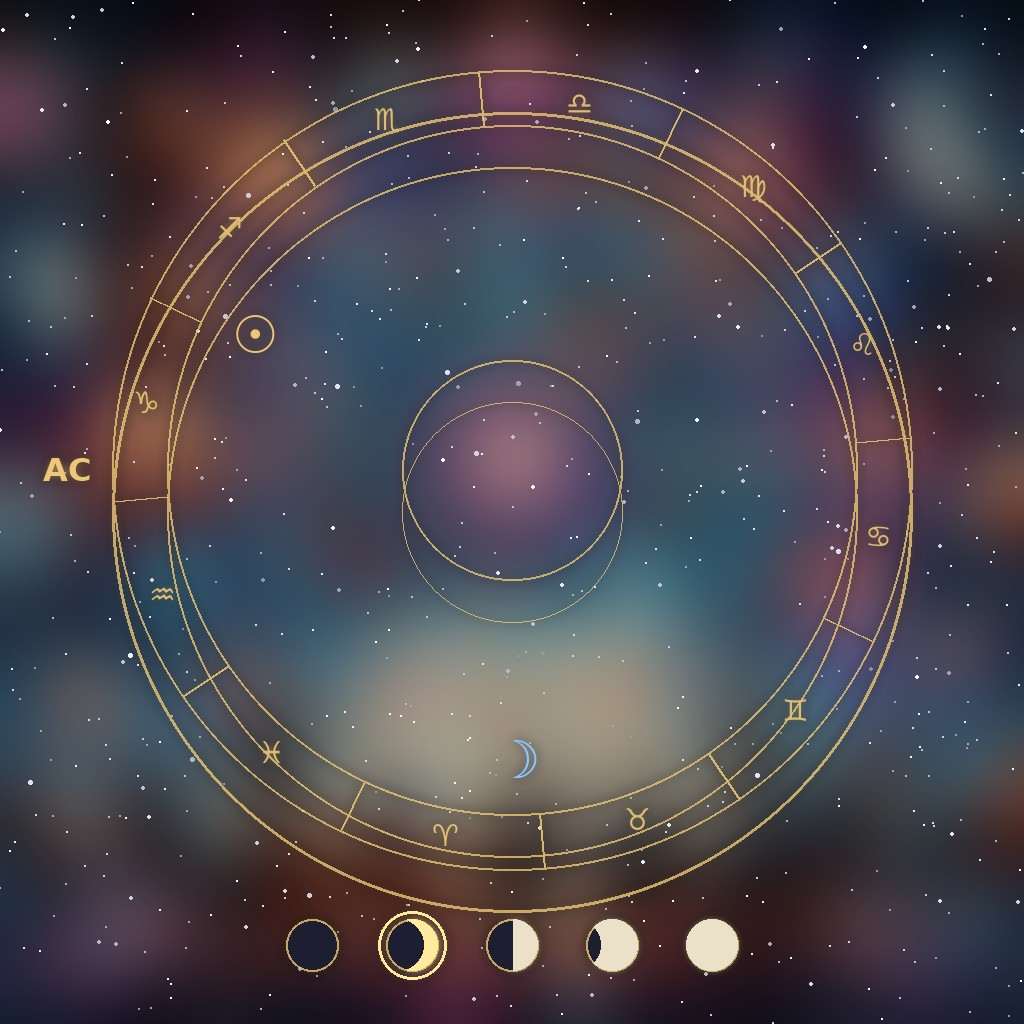
At 9:00 AM in New York, the rising sign is 22° Capricorn. With each sign as one room, Cancer then sits on the 7th, the room of marriage. Cancer is ruled by the Moon. So the planet in charge of the marriage room, the Moon, is less than one degree from its trine to Jupiter, and closing in. Astrologers call an aspect that is closing in an applying aspect, and they rate it higher than one that is pulling apart.
The Ascendant moves into Aquarius at 9:25 AM EST. So the best window that morning is about 9:00 to 9:20 AM. A start at 9:10 AM ticks each box we set.
What is not perfect
No election is flawless, and this one is no exception. Jupiter itself turned retrograde on the 12th at 7:56 PM EST. Some astrologers would mark that down. The Moon in Aries is fast and fiery, which suits a bold start more than a quiet one.
A couple who prefers the afternoon could wait until the Moon enters Taurus at 3:29 PM. According to Ptolemy, Taurus is the sign where the Moon is exalted, which means it works at its best there. But the Moon then squares Pluto at 10:23 PM EST that night. A square is a 90 degree angle, read as friction. Modern astrologers would count that against it, while traditional ones, who do not use Pluto, would not.
This is the honest shape of the work: weigh a few good options and pick one.
Mercury and Venus retrograde dates for 2026 and 2027
A station is the day a planet seems to stop before it turns. The table shows each Mercury retrograde with both stations, in UTC and New York time, and the degree where each turn happens.
| Period | Turns retrograde | Turns direct |
|---|---|---|
| Mercury, early 2026 | Feb 26, 2026, 06:48 UTC (1:48 AM EST), at 22° Pisces | Mar 20, 19:32 UTC (3:32 PM EDT), at 8° Pisces. |
| Mercury, mid 2026 | Jun 29, 2026, 17:35 UTC (1:35 PM EDT), at 26° Cancer | Jul 23, 22:57 UTC (6:57 PM EDT), at 16° Cancer. |
| Mercury, late 2026 | Oct 24, 2026, 07:12 UTC (3:12 AM EDT), at 20° Scorpio | Nov 13, 15:53 UTC (10:53 AM EST), at 5° Scorpio. |
| Mercury, early 2027 | Feb 9, 2027, 17:36 UTC (12:36 PM EST), at 5° Pisces | Mar 3, 12:32 UTC (7:32 AM EST), at 20° Aquarius. |
| Mercury, mid 2027 | Jun 10, 2027, 18:15 UTC (2:15 PM EDT), at 6° Cancer | Jul 4, 19:39 UTC (3:39 PM EDT), at 27° Gemini. |
| Mercury, late 2027 | Oct 7, 2027, 14:37 UTC (10:37 AM EDT), at 4° Scorpio | Oct 28, 14:10 UTC (10:10 AM EDT), at 19° Libra. |
| Venus, 2026 | Oct 3, 2026, 07:15 UTC (3:15 AM EDT), at 8° Scorpio | Nov 14, 00:27 UTC (Nov 13, 7:27 PM EST), at 22° Libra. |
Venus has no retrograde at all in 2027. Over the two years, Mercury is retrograde 18% of the time and Venus about 6%. Mars turns retrograde on January 10, 2027, and direct on April 1, 2027, which matters for anything that needs drive or a quick fight.
Mercury rules words, papers and deals, so the tradition reads its retrograde as delays and fine print gone wrong. Venus rules love and money, so its retrograde is the one wedding planners watch. Our guide to retrograde planets in the natal chart explains what the backward motion is and how it reads in a birth chart.
Eclipses in 2026 and 2027
An eclipse is a New Moon or a Full Moon that falls close to the lunar nodes, the two points where the Moon’s path crosses the Sun’s path. The tradition reads eclipses as unstable times, with sudden turns. Most electional astrologers keep a start at least a few days away from one. The times below are the moment of greatest eclipse.
| Date | Type | Time and degree |
|---|---|---|
| Feb 17, 2026 | Annular solar eclipse | 12:11 UTC (7:11 AM EST), at 28° Aquarius. |
| Mar 3, 2026 | Total lunar eclipse | 11:33 UTC (6:33 AM EST), at 12° Virgo. |
| Aug 12, 2026 | Total solar eclipse | 17:45 UTC (1:45 PM EDT), at 20° Leo. |
| Aug 28, 2026 | Partial lunar eclipse | 04:12 UTC (12:12 AM EDT), at 4° Pisces. |
| Feb 6, 2027 | Annular solar eclipse | 15:59 UTC (10:59 AM EST), at 17° Aquarius. |
| Feb 20, 2027 | Penumbral lunar eclipse | 23:12 UTC (6:12 PM EST), at 1° Virgo. |
| Jul 18, 2027 | Penumbral lunar eclipse | 16:03 UTC (12:03 PM EDT), at 25° Capricorn. |
| Aug 2, 2027 | Total solar eclipse | 10:06 UTC (6:06 AM EDT), at 9° Leo. |
| Aug 17, 2027 | Penumbral lunar eclipse | 07:13 UTC (3:13 AM EDT), at 24° Aquarius. |
A penumbral eclipse is the faintest kind: the Moon only grazes Earth’s outer shadow. In an annular eclipse, the Moon is too far away to cover the whole Sun, so a bright ring stays visible.
New and full Moons, November and December 2026
For the last two months of 2026, here are the four lunations, the name for a New or Full Moon. The waxing half of each month runs from a New Moon to the next Full Moon.
| Lunation | UTC | New York and degree |
|---|---|---|
| New Moon | Nov 9, 07:02 UTC | Nov 9, 2:02 AM EST, at 16° Scorpio. |
| Full Moon | Nov 24, 14:53 UTC | Nov 24, 9:53 AM EST, at 2° Gemini. |
| New Moon | Dec 9, 00:51 UTC | Dec 8, 7:51 PM EST, at 16° Sagittarius. |
| Full Moon | Dec 24, 01:28 UTC | Dec 23, 8:28 PM EST, at 2° Cancer. |
Note the trap in November. The Moon waxes from the 9th to the 24th, but Mercury and Venus stay retrograde until the 13th. So the clean waxing days are only the 14th to the 23rd. The December run, from the night of the 8th to the 23rd, has no retrograde of Mercury or Venus at all.
Mind the time zone. The last New Moon of the year falls on Dec 9 in UTC, but on the evening of Dec 8 in New York.
How often is the Moon void of course?
The Moon changes sign about once each two and a half days. After its last angle to another planet in a sign, it drifts until the next sign. That drift is the void of course Moon: a Moon with nothing left to do, so a plan begun then is said to go nowhere.
We measured how much of 2026 falls in that state. Using the five classic angles (0, 60, 90, 120 and 180 degrees) and the planets from the Sun to Saturn, the Moon is void of course for 23.7% of the year. Counting Uranus, Neptune and Pluto as well, the share falls to 19.6%. More planets give more chances for a late contact, so the void spells get shorter.
The year holds 160 void spells. With the classic planets, the middle spell lasts about 9.7 hours. Some last only a few minutes. The longest of 2026 runs from January 4 at 2:44 AM EST to January 6 at 11:56 AM EST, a span of 57 hours. So about one hour in every four or five is ruled out before you look at anything else.
Which list should you use? Lilly and the older authors only knew the planets out to Saturn. Many modern astrologers add the outer three. If your astrologer uses one list, stick with it. Our worked example gives the same void hours with both lists.
Is there an electional astrology calculator?
Software can do a large part of the work. It can list retrograde dates, Moon phases, void of course hours and the rising sign for any minute and any city. That covers steps 2 to 4 and the arithmetic of step 5.
What a tool cannot do is weigh the trade-offs. It cannot tell you whether a Moon in Aries applying to Jupiter beats a Moon in Taurus that later squares Pluto. The tables on this page give you the fixed parts for 2026 and 2027. The judgment is still yours.
Many astrologers also check the election against the birth charts of the people involved. They look at how the planets of the chosen day touch each chart, which is what planetary transits describe.
Electional, horary and mundane astrology: three different jobs
These three branches all use charts cast for a moment, but each answers a different question.
Electional astrology looks forward. You ask when to act, and you shop for the best minute. Horary astrology looks at the present. You ask a single question, such as whether a deal will close, and the astrologer reads the chart for the minute the question was asked. Mundane astrology is a third branch that reads charts for countries, cities and world events, not for one person’s plans.
The three meet in the wider field of predictive astrology, which deals with timing in general.
Limits and honest caveats
Astrology is not a science, and electional rules have not been shown to change outcomes. What the tradition offers is a frame for thinking about timing. Use it for the choices that are truly open, such as which Saturday or which hour.
Some dates are not yours to move. Never shift a medical or legal date to fit a chart. And a wedding at 9:10 AM is no gift if half the guests cannot get there.
Electional astrology FAQ
What is electional astrology?
Electional astrology is the branch of astrology that picks the start time of an event, such as a wedding, a move or a launch. The astrologer looks for a waxing Moon that is not void of course, avoids Mercury and Venus retrograde and eclipses, and chooses a minute when the key planets sit in strong places.
Is there an electional astrology calculator?
Software can list retrograde dates, Moon phases, void of course hours and the rising sign for any time and place. It cannot choose between two imperfect charts for you. That choice depends on your goal and on the tradition you follow.
What does void of course Moon mean?
The Moon is void of course after its last major angle to another planet and before it enters the next sign. In 2026, it spends 23.7% of the year in that state when you count the planets from the Sun to Saturn, and 19.6% when you add Uranus, Neptune and Pluto.
Should I avoid Mercury retrograde for a wedding?
Most electional astrologers avoid Venus retrograde first for a wedding, since Venus rules love. Mercury retrograde matters most for contracts and talks. In 2026, Venus is retrograde from October 3 to November 13 (New York time). Mercury is retrograde from October 24 to November 13. Neither planet is retrograde in December 2026.
How is electional astrology different from horary astrology?
Electional astrology chooses a future moment to act. Horary astrology answers one question from the moment it was asked. Both read a chart for a single minute, but one looks ahead and one looks at the present.
How we calculated the dates
All positions come from the Swiss Ephemeris, a standard astronomy library, in the tropical zodiac. A station is the exact moment a planet’s speed reaches zero. We checked the stations, the lunations and all eclipses against a second library, Astronomy Engine. They agree to within ten minutes. Void of course spells use the five classic angles, with exact contacts only. The chart for December 19 uses New York City at 40.71° north and 74.01° west, with each sign as one house. If you want to see how these timing rules meet your own sky, our complete natal chart report reads your birth chart in full.
Go deeper with your personal Astrovision report
Reading about astrological concepts is a great start, but nothing compares to hearing how they apply directly to you. Our users love our audio-first approach, calling it “friendly, personal, and easy to understand.” While this article gives you the “what,” a personal report gives you the “so what.” Discover your unique path with an Astrovision report—your personal ‘user manual’ delivered in our celebrated podcast format.